
EWSN: Decoding Spammer Intentions via Word Social Networks and Immune Adaptation
Adaptive e-mails intention finding system based on words social networks
The paper introduces the E-mail Word Social Network (EWSN), an adaptive spam detection system that profiles sender intentions by modeling word associations as social networks. It leverages World Wide Web information to expand keyword relations and uses an Artificial Immune System (AIS) for continuous learning, achieving SOTA-level performance with minimal training data.
TL;DR
The battle against spam is moving from "keyword matching" to "intent recognition." This paper proposes the E-mail Word Social Network (EWSN), a system that constructs a social graph of words to profile a sender's true purpose. By integrating Web-based knowledge expansion and an Artificial Immune System (AIS), EWSN can identify novel spam with remarkably little training data, outperforming traditional SVMs in data-scarce scenarios.
Problem & Motivation: The "Cat-and-Mouse" Evolution
Traditional spam filters are hitting a ceiling. Spammers use "good-words attacks" (inserting legitimate words to fool Bayes filters) or "image spam" to bypass content inspection. The authors identify a core flaw in existing systems: they focus on the 'what' (content) rather than the 'why' (intention).
While a spammer might change their words, their intention (e.g., phishing, advertising) remains invariant. The challenge is constructing a model that can:
- Operate with very small personalized training sets.
- Adapt to "Concept Drift" as spam tactics evolve.
- Leverage global knowledge to understand words it hasn't seen in its local training set.
Methodology: Words as a Social Network
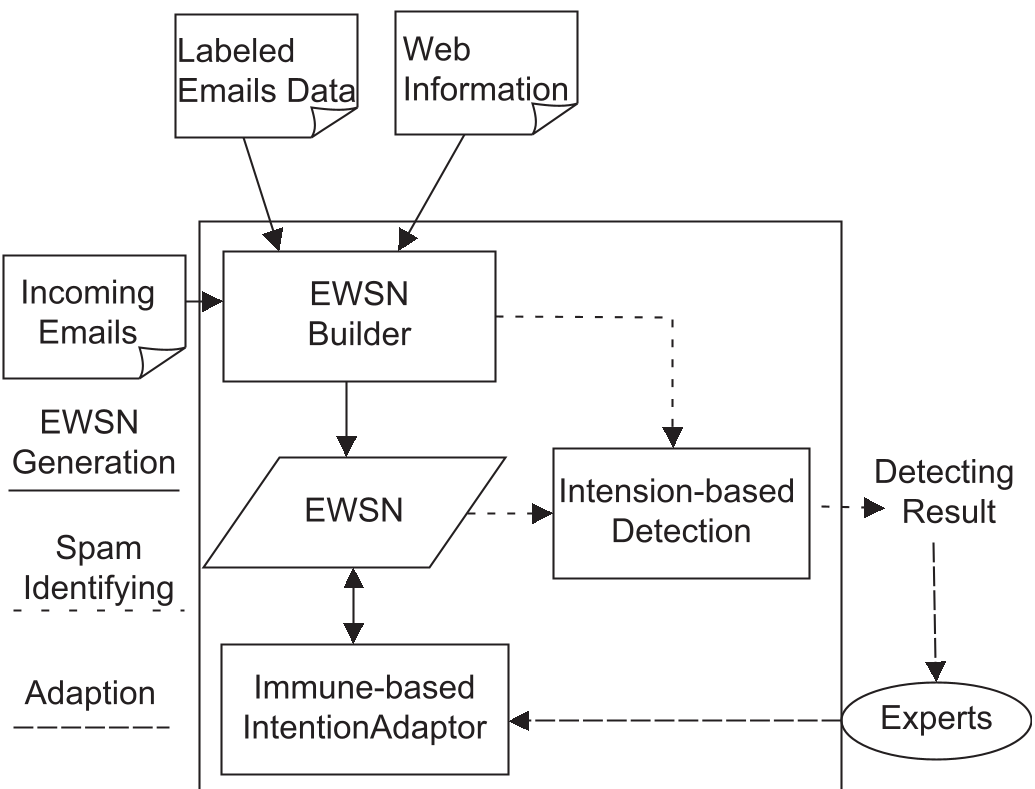
The EWSN architecture consists of three pillars: the Network Builder, the Intention Detector, and the Immune Adaptor.
1. Building the EWSN (Knowledge Expansion)
Instead of just counting word frequencies, the system treats words as nodes in a graph. If "Discount" and "Viagra" appear together, an edge is formed. The Secret Sauce: To handle "novel" words, the system queries search engines (like Google) to find related terms, expanding the local graph with "global" social relations.
2. Identifying Intent through Centrality
The paper utilizes Centrality Betweenness—a measure from Social Network Analysis (SNA). Words with high betweenness act as "bridges" in the network, representing the core "Intention Cliques." If an incoming email maps closely to these high-weight cliques, it is flagged.
3. The Artificial Immune System (AIS)
To handle adaptation, the authors use a Resource-Limited Artificial Immune System (RLAIS).
- Stimulation: When a user marks an email as spam, the corresponding word weights in the EWSN are "stimulated" (strengthened).
- Restraint: Over time, irrelevant nodes that aren't reinforced are "restrained" and eventually eliminated, preventing the network from becoming bloated and noisy.
Experiments: Dominating the "Small Data" Regime
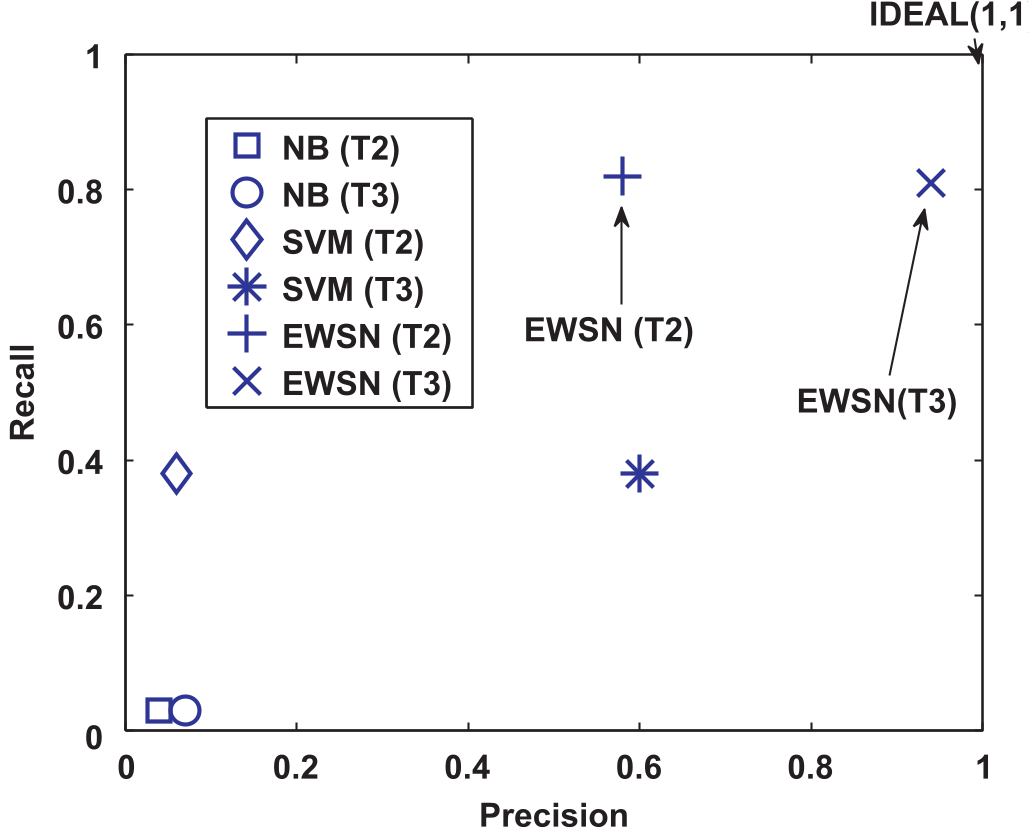
The most striking result of the study is EWSN's performance when training data is scarce.
| Method (100 Training E-mails) | Accuracy | Precision | Recall |
|---|---|---|---|
| SVM | 37.58% | 0.986 | 0.332 |
| Naive Bayes | 12.03% | 0.990 | 0.520 |
| EWSN (Proposed) | 87.72% | 0.943 | 0.860 |
While SVMs catch up once the dataset hits 1,000+ samples, EWSN is the clear winner for cold-start scenarios or highly personalized user mailboxes.
Critical Analysis & Future Outlook
Takeaway
The EWSN demonstrates that structure matters more than frequency. By modeling the social topology of language, we can extract "intent" which is much harder for spammers to obfuscate than simple keywords.
Limitations
- Computational Latency: Building EWSNs requires real-time search engine queries, which might introduce latency (though the authors argue word sets are small).
- Privacy: Relying on external Web-mining for personal email profiling could raise privacy concerns if the words queried are sensitive.
Future Work
Integrating this structural approach with modern Transformer-based embeddings could potentially create a "hyper-hybrid" filter—combining the deep semantic understanding of LLMs with the adaptive, resource-efficient nature of Artificial Immune Systems.