
The Emotional Loop: Toward Predicative Empathy in Ambient Intelligence
Adaptive Estimation of Emotion Generation for an Ambient Agent Model
The paper presents an adaptive computational model for estimating human emotion generation in ambient intelligence settings using the LEADSTO modeling language. It integrates Damasio’s "body loop" theory with a Theory of Mind (ToM) framework to allow an agent to monitor, predict, and intervene in a human's emotional state, such as anger.
TL;DR
This research introduces a computational framework that allows Ambient Intelligence (AmI) systems to not just "detect" emotions, but to estimate the generation process of those emotions over time. By combining a recursive "body loop" model with a Theory of Mind (ToM) architecture, an AI agent can learn an individual’s emotional triggers and volatility, enabling it to intervene before a human reaches a state of distress or poor performance.
Background: Beyond Simple Recognition
Most affective computing systems act as "cameras" that classify a snapshot of a face as "Happy" or "Angry." However, human emotion is a dynamic, physiological process. Identifying a naval officer is currently angry is useful; predicting that they will be angry in 30 seconds due to a series of stimuli—and intervening to prevent it—is transformative. This paper bridges the gap between biological intuition and computational logic.
Problem & Motivation: The Individual Volatility Gap
The core challenge in ambient agent modeling is the Individual Difference. Some people recover from a negative stimulus quickly (low persistence), while others harbor feelings that spiral into high-intensity states (high persistence). Prior work lacked a mechanism to:
- Model the self-reinforcing nature of emotions (the feeling of being angry making one more physically predisposed to anger).
- Adapt to the specific "persistence parameters" of a unique user in real-time.
Methodology: Recursive Body Loops and ToM
The authors propose a dual-layered approach.
1. The Recursive Body Loop
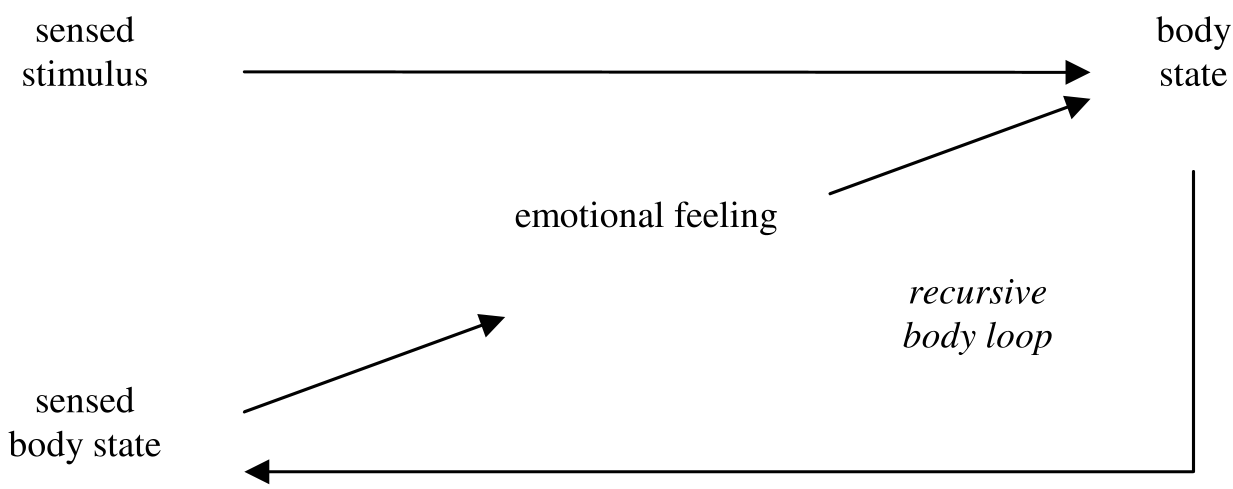
Inspired by Antonio Damasio’s work, the model suggests a causal chain:
Stimulus -> Body Preparation -> Sensing Body State -> Feeling Emotion -> Preparation.
By making this loop recursive, the model treats emotion as a positive feedback system. If you feel an emotion, your body prepares more intensely, which in turn amplifies the feeling.
2. Theory of Mind (ToM) & Adaptive Learning
The Ambient Agent (AA) maintains a meta-representation of the human. It doesn't just "see" the human; it holds a "belief" about the human's state:
has_state(AA, belief(has_state(human, emotion(anger, 0.7))))
To solve the problem of individual differences, the authors derived a differential equation to adjust the persistence parameter . If the agent's estimated emotion level deviates from the observed behavior, it uses the partial derivative of the emotion level with respect to to update its internal model.
Experiments & Results: Adaptation in Action
The model was validated using the LEADSTO simulation environment across several scenarios:
- Trace 1 (Perfect Match): When the agent's internal matches the human's, interventions (removing stimuli) happen at the optimal time, keeping performance high.
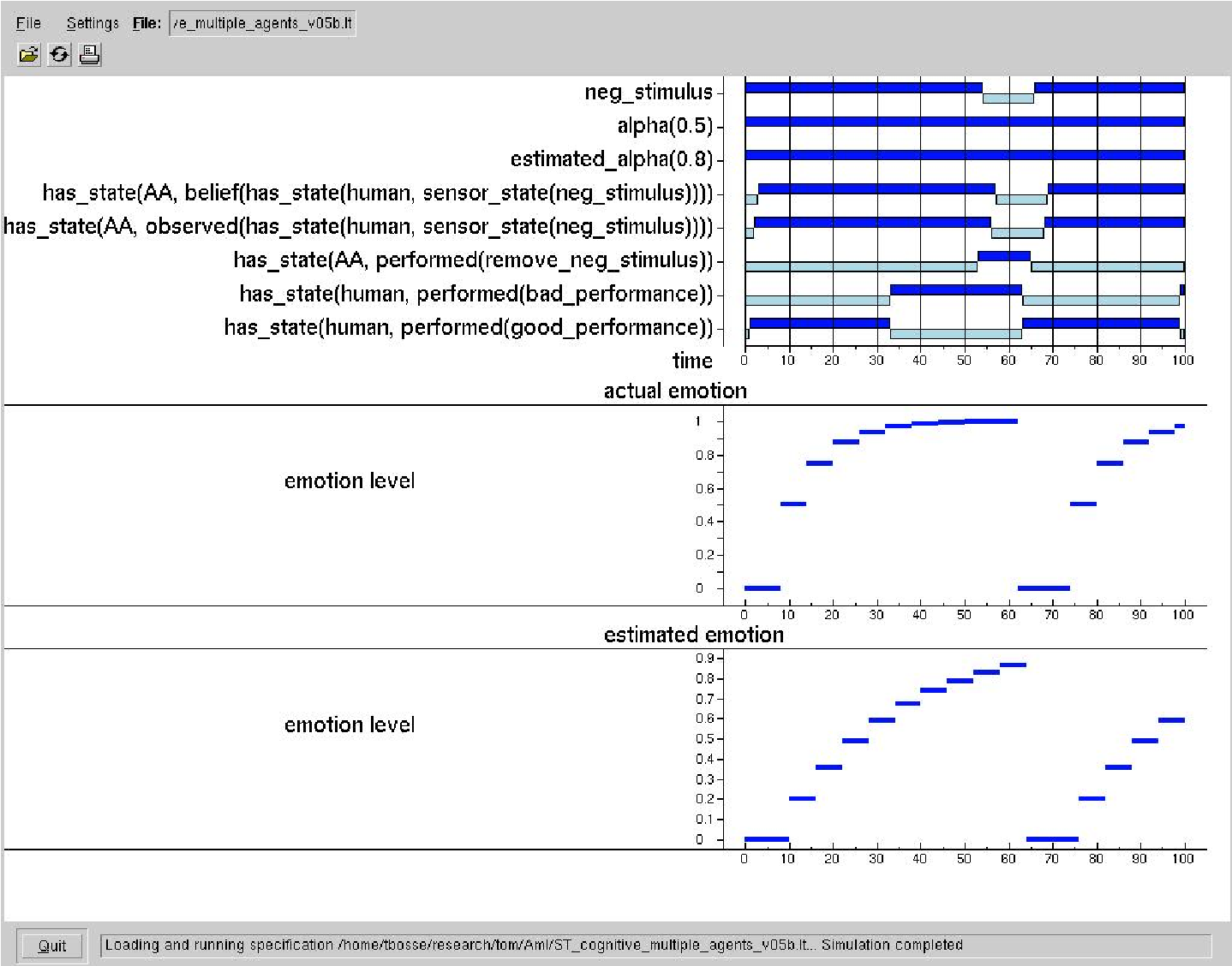
- Trace 2 & 3 (Parameter Mismatch): When the agent is too "optimistic" or "pessimistic" about the human's volatility, it intervenes either too late (causing bad performance) or too early (wasting energy).
- Trace 4 (The Adaptive Win): Starting with a wrong estimation (0.8), the agent observes the human's actual emotional spike, calculates the error, and adapts its to 0.65. Subsequent interventions are timed perfectly.
Deep Insight & Conclusion
This paper’s true value lies in its Recursive Modelling. By treating emotion as a dynamical system rather than a classification label, it opens the door for AI that acts like a supportive partner—anticipating needs before the human is even consciously aware of their own rising stress.
Limitations: The current study relies on simulated data. The "Ground Truth" of a human's emotion in a real-world setting is notoriously difficult to capture via sensors (noise in facial recognition, heart rate variability, etc.).
Future Outlook: As we integrate this with Large Language Models (LLMs) or multimodal sensors, the transition from reactive AI to proactive ambient support becomes a tangible reality. The next frontier will be applying these ToM models to multi-agent settings where humans and several virtual agents must synchronize their emotional states for complex tasks.