
When Ambiguity Rules: How WeChat Cultivates Adaptive Governance in Open Data Initiatives
When ambiguity rules: the emergence of adaptive governance from (in) congruent frames of knowledge sharing technology
This study investigates the Shanghai Open Data Apps (SODA) initiative to explore how the social media platform WeChat facilitates knowledge sharing in inter-organizational collaborations. By applying the Technological Frames of Reference (TFR) lens, it demonstrates that "Adaptive Governance" emerges from a mix of congruent and incongruent views of technology among government, university, and industry stakeholders.
TL;DR
In the complex dance of inter-organizational collaboration, we often assume that everyone must be on the same page to succeed. This study turns that notion on its head. By analyzing a high-stakes Open Data project in China (SODA), researchers found that it was the differences and ambiguities in how stakeholders used WeChat—moving between open brainstorming and closed task management—that actually allowed a flexible, "adaptive" governance structure to thrive.
Background: The Governance Tug-of-War
Modern technological shifts (AI, Open Data, Blockchain) require organizations to collaborate across boundaries. However, these collaborations often get stuck between two extremes:
- Top-Down Control: Stable but too rigid for fast-moving tech.
- Bottom-Up Learning: Flexible but prone to "governance voids" and lack of accountability.
The holy grail is Adaptive Governance—a balancing act that uses knowledge sharing to bridge these two worlds. But what happens when the technology used for sharing (like WeChat) is viewed differently by a Government official, a University professor, and a Startup CEO?
The Core Concept: Technological Frames of Reference (TFR)
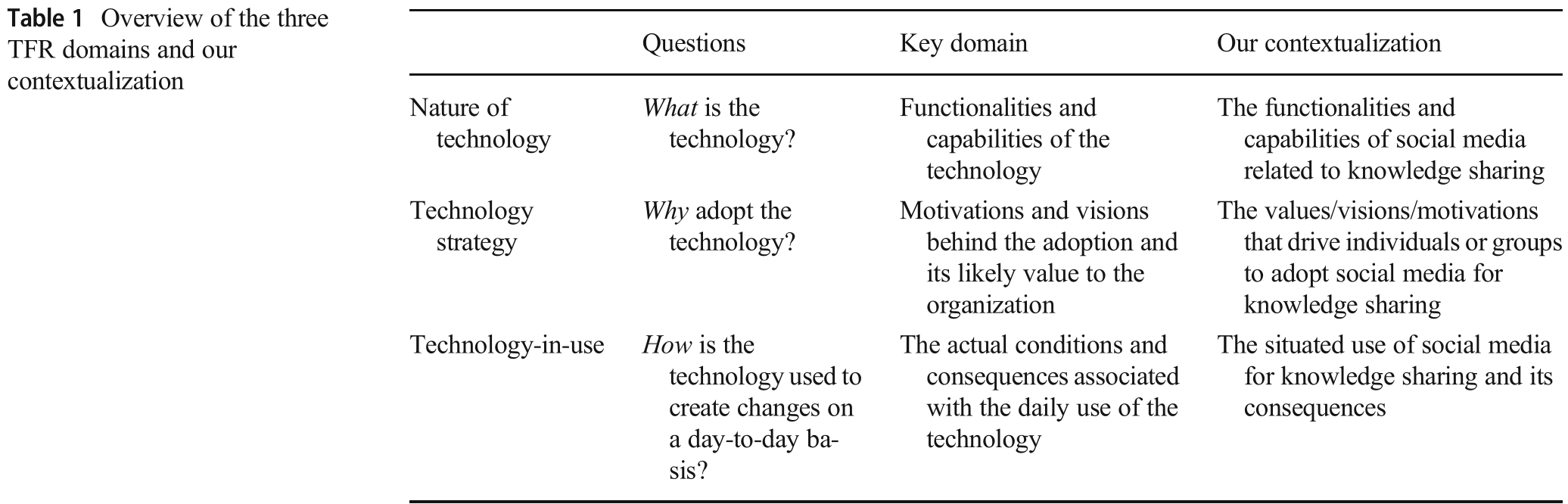
The authors use the TFR lens to break down stakeholder perceptions into three buckets:
- Nature of Tech: What is it? (e.g., "A chat app with file sharing.")
- Strategy: Why use it? (e.g., "To find new ideas" vs "To manage a to-do list.")
- Technology-in-use: How is it used daily? (e.g., "Group chats" vs "Private '@' mentions.")
The Framework for Analysis
Methodology: The SODA Case Study
The authors studied the Shanghai Open Data Apps (SODA) contest. This wasn't just a hackathon; it was a year-long collaboration between:
- Government (SMCEI): Seeking formal results and data security.
- University (Fudan/SJTU): Focusing on novel ideas and "crowdsourcing."
- Industry (Startups/Incubators): Focused on operational efficiency and resource mobilization.
They lived on WeChat. In 2015, online interactions on the platform far outweighed offline meetings.
Key Findings: The "Productive" Conflict
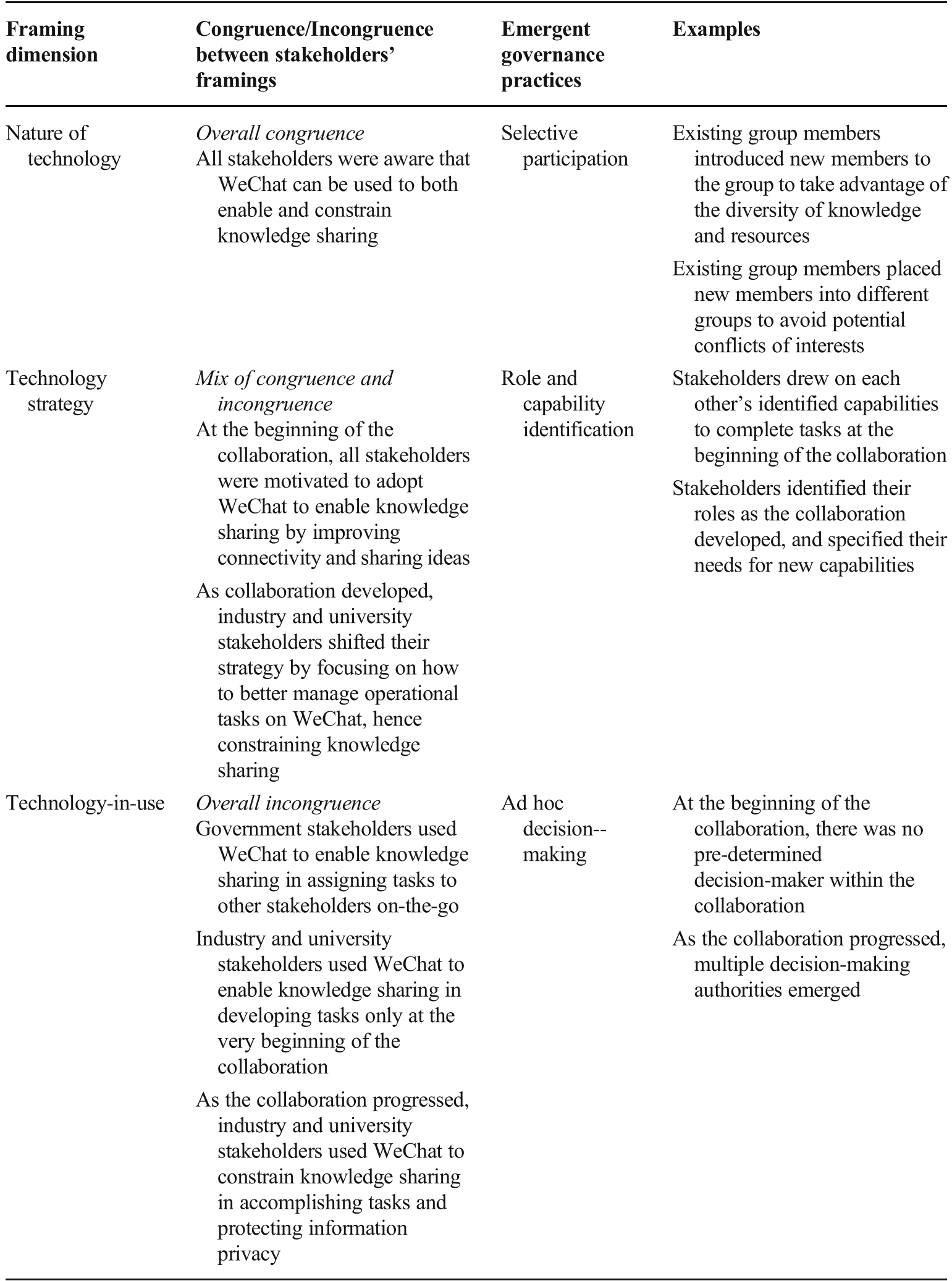
While everyone agreed on the Nature of WeChat (Group chats are useful), their Strategies diverged as the project matured.
- From Openness to Control: Initially, everyone used WeChat for "idea mining." But as deadlines loomed, Industry and University stakeholders shifted. They used the "@" mention and "group segregation" to constrain information flow to only those who needed it.
- Ambiguity as a Feature, Not a Bug: Unlike previous theories that suggest "incongruence" leads to failure, this study found that these conflicting uses allowed stakeholders to protect their interests while still contributing to the collective goal.
Mapping the Frames and Governance
Three Pillars of Adaptive Governance
The paper identifies three practices that emerged from this "technological ambiguity":
- Selective Participation: Using "Twin Groups" (parallel group chats) to bring in new members for fresh ideas while keeping sensitive discussions private in the original core group.
- Role & Capability Identification: Stakeholders didn't have fixed job descriptions. Instead, their roles "emerged" based on who was active in the WeChat threads, allowing the team to adapt to unexpected technical hurdles.
- Ad-Hoc Decision-Making: Decisions weren't always made by the highest-ranking official. For daily tasks, the "autonomy of the chat" ruled. But when political accountability was at stake, the group voluntarily shifted back to a hierarchical summary format for officials.
Critical Analysis & Conclusion
The Takeaway
The most profound insight here is that consensus is overrated. In socio-technical systems, a "truce frame"—a minimum level of agreement that allows for diverse, situated actions—is often more effective than an enforced unified vision.
Limitations & Future Outlook
While this study provides a brilliant roadmap for using social media in governance, it is limited by:
- Platform Specificity: WeChat's unique features (integrated payments, "mini-groups") might not translate perfectly to Slack or Teams.
- Cultural Context: The "Shanghai Model" operates within a specific Chinese bureaucratic and entrepreneurial ecosystem.
Future Work: We need to see how these adaptive practices hold up over years, not just during a single contest cycle. Can "Ad-hoc Decision-making" survive when a major crisis or failure occurs?
Final Verdict: For tech leaders and policy makers, the message is clear: Stop trying to over-regulate how your team uses collaboration tools. It is precisely in the "messy" and "ambiguous" use of these platforms that the most resilient governance structures are born.