
Adaptive Seeding: Why Static Strategies Fail in Dynamic Social Networks
Adaptive Influence Maximization in Dynamic Social Networks
The paper introduces the Adaptive Influence Maximization (AIM) problem within a novel Dynamic Independent Cascade (DIC) model. It proposes A-Greedy, an adaptive seeding strategy that achieves a provable (1 - 1/e) approximation ratio by iteratively selecting seeds based on real-time feedback from social network diffusion.
TL;DR
Social networks are not static spreadsheets; they are living, breathing systems where seed nodes can fail to activate and connections fluctuate. This paper introduces the Dynamic Independent Cascade (DIC) model and A-Greedy, an adaptive strategy that observes real-time results to decide the next best move. The result? A theoretical (1 - 1/e) guarantee and a performance boost of up to 320% over traditional methods.
The Problem: The "Set and Forget" Fallacy
Most Influence Maximization (IM) research stems from the seminal work of Kempe et al. (2003), which assumes you pick all "influencers" at the start. However, real-world networks exhibit three types of uncertainty:
- Activation Failure: Giving a free sample (seeding) doesn't guarantee the user will actually use or promote it.
- Probabilistic Diffusion: Information flow is inherently stochastic.
- Dynamic Topology: Relationships evolve, and propagation probabilities change over time.
Static algorithms are "pessimistic" because they can't adapt if a key influencer fails to ignite or if a specific branch of the network proves more fertile than expected.
Methodology: The Power of Adaptivity
1. The DIC Model & Auxiliary Graphs
To analyze this, the authors transform the dynamic network into an Auxiliary Graph (c-G). This ingenious mapping allows them to treat multiple seeding attempts on the same node as distinct nodes in a larger, static-looking graph, making the complex math of stochastic processes manageable.
 Fig 2: The construction of the auxiliary graph c-G1 allows representing multiple seeding attempts and various propagation states.
2. The Optimal Seeding Pattern (A*)
The authors prove that the best way to spend a budget is to be patient. Instead of seeding everyone at once, the A Pattern* seeds one node, waits for the influence to stop spreading, observes the results, and then picks the next node. This maximizes the "marginal profit" of every unit of budget used.
3. A-Greedy & H-Greedy
- A-Greedy: A hill-climbing algorithm that uses Monte Carlo simulations to estimate which node provides the highest expected gain given current network states.
- H-Greedy (Heuristic): Real-world social networks follow a power-law distribution. The authors observed a massive "influence gap" between top-tier nodes and the rest. H-Greedy filters out the bottom 50-80% of nodes before the process starts, drastically speeding up computation without sacrificing much accuracy.
Experimental Results: A Performance Explosion
The researchers tested their methods on datasets like Hep (academic collaborations) and Wiki (Wikipedia voting).
- Massive Gains: When seed activation is uncertain (Prob=0.5), A-Greedy achieved 3.2x the influence of the standard static Greedy algorithm.
- Stability: Unlike static methods, which become erratic in unpredictable environments, adaptive strategies remain robust because they "course-correct."
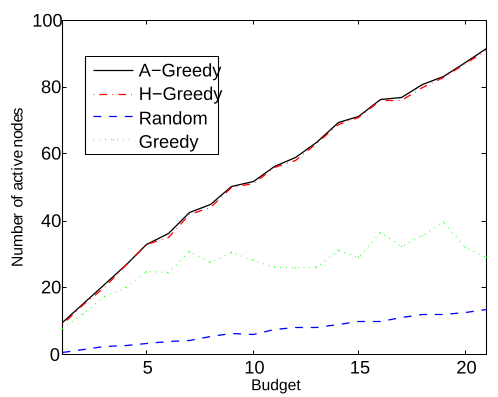 Fig 5c: Comparison on the Hep network shows A-Greedy (top curve) far exceeding static strategies.
Critical Insight & Evaluation
The core value of this paper lies in its bridge between stochastic submodular optimization and practical network theory. By proving the (1 - 1/e) bound for the A* pattern, the authors provide a rigorous mathematical floor for what sounds like a simple "common sense" approach.
Limitations: The primary drawback is the computational cost of Monte Carlo simulations in the adaptive loop. While H-Greedy alleviates this, the method might still struggle with hyper-scale networks (billions of edges) where real-time observation of "all" active nodes is impossible.
Conclusion
This work shifts the paradigm of social influence from "Targeting" to "Engagement." If you are designing marketing bots or public health interventions, the takeaway is clear: don't fire all your shots at once. Build a feedback loop, observe who actually "activates," and let the network tell you where to spend your next dollar.