
Beyond Static Security: Adaptive Trust Estimation in the Wild IoT
An adaptive IoT trust estimation scheme combining interaction history and stereotypical reputation
The paper introduces an adaptive IoT trust estimation scheme that fuses personal interaction history with non-personal "stereotypical reputation." By leveraging M5 model trees and an extended Subjective Logic framework, the system provides situation-aware trustworthiness assessments for IoT devices in public spaces where complete social network data is often unavailable.
TL;DR
As the Internet of Things (IoT) infiltrates our public spaces, we can no longer rely solely on static security keys. This paper introduces a dynamic trust estimation scheme that combines your personal "gut feeling" (interaction history) with the general public's opinion (stereotypical reputation). By analyzing current context—where you are and what the device is doing—it calculates a reliability score that matures as you interact more with the environment.
The Missing Context in IoT Trust
Most current IoT security research focuses on encryption or access control. However, Trust Management is the necessary social layer on top of that. Previous models, like those based on Social IoT (SIoT), assume we can see the entire "friendship network" of devices.
But what happens when you walk into a public airport? You don't know the devices there, and they don't know you. This is the Cold Start Problem. Furthermore, trust is situational. You might trust a public camera in a high-security bank, but find the same camera creepy in a private changing room. Existing models rarely capture this Situation-Awareness.
Methodology: Fusing Experience and Reputation
The authors tackle this by splitting trust into two components:
- Personal Trust (History-based): Learned via an M5 Model Tree.
- Reputation (Stereotype-based): General expectations based on the device category and manufacturer.
1. Capturing the Situation
When you encounter an IoT device, the system generates a Situational Characteristic Vector. This includes:
- Device Type: Category, Manufacturer, Model.
- Device Role: The specific task (e.g., "Screen Sharing").
- Place Type: Category, Function, and Privacy Level (e.g., Semi-private Office).

2. The Logic of Trust Evolution
The core innovation lies in using Subjective Logic (SL). Unlike binary logic, SL accounts for Uncertainty ().
- When you first meet a device, uncertainty is high, so the system relies on Stereotypical Reputation.
- As you interact more (collecting positive and negative interactions), the uncertainty drops.
- The Personal Trust () gained from the M5 Model Tree begins to dominate the calculation.
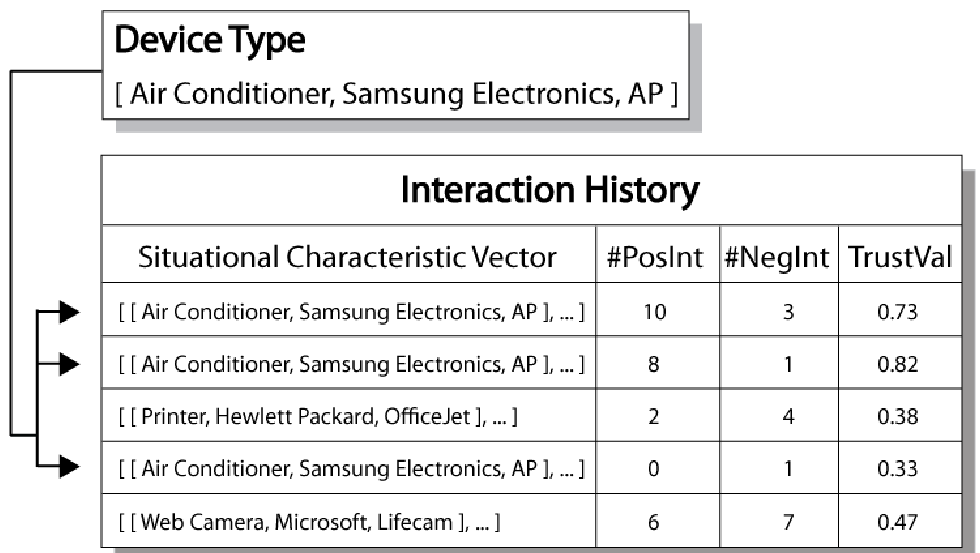 The M5 Model Tree acts as a localized regression engine, mapping specific situational features (like "Privacy Level: Public") to a numerical trust value.
Experimental Results: Proving the Intuition
The researchers validated their approach through a user study involving 21 participants and 87 different situational scenarios.
Key Findings:
- Context Matters: Using "Place Type" and "Device Role" together (HPC-PT&DR) yielded the lowest Root Mean Square Error (0.149) compared to a non-personal aggregate (0.235).
- Learning Curve: As the number of situational experiences grew from 0 to 87, the error rate plummeted, and the system's confidence (narrower Confidence Intervals) increased significantly.

Deep Insight & Conclusion
This work highlights that Trust is an additive process. By marrying the statistical power of M5 Trees with the philosophical framework of Subjective Logic, the authors have created a blueprint for IoT devices that can "read the room."
Limitations: The current model relies on a trusted server for heavy computations and assumes that the "Stereotypical Reputation" provided by the public is honest (not shielded from "bad-mouthing" attacks).
Future Outlook: The next step is moving this from a theoretical score to an automated security trigger—where your phone might automatically block data sharing if the "Situational Trust" score drops below a specific threshold in a public space.