
Adaptive Polling: Leveraging Blackwell Dominance to Decode Hierarchical Social Networks
Adaptive Polling in Hierarchical Social Networks Using Blackwell Dominance
This paper introduces an adaptive polling framework for hierarchical social networks using a Partially Observed Markov Decision Process (POMDP) to estimate a time-varying state of nature. It proposes feedback-based versions of Intent, Expectation, and Neighborhood Expectation Polling, achieving efficient state estimation by minimizing measurement costs and Bayesian uncertainty.
TL;DR
In the era of social media, opinions are not formed in a vacuum; they trickle down through a hierarchy of influencers. This paper reformulates polling as an Adaptive Control Problem (POMDP). By applying the mathematical concept of Blackwell dominance, the authors prove that simple "myopic" (short-sighted) polling strategies are nearly as effective as complex, computationally expensive optimal strategies for estimating the state of the world.
The Problem: The Influence Bottleneck
Standard polling assumes that every response is an independent observation of a state. However, in reality:
- Hierarchy Matters: Information flows from "Level 0" (opinion leaders) to "Level N" (the general public).
- State Evolution: Public interest and political climates change over time.
- The Cost-Accuracy Trade-off: Polling elites (Level 0) is accurate but expensive; polling the masses is cheap but noisy.
To solve this, the authors treat a pollster as a decision-maker who must choose whom to poll at each step to minimize cost and maximize "information gain."
Methodology: The Physics of Information
The core innovation lies in the use of Blackwell Dominance. In simple terms, matrix Blackwell dominates matrix if is "more informative" than —meaning can be viewed as a noisy version of .
1. Adaptive Intent Polling (Polynomial Channels)
The pollster asks: "What do you think the state is?" The authors model the information flow as a matrix polynomial . They discovered that if these polynomials are Hurwitz (stable), the channels can be ordered by their Shannon capacity, allowing the pollster to mathematically rank different polling actions.
2. Adaptive Expectation Polling (Ultrametric Channels)
The pollster asks: "What do you think your influencers would say?" This uses the Friendship Paradox (your friends, or in this case, influencers, have more influence than you). The authors use ultrametric matrices to represent the opinion distributions. Because ultrametric matrices have well-defined fractional powers, they can prove that asking a node about its superior is Blackwell-dominant over asking the node about its own opinion.
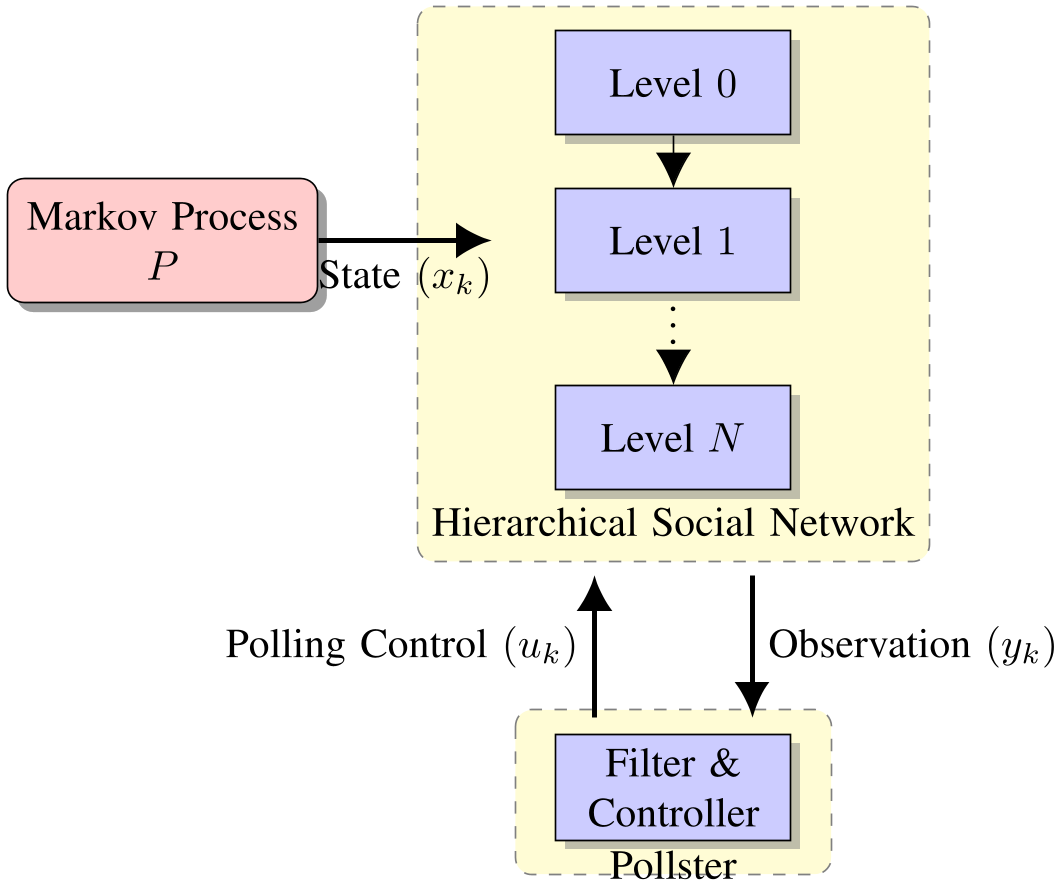 Figure 1: The hierarchical structure where state influences Level 0, which then cascades down to lower levels.
Experiments: Real-world Validation via YouTube
The authors tested their theory on a Market Research task: predicting movie revenue (High, Medium, Low) based on YouTube trailer comments.
- Data Estimation: They used Maximum Likelihood Estimation (MLE) with ultrametric constraints to build the opinion matrices.
- Efficiency: They compared their Myopic Policy (choosing the action that looks best right now) against the Optimal Policy (which requires solving a P-SPACE hard Bellman equation).
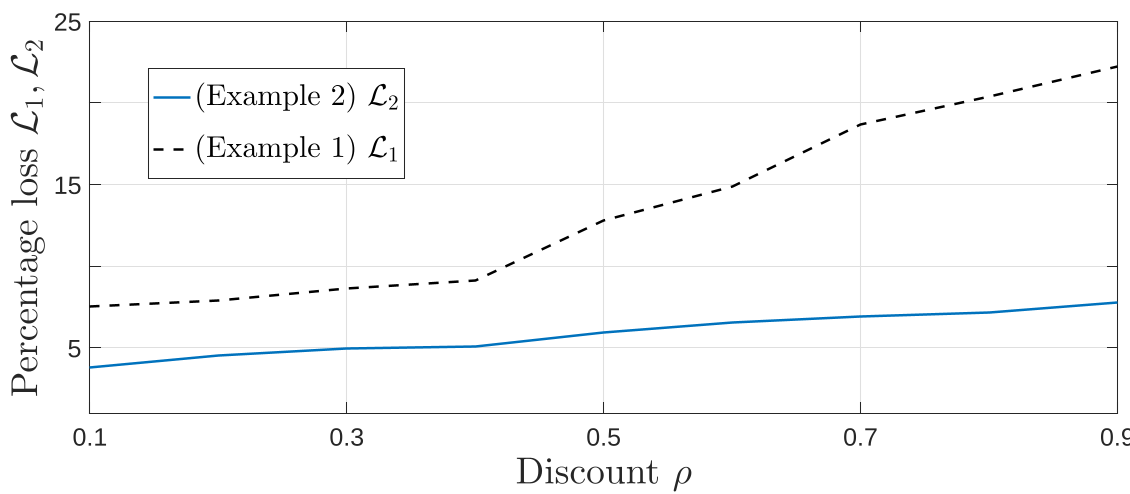 Figure 2: Percentage loss in optimality. Even as the discount factor increases (making the future more important), the myopic policy remains remarkably close to the optimal one.
Critical Insight: Why Does This Matter?
The most profound takeaway is the Ordinal Sensitivity. The authors prove that some social networks are inherently "more expensive" to poll than others based on their topology. If a network has a "more informative" distribution at every level, the cumulative cost of state estimation is guaranteed to be lower.
Limitations & Future Work
- Rigid Hierarchy: The model assumes a strict tree-like influence. Real social networks are often "loopy" or scale-free.
- Homophily: The model doesn't explicitly account for "echo chambers" where nodes only listen to those they already agree with.
- Extension: Applying this to Multi-modal sensing (e.g., combining Twitter text with YouTube video sentiment) could be a potent next step.
Conclusion
This paper elevates polling from mere "counting" to an information-theoretic control problem. By proving that myopic policies are upper bounds to optimal ones, it provides a green light for practitioners to use simple, feedback-driven polling strategies in complex, hierarchical environments without sacrificing significant accuracy.