
APIS: Masterfully Navigating Multimodal Landscapes with Adaptive Populations
An adaptive population importance sampler
This paper introduces Adaptive Population Importance Sampling (APIS), a novel Monte Carlo framework for statistical inference. It utilizes a cloud of proposal densities that are iteratively adapted using a deterministic mixture approach, achieving significantly higher robustness in estimating integrals of multimodal target densities.
TL;DR
Statistical inference in complex, multimodal systems often fails when using standard Importance Sampling due to poor "proposal" matches. Adaptive Population Importance Sampling (APIS) solves this by unleashing a "cloud" of proposals that learn locally and contribute globally. It combines the parallel efficiency of Population Monte Carlo with a more stable, deterministic weighting scheme, slashing estimation errors by orders of magnitude compared to traditional methods.
Background: The Importance Sampling Dilemma
In Bayesian inference, we often need to calculate integrals of a "target" distribution . Importance Sampling (IS) does this by drawing samples from a simpler "proposal" . However, if misses the peaks of , the variance explodes.
Existing solutions like Population Monte Carlo (PMC) use resampling (which can be unstable), and Adaptive Multiple Importance Sampling (AMIS) becomes computationally expensive over time because it re-evaluates all previous proposals. APIS enters the scene as a lightweight, robust alternative.
The Core Innovation: Local Adaptation, Global Wisdom
The genius of APIS lies in its "Epoch-based" adaptation. Instead of updating a single global proposal, APIS manages distinct proposals (typically Gaussians).
How it Works:
- Iterative IS Steps: At each step , samples are drawn from all proposals.
- Deterministic Mixture Weighting: Weights are calculated not just against one proposal, but against the average of the whole population. This "cooperative" weighting stabilizes the estimator.
- Local Learning: Proposals are updated (their means moved) based on the specific samples they generated. This allows different proposals to "specialize" in different modes (peaks) of the target distribution.
- No Resampling: Unlike PMC, APIS doesn't kill off proposals; it simply migrates them to better locations.
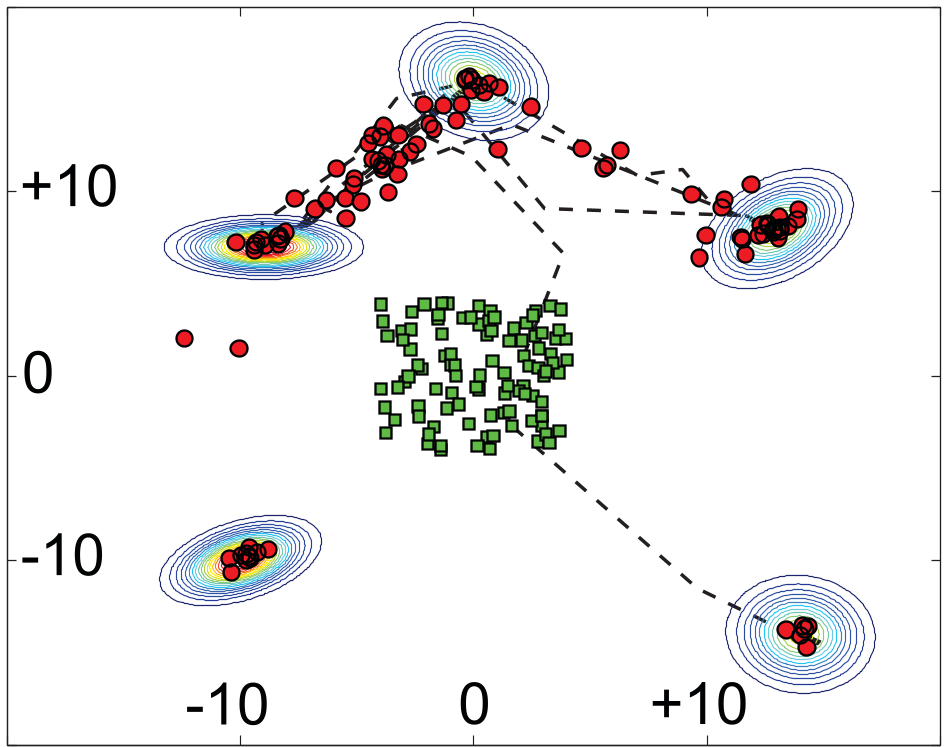 Fig 1: The adaptation in action. Squares represent randomized initial means; circles show how proposals migrate to cover every mode of the multimodal target.
Proof in Numbers: Smashing the Baseline
The authors tested APIS against a highly challenging bivariate multimodal target. Initially, the proposals were placed in a "bad" region far from the target's peaks.
Key Findings:
- Robustness to : Even with poorly chosen proposal variances, APIS converges.
- Adaptation Frequency: The more frequently the population adapts (higher ), the lower the error.
- The SOTA Gap: As shown in the table below, at , the error drops from 8.31 (Standard IS) to 0.05 (APIS with frequent adaptation).
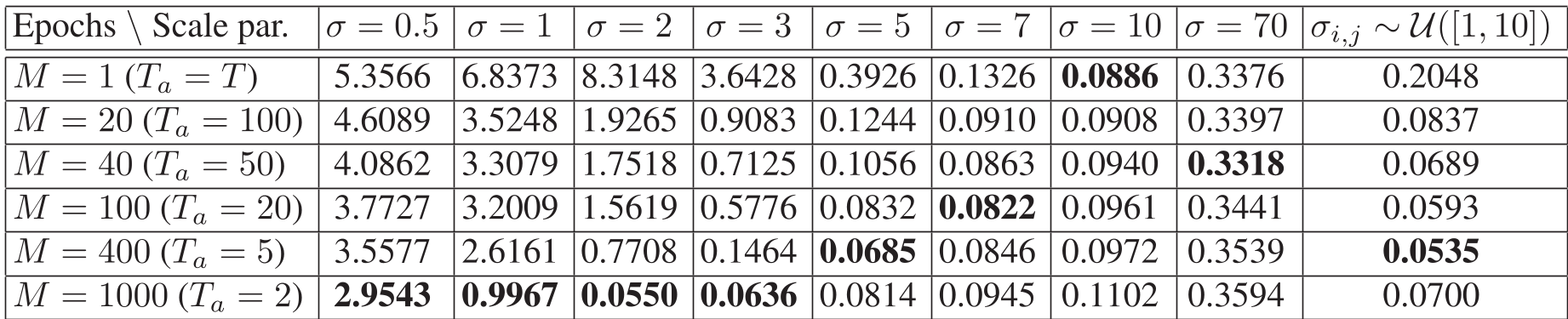 Table 1: Mean Absolute Error comparison. Notice the dramatic improvement as the number of Epochs (M) increases.
Academic Insight: Why it Works
APIS succeeds because it creates an Implicit Parallelism. Each proposal acts like a scout. By using the partial IS estimator to update means, the algorithm turns the "failure" of local IS (high variance) into a "feature" (directional signal for moving the mean). Because the global estimate uses the deterministic mixture of all samples, the final result is unbiased and highly efficient.
Critical Analysis & Future Outlook
Takeaway: APIS is a powerful "set-and-forget" tool for practitioners dealing with complex posteriors. It is inherently parallelizable, making it a prime candidate for GPU acceleration.
Limitations: The current paper focuses on updating Gaussian means. In extremely high dimensions, the covariance matrices () would also need to adapt to the local curvature, which adds complexity.
Future Work: The next frontier for APIS is the joint adaptation of shape, scale, and location, potentially integrating with Hamiltonian dynamics to explore even more rugged probability landscapes.