
APIS: Learning from Uncertainty through Adaptive Population Importance Sampling
An Adaptive Population Importance Sampler: Learning From Uncertainty
The paper introduces Adaptive Population Importance Sampling (APIS), a novel Monte Carlo methodology designed for efficient Bayesian inference. APIS combines a population of proposal densities with a deterministic mixture approach to provide robust global estimation of variables through an iterative, epoch-based adaptation mechanism.
TL;DR
Adaptive Population Importance Sampling (APIS) is a robust and efficient Monte Carlo method that solves the scalability issues of AMIS and the diversity loss of PMC. By combining a deterministic mixture approach with epoch-based local adaptation, it achieves SOTA performance in multimodal Bayesian inference tasks with constant computational complexity per iteration.
Problem & Motivation: The Tug-of-War in Adaptive IS
Monte Carlo methods are essential for estimating complex integrals in signal processing and machine learning. However, traditional Adaptive Importance Sampling (AIS) methods face a classic trade-off:
- Population Monte Carlo (PMC) uses multiple proposals but relies on resampling, which often causes "particle collapse" or a loss of diversity in the population.
- Adaptive Multiple Importance Sampling (AMIS) is theoretically elegant but computationally heavy; its cost grows linearly with time because every new sample must be evaluated against all previous proposals to maintain the deterministic mixture balance.
The authors of APIS noticed that there was no "middle ground" that offered the stability of deterministic mixtures without the ballooning overhead.
Methodology: The Best of Both Worlds
The core innovation of APIS lies in how it handles information in two dimensions: Space and Time.
1. Spatial Integration (The Deterministic Mixture)
Instead of weighting samples independently, APIS treats all proposals at a given iteration as a single "deterministic mixture." This significantly reduces the variance of the estimator compared to standard IS.
2. Temporal Integration (The Epoch Strategy)
To keep the algorithm fast, APIS does not re-evaluate old proposals. Instead, it divides the process into epochs. Within an epoch, proposals are fixed. At the end of an epoch, each proposal is updated independently based on the "local" samples it generated. This "memoryless" feature allows it to stay lightweight while still learning from the target distribution's topology.
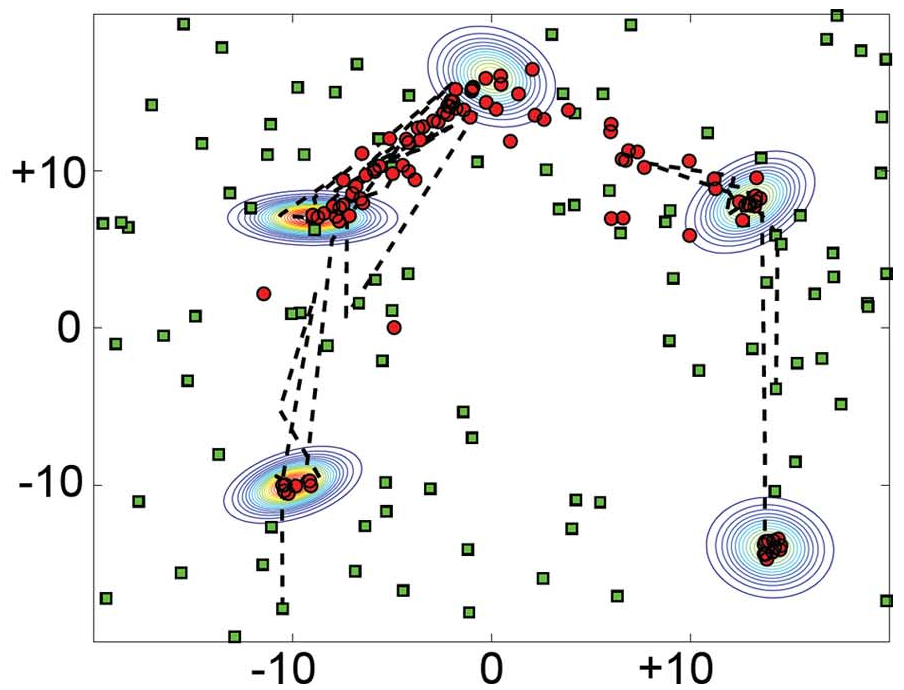 Figure 1: Evolution of proposal means in APIS. Notice how the proposals migrate from a random initialization (squares) to the high-probability modes (circles) of a multimodal target.
3. MAPIS: Adding MCMC Interaction
To further prevent proposals from getting "trapped" in local modes with zero information, the authors introduced MAPIS. This version adds a Sample Metropolis-Hastings (SMH) step between epochs, allowing proposal means to "interact" and swap positions, ensuring the entire state space is explored efficiently.
Experiments & Results
The authors tested APIS against a battery of benchmarks, including a bivariate multimodal target and a high-dimensional (D=30) Gaussian mixture.
- Robustness: Unlike AMIS, which is highly sensitive to the initial proposal scale, APIS maintained low Mean Square Error (MSE) across a wide range of standard deviations ().
- Efficiency: In a sensor localization task, APIS consistently matched or beat PMC with fewer samples, particularly when the initial location parameters were sub-optimal.
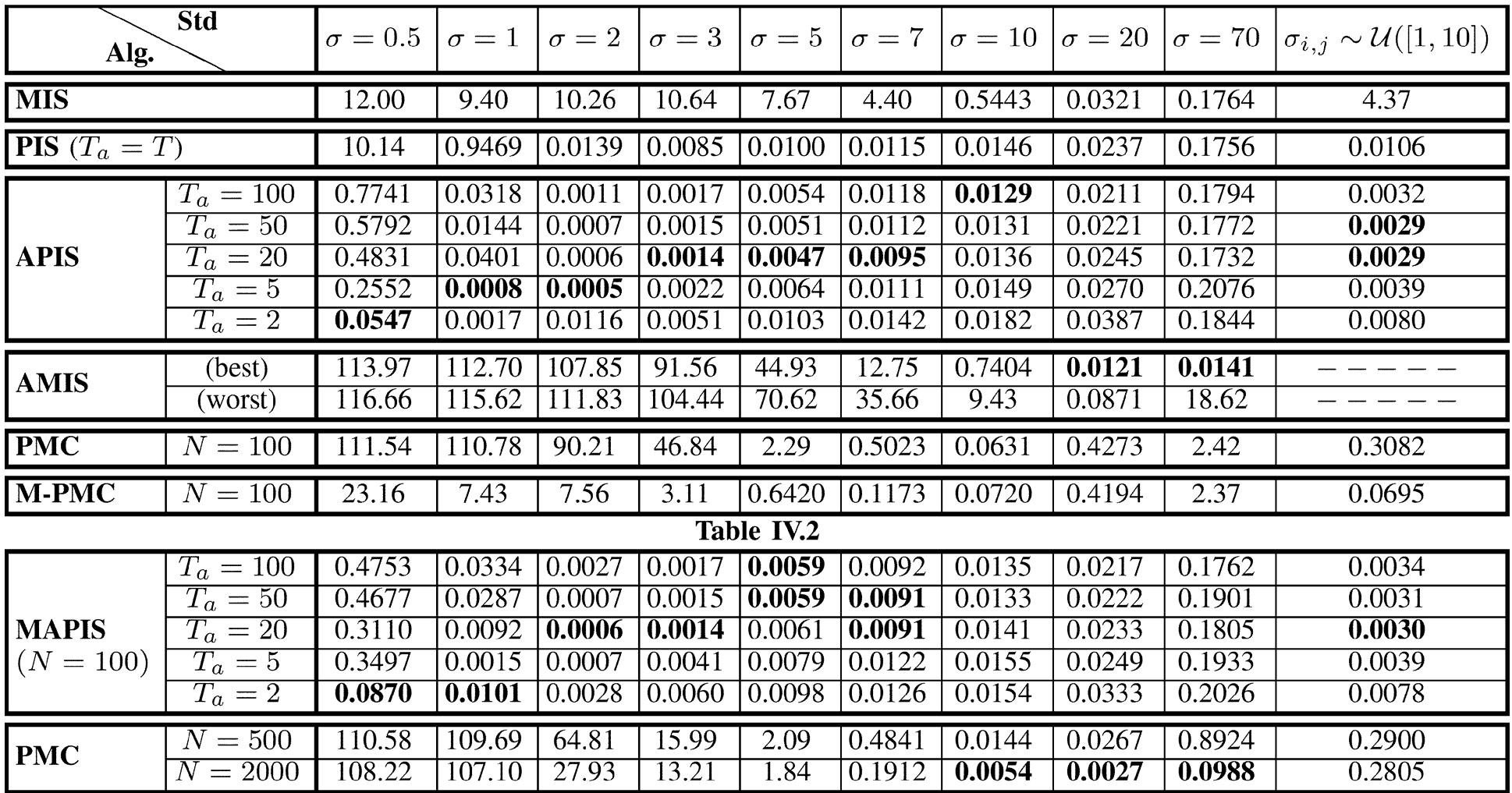 Table 1: MSE results demonstrating APIS's superiority over traditional MIS, PMC, and AMIS across different scales of .
Critical Analysis & Conclusion
Takeaway
APIS is a "workhorse" algorithm. It is easy to parallelize (since proposals update independently within an epoch) and does not require the sophisticated parameter tuning usually associated with MCMC or AMIS.
Limitations
While APIS adapts the location (mean) of proposals efficiently, it currently keeps the scale (covariance) fixed. In highly anisotropic distributions where the "width" of the target varies significantly across different dimensions, the lack of scale adaptation might lead to slower convergence compared to more complex AIS schemes that adapt second-order moments.
Future Outlook
The simplicity of the APIS update rule makes it an ideal candidate for distributed systems and large-scale Bayesian sensor networks. Integrating it with automated scale-adaptation (like adapting the covariance matrix) could be the next frontier for this framework.