
Beyond the Nash Equilibrium: How Adaptive Reputation Saves Trust in Social Networks
Adaptive Reputation Promotes Trust in Social Networks
2021-08-10
Summary
Problem
Method
Results
Takeaways
Abstract
This paper investigates the evolution of trust in networked populations by proposing an N-player trust game model featuring an adaptive reputation mechanism. By integrating investor rationality and a third-party reputation evaluation system, the study demonstrates that trust can significantly proliferate and eliminate untrustworthy trustees even in "hard" social dilemma scenarios.
## TL;DR
Why do we trust strangers in online markets despite the risk of betrayal? This paper provides a rigorous mathematical foundation for this phenomenon. By introducing an **Adaptive Reputation mechanism** and **Investor Rationality** into an N-player trust game, the researchers prove that even a small amount of "rational investigation" into past behavior can trigger a cascade of trust that wipes out bad actors and maximizes collective wealth.
## The Core Challenge: The Lubricant of Society is at Risk
Trust is the "favorable lubricant" of society. In a standard Trust Game, a rational investor shouldn't trust, and a rational trustee shouldn't return money. This lead to a stagnant economy where no one interacts. While social networks (who you know) help, they often aren't enough when the "temptation to defect" is high. Most prior models resulted in a "race to the bottom" where untrustworthy agents eventually dominated.
## Methodology: The Architecture of Trust
The authors move beyond static models by introducing a dynamic, third-party evaluation system.
### 1. The Rationality Factor (α)
Investors are no longer "blind." With a probability $\alpha$, they check a trustee's reputation $R_i$. If $R_i$ is below a threshold $R_c$, they don't invest. Even if they do invest, they allocate more funds to those with higher reputations.
### 2. Adaptive Reputation Update
Reputation isn't a fixed score; it’s a living metric.
* **Trustworthy Return:** $R_i(t+1) = R_i(t) + \Delta$
* **Betrayal:** $R_i(t+1) = R_i(t) - \Delta$
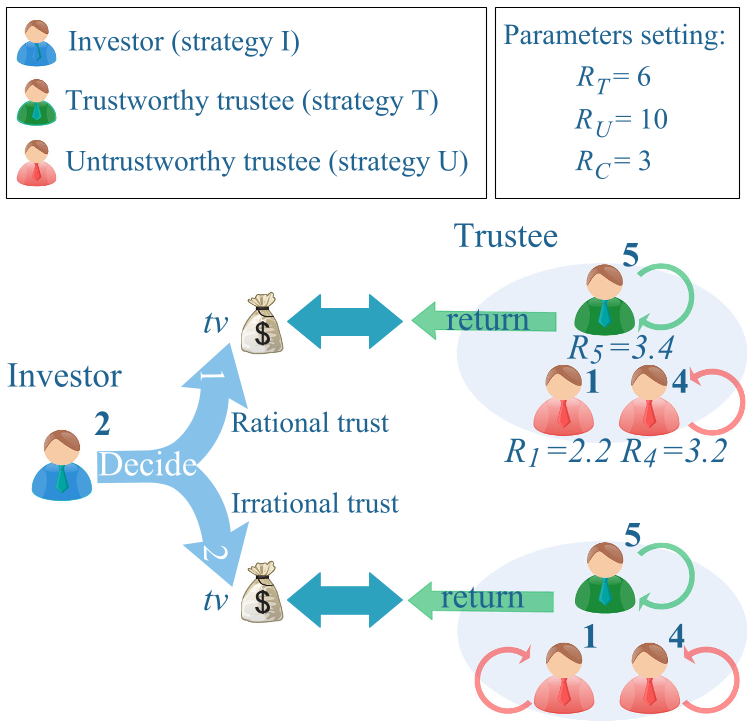
*Fig 1: The dual-path decision process of investors—Rational Trust vs. Irrational Trust.*
## Experimental Breakthroughs
Using Monte Carlo simulations on Scale-Free (SF) and Erdos-Renyi (ER) networks, the study reveals several "Phase Transitions" in social behavior.
### Rationality as a Catalyst
As shown in the performance charts, once the degree of rationality $\alpha$ hits a threshold (typically around 0.4), the population of untrustworthy agents ($K_u$) plummets toward extinction. This is because rational investors effectively "starve" bad actors of capital, while trustworthy clusters form "economic fortresses."
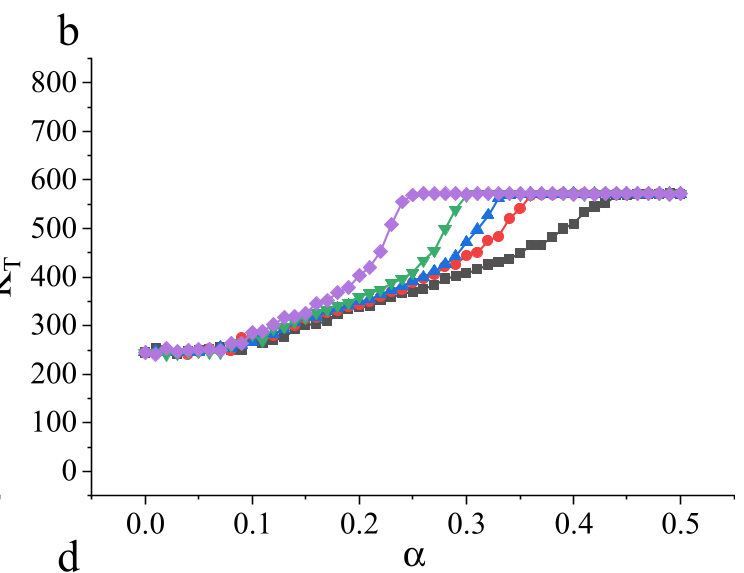
*Fig 2: Collective wealth (GW) and strategy densities as a function of rationality.*
### Overcoming the "Social Dilemma"
Even when the temptation to betray is extreme ($r > 0.66$), the adaptive reputation system maintains high social stability. The system punishes untrustworthy trustees not just by reducing their future income, but by making them "visible pariahs" in the network.
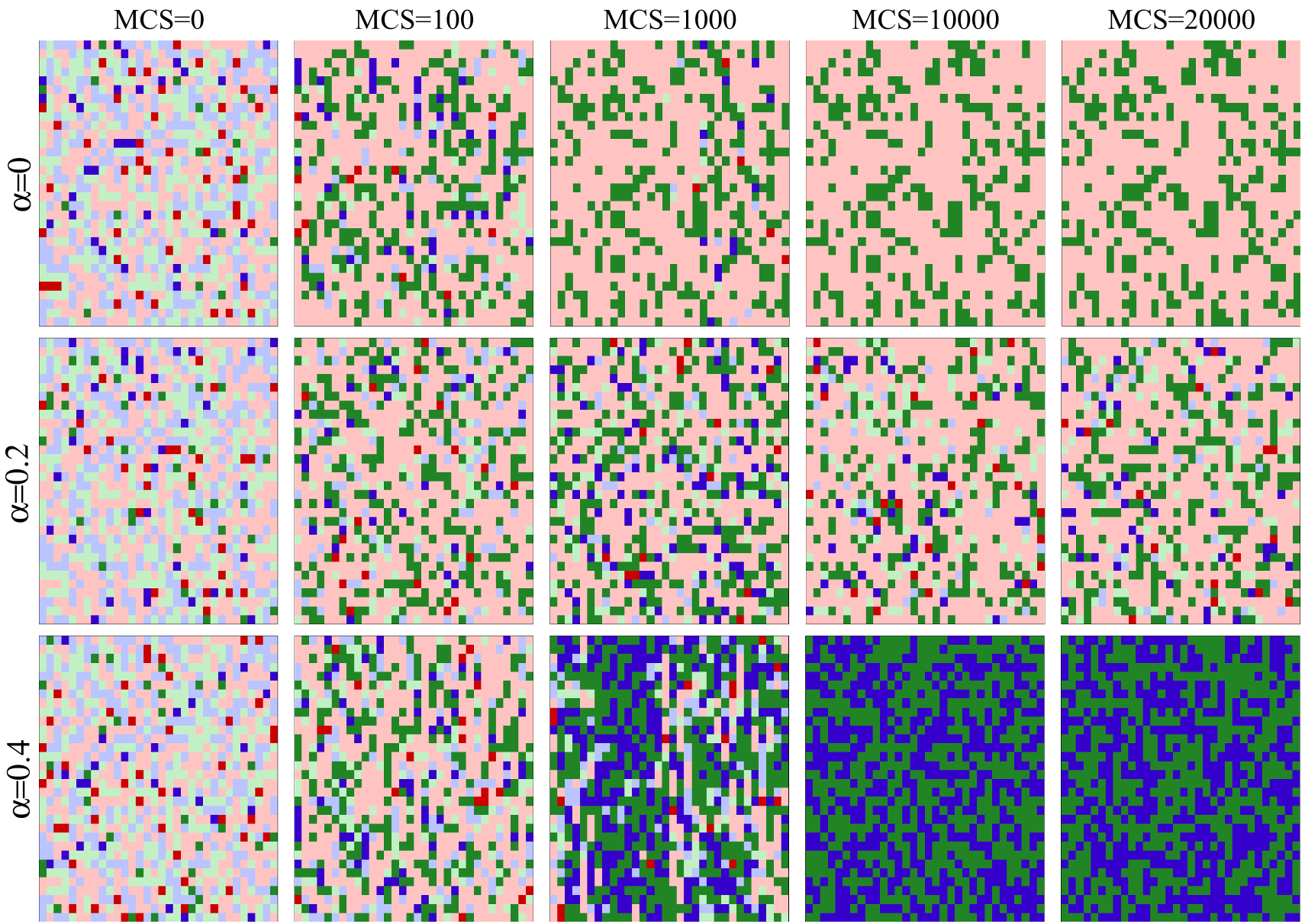
*Fig 3: Snapshots of the Square Lattice. Note how green (Trustworthy) and blue (Investors) form compact, resilient clusters to resist red (Untrustworthy) invasion as rationality increases.*
## Critical Insights & Takeaways
* **Network Reciprocity is Enhanced**: The "small-world" nature of social networks allows trustworthy clusters to survive early-game attacks from defectors, provided they have a tool (reputation) to identify each other.
* **Irrationality is Costly**: Even a small percentage of "blind trust" (low $\alpha$) can allow untrustworthy agents to parasitic off the system, dragging down global wealth.
* **Threshold Matters**: The reputation threshold ($R_c$) acts as a classifier. A higher bar for what counts as "trustworthy" forces agents to maintain better "images" to survive.
## Conclusion
This research formalizes why third-party credit systems (like those on eBay, Amazon, or even social credit concepts) are mathematically essential for scaling cooperation in large populations. For future research, the authors suggest exploring "individual heterogeneity"—acknowledging that some people are naturally more rational or more trusting than others—to see if a diverse "personality mix" further stabilizes the social web.