
Adaptive Resource Provisioning: Bridging the Gap Between Application Needs and Heterogeneous Infrastructure
Adaptive resource provisioning method using application-aware machine learning based on job history in heterogeneous infrastructures
The paper proposes an adaptive resource provisioning method for heterogeneous infrastructures (clusters and clouds) using an application-aware Multilayer Perceptron (MLP) with error back-propagation. It focuses on optimizing the selection of Virtual Machine (VM) types based on job history, application profiles, and real-time system states.
TL;DR
Managing scientific workloads across clusters and clouds is a balancing act between cost and speed. This paper introduces an application-aware machine learning model (MLP) that learns from job history to predict the best VM types. Unlike static policies, it dynamically scales resources during system failures or priority shifts, ensuring deadlines are met without overspending.
Background: The Heterogeneity Headache
Modern scientific research relies on High-Performance Computing (HPC). When local clusters are full, researchers "burst" to the cloud. However, choosing the right Virtual Machine (VM) flavor—balancing vCPUs, RAM, and cost—is notoriously difficult. Standard "Cost-Minimum" (CM) policies are too slow, while "Performance-Maximum" (PM) policies are too expensive.
The Core Insight: Learning from History
The authors argue that the system should "know" the application. By building a Job History Learning Model, the system captures:
- Application Profiles: CPU/Memory intensity (e.g., Autodock for drugs, Pythia for physics).
- System Status: Current load on clusters vs. available cloud slots.
- Execution History: Past performance metrics and costs.
Methodology: MLP with Back-Propagation
To handle the non-linear relationship between application demands and hardware performance, the authors utilize a Multilayer Perceptron (MLP).
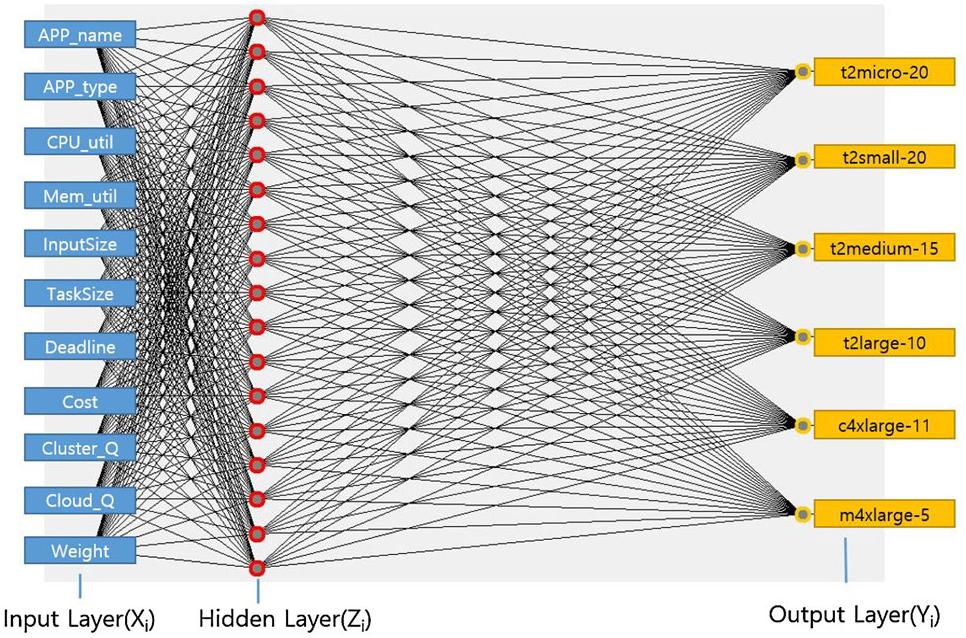 Figure 1: The MLP learning structure used to infer VM types based on application profiles and system status.
The model achieved a Kappa statistic of 0.7188, indicating substantial agreement between predicted and optimal resource allocations.
Adaptive Auto-Scaling Algorithms
Provisioning is only half the battle. What happens if a cluster node fails mid-job? The paper proposes a four-stage algorithmic suite:
- Selection: MLP picks the initial VM flavor.
- Monitoring: Tracks System Failure (SF) or Higher Priority Jobs (HJS).
- Scaling Decision: If a deadline violation (DV) is imminent, the system initiates scaling.
- Execution: Performs Horizontal Scaling (adding more VMs) or Vertical Scaling (upgrading to beefier VM types).
Experimental Validation
Testing focused on two CPU-intensive scientific workloads: Autodock (Molecular Docking) and Pythia (High-Energy Physics).
Performance Gains
In scenarios where cluster availability dropped to 50%, the Learning-Based (LB) approach outperformed the Cost-Minimum (CM) policy significantly:
- Speedup: Up to 35% faster than CM.
- Efficiency: Unlike Performance-Maximum (PM) policies which often exceeded budgets, the LB model stayed within SLA cost limits.
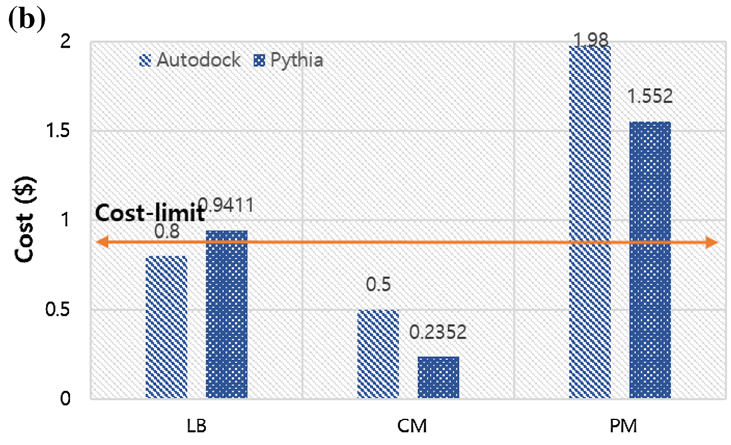 Figure 2: Performance comparison of LB, CM, and PM policies under different resource availability scenarios.
Resilience to Priority Shifts
When a high-priority job pre-empted current resources (Scenario 2), the non-adaptive baseline failed the deadline. The proposed Adaptive Resource Provisioning (ARP) successfully added cloud resources to compensate, finishing the task on time.
Critical Perspective
While the MLP approach is robust for the studied CPU-intensive tasks, the paper has limitations:
- Overhead: Vertical scaling often requires a VM reboot, which isn't fully accounted for in the performance gain metrics.
- Scope: The study primarily focuses on CPU-intensive tasks. Evaluation on Memory-intensive or I/O-intensive workloads (like Big Data analytics) remains future work.
Conclusion
This research highlights shift from "reactive" to "intelligent" resource management. By treating job history as a valuable training set, infrastructure can finally become application-aware, moving scientific computing toward a more cost-effective and reliable future.