
RID: Mastering Precision Drift in Quantitative Crowdsourcing
Adaptive Result Inference for Collecting Quantitative Data With Crowdsourcing
This paper introduces a probabilistic generative model for quantitative crowdsourcing, specifically addressing numerical answer aggregation. By incorporating dynamic worker ability tracking via Kalman filtering and an EM-based inference framework, the authors achieve superior truth estimation and quality control.
TL;DR
Crowd workers aren't machines; their performance fluctuates due to learning curves or fatigue. This paper introduces RID (Result Inference with Dynamic ability), the first model to track "precision drift" in quantitative crowdsourcing using Kalman Filters. By treating worker ability as a moving target, the model achieves a ~10% accuracy boost and allows for smart worker filtering to slash costs.
The "Static Ability" Fallacy
In traditional crowdsourcing research (like sentiment analysis or image labeling), we often treat a worker's accuracy as a fixed constant. However, in quantitative tasks—such as estimating the number of people in a crowd or grading a peer's essay—numerical precision is highly volatile. Unlike categorical tasks where you choose one correct label, quantitative results are aggregated values where a single "tired" worker's wild outlier can skew the entire mean.
The authors argue that existing SOTA methods fail because they ignore the temporal signals in worker behavior. A worker might start slow (learning), reach a peak (expertise), and eventually drop off (fatigue).
Methodology: Kalman Filters Meet EM
The core innovation lies in the RID Model, which treats worker precision () as a latent state in a Linear Dynamical System (LDS).
1. The Generative Process
The model assumes a worker's answer is generated by:
- Latent Truth (): The real value we want to find.
- Worker Bias (): The tendency to always over or underestimate.
- Dynamic Precision (): The inverse variance, which changes over time according to a Gaussian random walk.
2. The RID Engine
To solve this, the authors combine two powerful statistical tools:
- Expectation-Maximization (EM): Iteratively estimates the latent truth and worker parameters.
- Kalman Filter & Smoother: During the M-step, instead of calculating a single average ability, the model runs a forward-backward pass to track how a worker’s precision evolved across every task they completed.
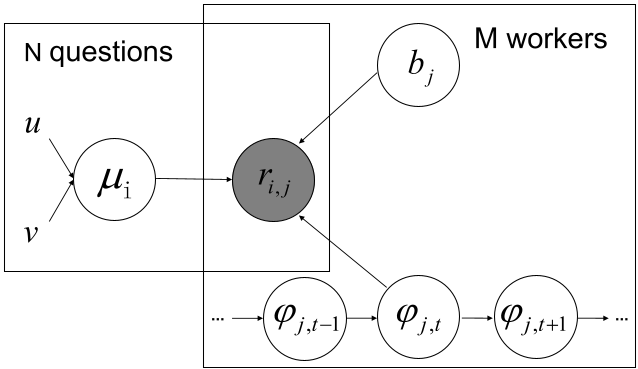 Fig 1. The Graphic RID Model: Notice the temporal links between and .
Experimental Proof: Real-World Triumphs
The authors tested RID on image-counting tasks via CrowdFlower. They collected 6,400 responses across two datasets (Mall and Road scenes).
SOTA Comparison
RID proved remarkably robust. While simple averages or outlier detection (LOF) failed when worker counts dropped, RID maintained high accuracy.
- Vs. Static (RIS): RID achieved ~10% lower RMSE (Root Mean Square Error).
- Vs. Outlier Detection: RID was vastly more stable, proving that "precision tracking" is better than just "deleting outliers."
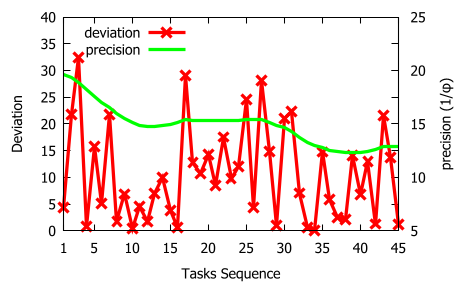 Fig 2. The "Ability Tracking" in action. Observe how different workers follow entirely different performance curves.
Impact: Smarter, Cheaper Crowdsourcing
One of the most practical takeaways is the RID-Filter algorithm. By identifying workers whose precision is historically low or dropping, system administrators can stop hiring them for future tasks. The experiments showed that filtering out the bottom performers didn't just save money—it actually improved the final truth estimation by removing noise.
Critical Insight & Future Outlook
The beauty of this work is its recognition of the human element in technical systems. However, a limitation exists: currently, if a worker is filtered out, they are gone forever. The authors acknowledge that since ability is dynamic, a "tired" worker today might be a "star" worker tomorrow.
For developers and researchers in Crowdsensing and IoT, the RID framework offers a blueprint for handling unreliable, time-varying sensor or human data. The next frontier? Extending this dynamic logic to categorical labels and complex multi-modal tasks.
Senior Editor's Note: This paper is a significant step toward "Human-in-the-loop" systems that respect the complexity of human cognitive states. It effectively bridges the gap between signal processing (Kalman filters) and crowdsourced data management.