
Adaptive Image Privacy: Beyond All-or-Nothing Encryption
Adaptive and safe presentation strategy of image information on social platform
This paper introduces an adaptive and safe image information presentation scheme for social platforms based on Ciphertext-Policy Attribute-Based Encryption (CP-ABE). It features a reversible partial image mosaic technique and an adaptive privilege calculation strategy that achieves higher image quality (PSNR +4dB) and significantly faster attribute revocation than existing methods.
TL;DR
Researchers have developed a new framework for social media image sharing that doesn't just "blur" sensitive areas—it intelligently "recovers" them based on who is looking. By combining CP-ABE (Ciphertext-Policy Attribute-Based Encryption) with a unique reversible mosaic and a vote-attribute system, this method allows for multi-level access control, 4dB higher image fidelity, and near-instant attribute revocation (1ms).
The Problem: The Rigidity of Current Privacy Tools
On social platforms like WeChat or Twitter, we often share images containing varying layers of sensitivity. A plane ticket might contain your name (low sensitivity for friends), your flight number (medium), and your barcode/ID (high).
Existing solutions are usually binary: either the whole image is encrypted, or the sensitive part is permanently blurred/scrambled. Moving to a "tiered" access model typically requires massive computational overhead, especially when a user's status changes (Attribute Revocation). If a student graduates, revoking their "student" access in a traditional system requires re-calculating complex cryptographic trees, often taking over a second—a lifetime in high-concurrency social systems.
Methodology: The Core Innovations
1. Reversible Partial Image Mosaic
Instead of simply destroying information in the "secret region," the authors use a reversible process.
- Data Embedding: The original pixel data from the sensitive region is compressed and hidden in the Least Significant Bits (LSB) of the non-secret regions of the image.
- Mosaic Generation: A mosaic is applied to the secret region.
- Recovery: Only users with the correct cryptographic keys (derived from their attributes) can extract the hidden data from the background and "reverse" the mosaic to see the original high-resolution detail.
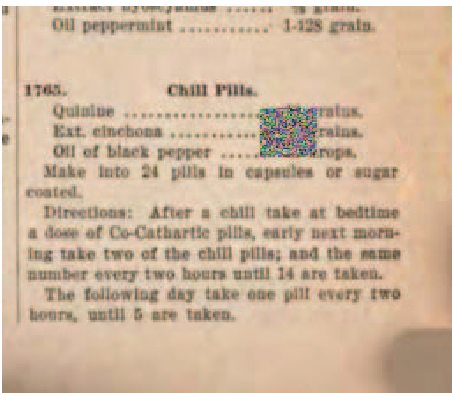 Fig 1: Hierarchical mosaic generation for different sensitivity levels (Ticket, Formula, Police).
2. Adaptive Privilege Calculation
The system doesn't just check if you have an attribute; it calculates how much of that attribute you possess using Preference Degree (PD).
- It handles continuous variables (like distance from a location) and discrete priorities (like educational level).
- It uses a mathematical formula to map these Real Values of Attributes (RVA) into a privilege score .
3. The "Vote-Attribute": The Speed Hack for Revocation
This is the paper's "secret sauce" for speed. By designating one attribute as a "vote-attribute," the system can instantly nullify access. If the vote fails, the privilege is multiplied by zero (), effectively revoking access in 1-2 milliseconds without re-encrypting the underlying data.
Experimental Performance
The authors tested the scheme against standard JPEG scrambling and P3 (Privacy-Preserving Photo) frameworks.
- Image Quality (PSNR): The proposed scheme achieved an average Peak Signal-to-Noise Ratio (PSNR) of 43.44dB, significantly higher than the ~39dB of competitors. This means the recovered image is almost indistinguishable from the original.
- Efficiency: Due to the out-of-region storage strategy, the system only needs to process 1/2 of the secret data compared to full-image encryption methods.
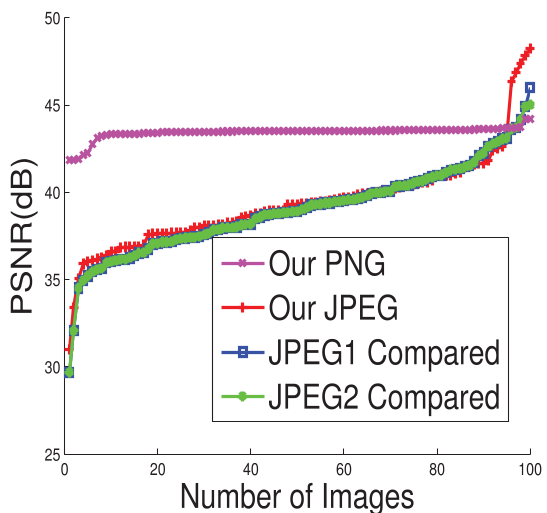 Fig 2: PSNR comparison showing the proposed method (PNG/JPEG) consistently outperforming existing JPEG-scrambling algorithms.
Deep Insight & Conclusion
The true value of this paper lies in its hierarchical flexibility. By decoupling the visual protection (mosaic) from the access logic (CP-ABE), the authors provide a pathway for social platforms to implement "context-aware" privacy.
Limitations: While the PSNR is high, the data embedding in LSBs might be vulnerable to heavy image compression (like the aggressive resizing done by WhatsApp or Facebook). Future work would need to address "Robust" Reversible Data Hiding to ensure the secret data survives social media's lossy compression pipelines.
Final Takeaway: This is a significant step toward a "graceful" privacy model where security doesn't have to come at the cost of user experience or system performance.