
Dynamic Boundaries: Revolutionizing Social Media Clustering with Adaptive ART
7601_Adaptive Scaling of Cluster Boundaries for Large-Scale Social Media Data Clustering.
This paper introduces three adaptive clustering algorithms (AM-ART, CM-ART, and HI-ART) based on Fuzzy Adaptive Resonance Theory (Fuzzy ART) to handle large-scale social media data. By enabling individual clusters to self-tune their "vigilance" parameters—the criteria for similarity—the methods achieve state-of-the-art performance in categorizing complex datasets without needing a predefined number of clusters.
TL;DR
Clustering massive social media streams is notoriously difficult because the number of topics is unknown and the data is incredibly noisy. This paper presents a breakthrough by reimagining Fuzzy Adaptive Resonance Theory (Fuzzy ART). By allowing every cluster to dynamically "negotiate" its own similarity threshold (Vigilance Parameter), the authors created a suite of algorithms—AM-ART, CM-ART, and HI-ART—that are faster, more accurate, and far more robust than traditional density-based or centroid-based methods.
The "Vigilance" Bottleneck
In the world of ART models, "Vigilance" () is the gatekeeper. It defines how similar a new data point must be to an existing cluster to be "absorbed." If is too high, you get thousands of tiny, useless clusters. If it's too low, different topics merge into one giant "super-cluster."
The fatal flaw of prior work was using a single global vigilance value for all data. In social media, where one topic might be a tight-knit community (like "Particle Physics") and another a broad, diverse category (like "Travel"), a "one-size-fits-all" threshold simply fails.
Methodology: The Geometry of Thinking
The authors first define the Vigilance Region (VR). Through complement coding—a technique that normalizes data and its negation—they prove that a cluster in Fuzzy ART isn't just a point; it’s a hyper-rectangle in high-dimensional space.
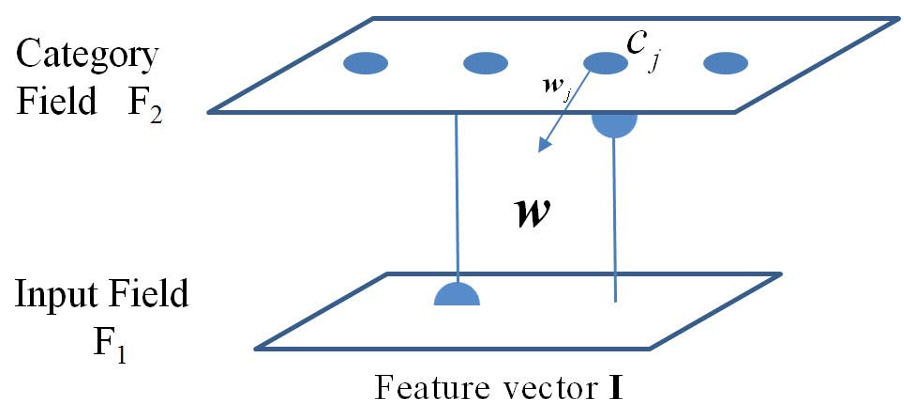
To solve the sensitivity issue, they introduced three core strategies:
- Activation Maximization (AMR): If a cluster keeps "winning" data, its vigilance increases slightly to prevent it from becoming a "catch-all" sink.
- Conflict Minimization (CMR): When two clusters compete for the same area of the feature space, the algorithm "shrinks" their overlapping boundaries to create cleaner separations.
- Hybrid Integration (HIR): Combined, these allow for a self-organizing system where boundaries expand and contract based on local data density.
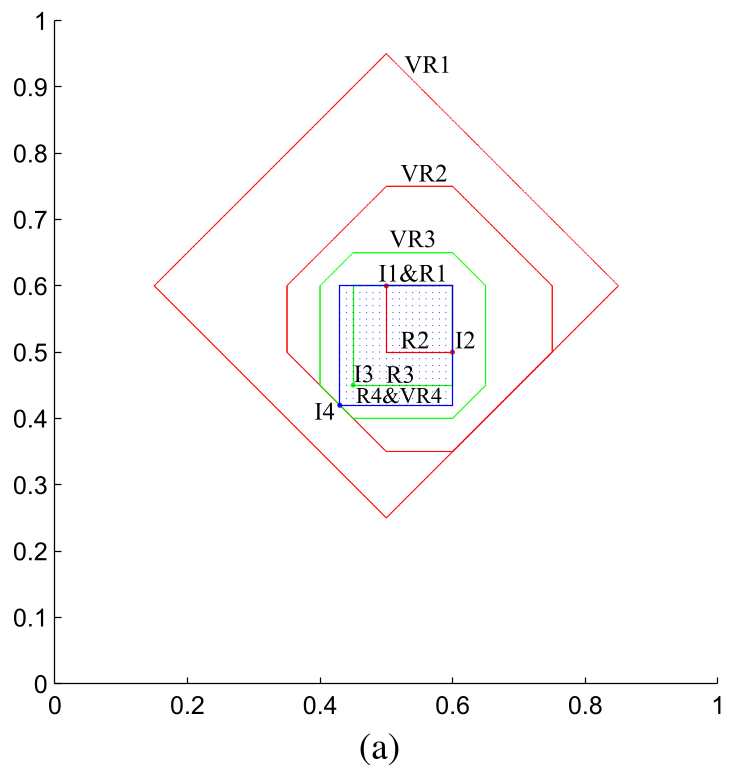 Figure: The evolution of a cluster boundary (Rectangle R) and its Vigilance Region (Octagon VR) as it learns new patterns.
Battle-Tested Performance
The researchers pitted their models against heavyweights like DBSCAN, Affinity Propagation, and Clusterdp.
- Scalability: The ART-based methods scaled linearly. While other algorithms struggled with the quadratic explosion of distances, HI-ART processed over 10,000 images in roughly 6 seconds.
- Noise Immunity: Social media is messy. By using the Hybrid (HI-ART) approach, the model maintained high precision even when Gaussian noise was added to 50% of the dataset.
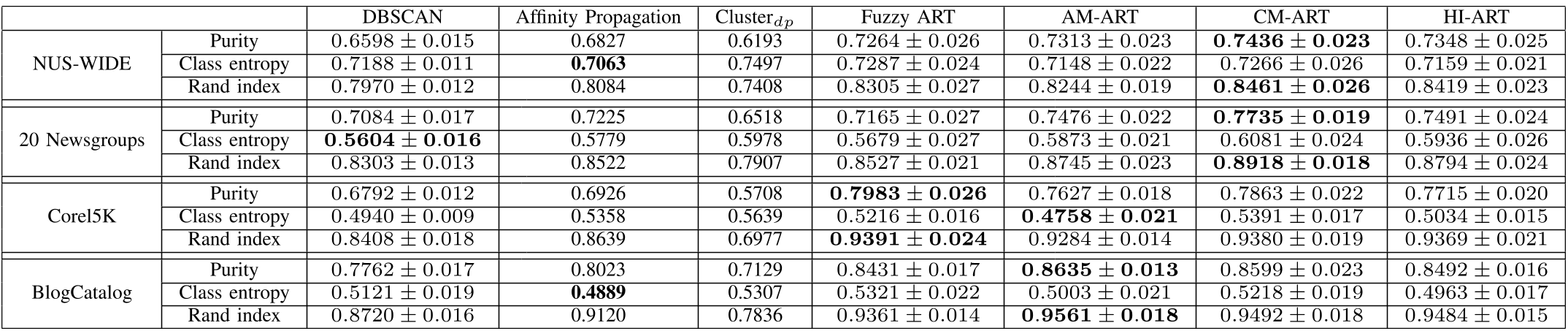 Experimental evidence showing AM-ART and CM-ART consistently outperforming baselines in Purity and Rand Index across various datasets.
Critical Insight: Why This Matters
The true value of this work lies in its Inductive Bias. Most clustering algorithms assume clusters are "blobs" (spheres). By using the Vigilance Region theory, this paper acknowledges that data often exists in "hyper-rectangles." This geometric insight, combined with local parameter adaptation, allows the model to map the diverse "topography" of human behavior on social media far more accurately than a global algorithm ever could.
Conclusion
The move from global vigilance to local, adaptive boundaries marks a significant transition for ART-based neural networks. For developers dealing with high-velocity data streams where the "ground truth" changes by the minute, the linear complexity and self-tuning nature of HI-ART offer a powerful, production-ready alternative to the slow and rigid clustering methods of the past.