
Adaptive Scaling of Cluster Boundaries: Solving the Scalability Bottleneck in Social Media Discovery
12509_Adaptive Scaling of Cluster Boundaries for Large-Scale Social Media Data Clustering.
The paper introduces three novel algorithms (AM-ART, CM-ART, and HI-ART) based on Fuzzy Adaptive Resonance Theory (Fuzzy ART) for large-scale social media clustering. These methods feature linear computational complexity and implement dynamic vigilance parameter adaptation to automatically define cluster boundaries without a predefined number of clusters.
Executive Summary
TL;DR: This paper tackles the challenge of clustering massive, noisy social media data by introducing Adaptive Vigilance to Fuzzy Adaptive Resonance Theory (Fuzzy ART). By allowing each cluster to dynamically resize its own "Vigilance Region" (VR), the proposed algorithms—AM-ART, CM-ART, and HI-ART—achieve linear time complexity and superior robustness to initial parameters compared to traditional methods like DBSCAN or k-means.
Background: Within the academic landscape, this work provides a much-needed theoretical bridge between the cognitive-inspired ART models and the practical requirements of Big Data analytics. It moves ART from a rigid, parameter-sensitive framework to a flexible, self-organizing system.
Problem & Motivation: The "Static Parameter" Trap
Clustering in social media is notoriously difficult because we rarely know the number of underlying topics (). While algorithms like Affinity Propagation (AP) or DBSCAN can estimate , they often fail when:
- Scale is massive: complexity makes AP impossible for millions of tweets.
- Density varies: A single global density or similarity parameter (Vigilance) cannot capture both a broad topic like "Sports" and a niche one like "Undersea Archeology."
- Noise is prevalent: Social data is messy; static boundaries lead to "category proliferation" (creating too many tiny clusters) or over-generalization.
The authors identify that the core issue in Fuzzy ART is its reliance on a global Vigilance Parameter (). Their insight: Treat as a local, learnable property of each cluster.
Methodology: The Geometry of Vigilance
The Vigilance Region (VR)
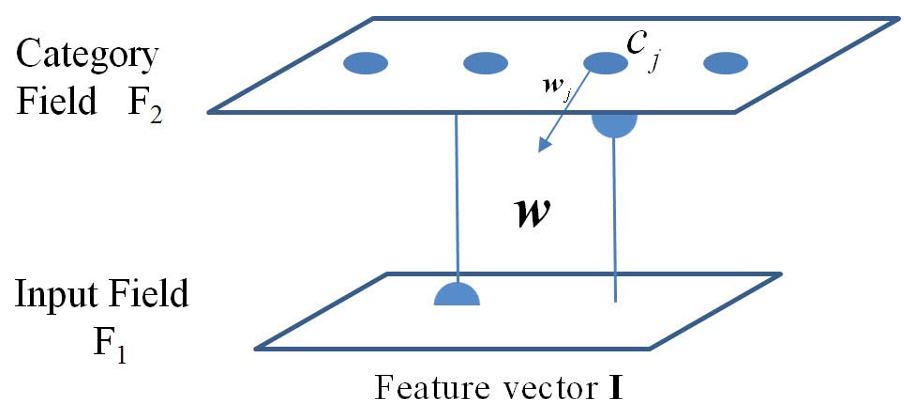
The paper’s first major contribution is the rigorous proof of the Vigilance Region (VR). When using complement coding (a normalization technique), a cluster in Fuzzy ART isn't just a point; it’s a hyper-rectangle. The VR is a "safety zone" around this rectangle—specifically a regular hyper-octagon. If a new data point falls inside this octagon, it "resonates" with the cluster.
Adaptive Rules
To optimize these boundaries, the authors propose:
- Activation Maximization (AMR): Penalizes clusters that frequently shut out data, encouraging them to expand their VR, while rewarding successful resonance by slightly tightening boundaries.
- Conflict Minimization (CMR): If multiple clusters compete for the same point, CMR shrinks the VRs of the "losers" to reduce overlap and sharpen boundaries.
- Hybrid Integration (HI-ART): Combines both to maintain high resolution without instability.
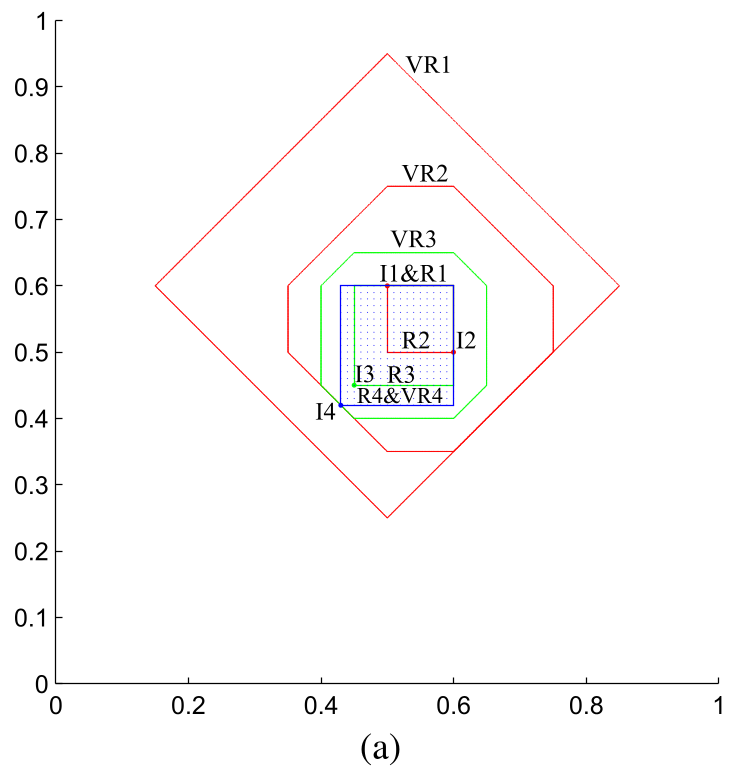 Figure: The evolution of the weight rectangle and VR as new inputs are processed.
Experiments & Results: Speed and Robustness
The researchers tested their models against four datasets, including NUS-WIDE (images) and 20 Newsgroups (text).
SOTA Comparison
As shown in the table below, the ART variants (especially CM-ART and AM-ART) dominated in Purity and Rand Index. While DBSCAN and AP occasionally excelled in class entropy, they were significantly slower and harder to tune.

Efficiency & Noise
The most striking result is the time-cost analysis. While AP and Clusterdp showed exponential growth in processing time, the ART-based methods remained virtually flat (Linear Complexity). Furthermore, HI-ART proved remarkably resilient to Gaussian noise, maintaining performance where standard Fuzzy ART degraded.
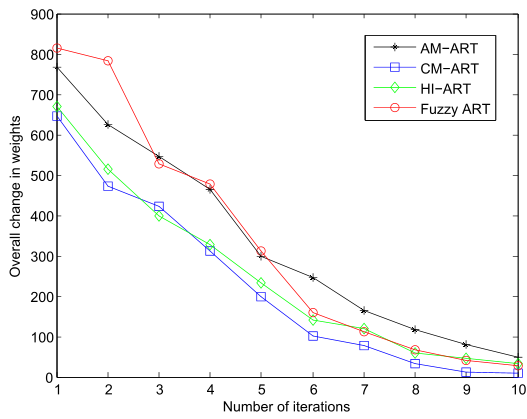 Figure: Convergence speed comparison across datasets.
Critical Analysis & Conclusion
Takeaway
The shift from Global Vigilance to Local Adaptive Vigilance is the "secret sauce" here. It allows the model to handle multi-scale data distributions—a hallmark of social media.
Limitations
Despite the adaptation, the algorithms still require an initial vigilance value. While the results show robustness, a poorly chosen starting point can still affect early-stage cluster formation. Additionally, the min-max normalization required by ART might be sensitive to extreme outliers in other types of sensor data.
Future Outlook
This work paves the way for truly "parameter-free" clustering. By further refining the shape of the VR (perhaps moving from octagons to more flexible manifolds) and integrating deep feature learning, we could see ART-based systems powering real-time trend discovery in global social feeds at an unprecedented scale.