
Adaptive Similarity Aggregation: Solving the "Static Weight" Problem in Ontology Matching
Adaptive Similarity Aggregation Method for Ontology Matching
The paper introduces an Adaptive Similarity Aggregation Method for ontology matching that dynamically calculates combination weights based on structural features. By integrating linguistic matchers (ISub, VDoc) and a structural matcher (GMO), it achieves SOTA-level precision and recall on the OAEI 2009 benchmark, particularly for class-level alignment.
TL;DR
In the realm of Semantic Web interoperability, Ontology Matching remains a critical but difficult hurdle. This paper introduces an Adaptive Similarity Aggregation strategy that ditches the traditional "one-size-fits-all" weight approach. Instead, it calculates unique weights for every pair of entities by analyzing their local structural neighborhood (parents, children, depth, etc.), significantly improving F-measure performance on the OAEI benchmarks.
The "Weighting" Bottleneck
To find correspondences between two different ontologies, most systems use multiple "matchers" (e.g., comparing names, comparing internal structures). The million-dollar question is: How do we combine their results?
Current solutions typically fall into two traps:
- Fixed Weights: Using the same weight for every pair of classes across the entire ontology. This ignores the fact that while some parts of an ontology might be linguistically similar, others might only be similar in their hierarchical structure.
- ML-based Weights: These require a "Ground Truth" (manually aligned examples) to train on, which is almost never available in real-world, large-scale deployments.
Methodology: Structural Topology as a Guide
The core insight of this paper is that the local structure of a class provides a hint about which matcher to trust. The authors utilize three primary matchers: ISub (String similarity), VDoc (Virtual Document/Linguistic extraction), and GMO (Graph Matching).
1. The Adaptive Weight Formula
Instead of a global constant, the combination weight () is derived from six structural attributes for each pair of concepts ():
- Sup/Sub: Number of super and sub-classes.
- Depth: Tree depth from the root.
- Ins/Prop: Number of instances and properties.
- Sib: Number of siblings.
The Structural Combination Weight (scw) is calculated as:
This value tells the system: "If the structures are very different (High ), trust the linguistic matchers more. If the structures look identical, give more weight to the structural match (GMO)."
2. Architecture Overview
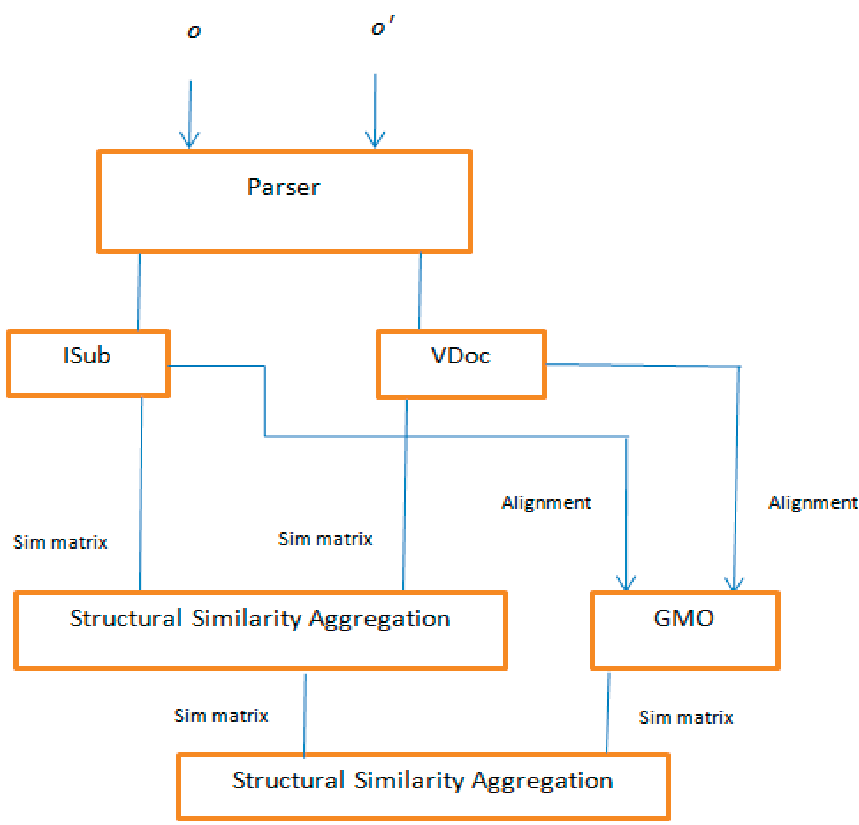 The workflow: Linguistic similarities (VDoc+ISub) are first aggregated using SCW, then fed into the GMO graph matcher for final resolution.
Experimental Proof: Finding the "Saturation Point"
The authors conducted exhaustive tests to visualize how F-measures change with different weights. They discovered that most ontology pairs have a Saturation Point—a specific weight where the performance reaches its peak and stabilizes.
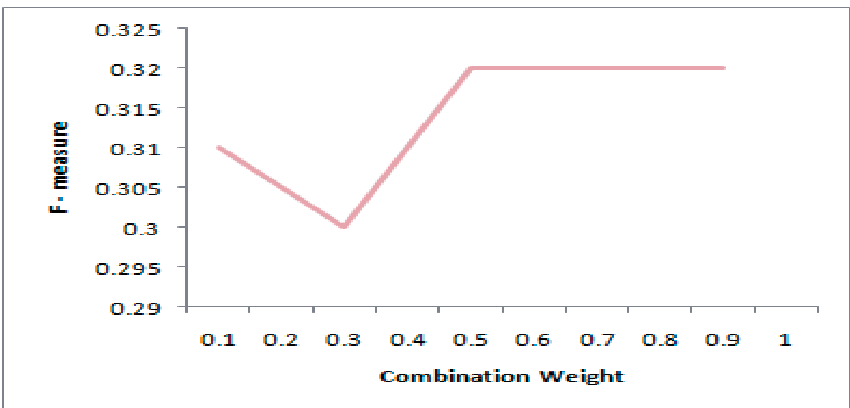 Sample results showing that performance often peaks at specific combination weights, validating the need for an adaptive mechanism to "find" these peaks automatically.
Key Results:
- Test cases 221-247 (Structural Changes): By using linguistic matchers to "seed" the structural matcher (GMO), the system maintained high precision even when the graph structure was intentionally altered.
- Real-World Cases (301-304): The adaptive system outperformed static baseline matchers, proving it can handle the messiness of real-world bibliographical ontologies.
Critical Insight & Conclusion
This paper shifts the paradigm from global optimization to local adaptation. By treating each concept pair as a unique context with its own "structural signature," the authors avoid the need for supervised training data.
Limitations: The current version uses homogeneous weights for properties and instances, potentially missing out on further precision gains. Future work involves integrating external lexicons (like WordNet) and developing a more specialized structural matcher to replace GMO.
Takeaway for the Industry: For anyone building Knowledge Graphs, the message is clear: don't trust a single similarity metric. Use the topology of your data to decide which algorithm is right for the job, one node at a time.