
Beyond Static Decay: Adaptive Social Influence via Local Network Topology
An Adaptive Social Influence Propagation Model Based on Local Network Topology
The paper introduces an Adaptive Social Influence Propagation Model based on Local Network Topology (LNC) for social recommendation. It leverages a dynamic influence computation method that factors in a user's local neighborhood rather than global network attributes, significantly outperforming traditional Collaborative Filtering and fixed-decay propagation models.
TL;DR
This paper presents a novel adaptive social influence model that moves away from fixed decay rates in social recommendations. By calculating influence based on Local Node Centrality (LNC) and employing a Shortest Path Maximum Propagation Strategy, the model significantly enhances prediction accuracy and coverage for users with very few ratings (the "cold-start" problem).
Background Positioning
In the landscape of Recommender Systems (RS), we have moved from simple Collaborative Filtering (CF) to Social Recommendation. However, the "Influence Propagation" phase often relies on oversimplified assumptions—such as the idea that all your friends influence you equally. This work sits as a structural refinement of propagation theory, arguing that influence is a function of local topology rather than just distance.
Problem & Motivation: The "Equality" Fallacy
Existing models like the Fixed Decay Factor (DF) or Linear Decrease (LD) assume that if two people are direct neighbors (distance = 1), they exert the same influence.
- The Reality: You might have 200 friends, but only 5 actually sway your decision on a movie.
- The Limitation: Global metrics (like PageRank) are too computationally expensive for real-time recommendation and ignore the unique "local flavor" of a user's circle.
The authors' insight is grounded in sociophysics: the behavior of a user is influenced heavily by people within a three-degree distance, and the strength of that influence is relative to the "connectedness" (degree) of the influencer within the specific local neighborhood.
Methodology: Local Node Centrality (LNC)
The core of the paper is the LNC formula, which calculates the influence of node on node as:
1. Architectural Logic
Unlike global centrality, LNC only requires information about 's immediate neighbors. If a neighbor has a high degree relative to 's other friends, they are granted a higher influence weight.
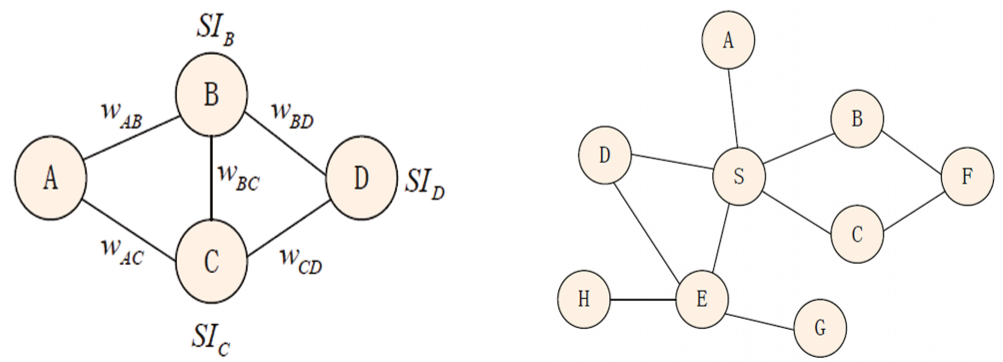 Figure 1: (a) Influence Propagation Path; (b) Example of Local Influence Computation.
2. Path Strategy: SPMPM
When multiple paths exist between two users, the model uses the Shortest Path with Maximum Propagation Methods (SPMPM). It finds all shortest paths and selects the one that yields the highest cumulative influence (product of weights and ).
Experiments & Results
The model was tested on the Epinions dataset, a benchmark characterized by extreme sparsity (99.99%).
Key Findings:
- Cold Start Performance: The model excelled for users with only 3-4 ratings.
- Consistency: While the MAUE (Mean Absolute User Error) showed marginal gains, the RMSUE (Rooted Mean Squared User Error) showed a "notable" improvement. This suggests the LNC model is much better at avoiding large, outlier errors compared to LD and DF methods.
- Coverage: The most significant victory was in User Coverage (UC) and Item Coverage (IC). The LNC model could provide recommendations for a much larger portion of the user base than traditional CF.
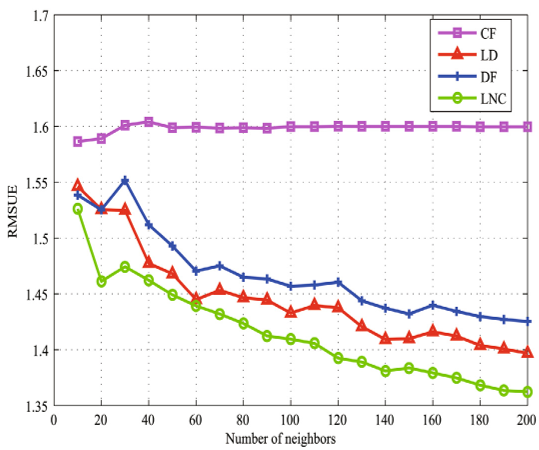 Figure 2: Performance comparison showing LNC consistently outperforming CF and maintaining stability across different neighbor counts.
Critical Analysis & Conclusion
Takeaway
The research successfully demonstrates that local topology is a "cheap" yet powerful proxy for influence. By making the influence weight adaptive to the receiver's neighborhood, the system becomes more personalized and accurate.
Limitations
- Degree-Only Metric: The model uses "degree" as the sole proxy for influence. It does not account for semantic similarity or the quality of previous recommendations.
- Directed vs. Undirected: The experimental focus was primarily on undirected networks; however, influence in social media (e.g., Twitter) is highly directional.
Future Outlook
The LNC model provides a blueprint for efficient "Edge AI" in social recommendations. Future iterations could integrate Temporal Effects (influence waning over time) or Content-Aware Weights to further refine the dynamic nature of social propagation.