
Beyond Static Graphs: Decoding Social Contagion via Adaptive Temporal-Causal Networks
An adaptive temporal-causal network model for social networks based on the homophily and more-becomes-more principle R
This paper introduces an adaptive temporal-causal network model to simulate the co-evolution of opinions and social connections. By integrating the "Homophily" and "More-Becomes-More" (MBM) principles, the model successfully captures the dynamic interplay between peer influence and network structural evolution in adolescent substance use (alcohol and tobacco) datasets.
Executive Summary
TL;DR: This paper tackles the "chicken and egg" problem of social networks: do we become friends because we are similar, or do we become similar because we are friends? The authors propose an adaptive temporal-causal network model that simulates how opinions (like alcohol use) and friendship weights evolve in tandem. By applying this to longitudinal data of Glasgow students, they demonstrate that social structures are not just containers for behavior but are actively reshaped by it.
Academic Positioning: This work bridges the gap between Network Science and Behavioral Informatics, moving beyond descriptive graph theory into the realm of predictive, dynamic causal modeling using differential equations.
The Core Dilemma: Homophily vs. Popularity
Most social simulations fail because they assume the "pipes" (connections) are fixed while the "water" (opinions) flows. In reality, the pipes melt and move. The authors identify two competing forces:
- Homophily: We strengthen ties with those who share our views (the "birds of a feather" effect).
- More-Becomes-More (MBM): Well-connected individuals (hubs) naturally attract even more influence, regardless of their specific opinions.
The challenge lies in mathematically formalizing these qualitative sociological observations into a stable, computable system that doesn't explode into numerical instability.
Methodology: The Temporal-Causal Engine
The model treats every connection weight () and every node state () as a variable governed by a differential equation.
1. The Adaptation Logic
The change in a connection weight is modeled as:
This "Regulation" term is a weighted sum (controlled by parameter ) of the Homophily effect and the MBM effect.
2. Visualizing the Architecture
The architecture follows a recursive feedback loop where node states influence weight updates, which in turn scale the contagion of opinions between nodes.
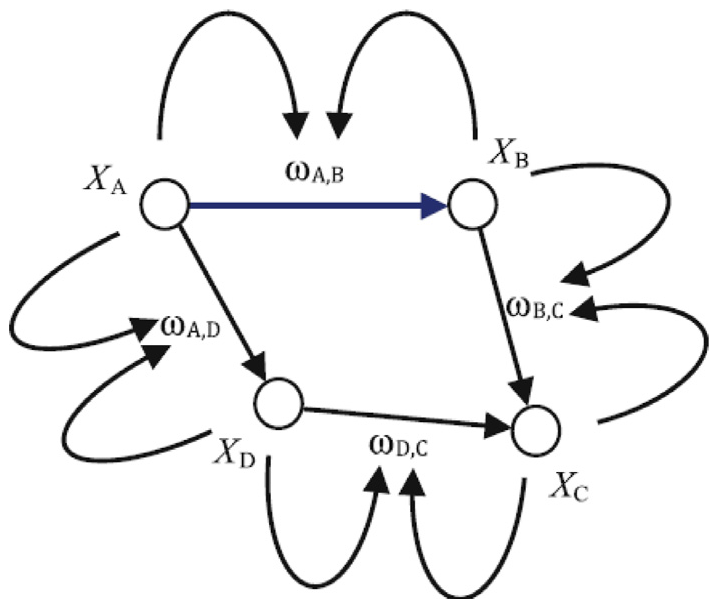
The authors use a quadratic function for Homophily, ensuring that if the difference between two individuals' opinions exceeds a threshold (), the connection weight actively decays. For MBM, they use an Advanced Logistic Sum to reflect the non-linear "saturation" of social influence.
Experiments: The Glasgow Case Study
The model was validated using the famous Glasgow dataset, tracking 160 students over three years regarding their alcohol and tobacco consumption.
Key Findings:
- Predictive Accuracy: The model achieved an RMS error of approximately 11.2% - 12.5%. This is remarkably high for social data, which is notoriously noisy.
- Dominance of Similarity: Through parameter tuning using Simulated Annealing, the researchers found . This implies that in high-school settings, Homophily is the absolute king. Popularity (MBM) exists but plays a negligible role in the sustained usage of substances compared to the reinforcement of similar peer groups.
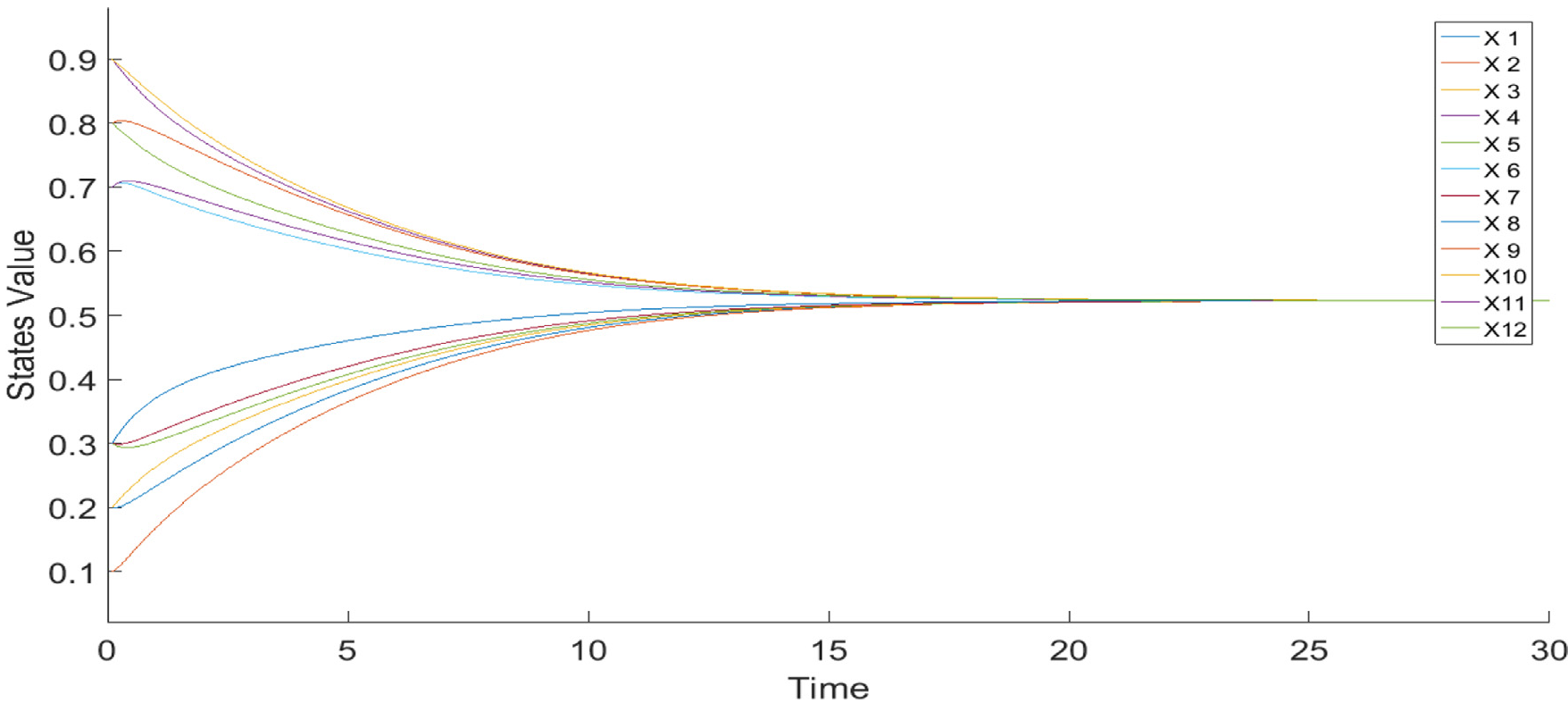 In simulation 1, we see opinions converging over time as the adaptive connections bridge sub-groups through the identified "hubs".
Critical Insight & Future Outlook
Takeaway: The study proves that "The Rich Get Richer" isn't the primary driver of adolescent social behavior—"Like Attracts Like" is.
Limitations:
- Scale: The validation was limited to 30-160 subjects. Whether these causal dynamics hold in massive "Scale-Free" online social networks (like Twitter/X) remains to be seen.
- Granularity: The tobacco data was less accurate because the measurement scale was too coarse (3 points vs. 5 points for alcohol), highlighting the model's sensitivity to data precision.
Future Directions: Integrating more complex contagion models (e.g., emotional contagion or cognitive dissonance) could turn this into a powerful tool for public health officials to design "Socially Aware" intervention programs that disrupt negative behavioral clusters.
Conclusion
This paper provides a robust mathematical framework for Adaptive Social Networks. It reminds us that to understand human behavior, we must treat the social graph as a living, breathing entity that adapts to the values of its nodes.