
SMILE: Bridging the Gap Between Legal Text and Symbolic Reasoning
Toward adding knowledge to learning algorithms for indexing legal cases
The paper introduces SMILE, a machine learning system designed to automatically index legal cases for Case-Based Reasoning (CBR). It utilizes a sentence-level classification approach combined with an ID3 decision tree algorithm and integration of a legal thesaurus to identify abstract fact patterns (factors) in maritime and trade secret law.
TL;DR
This seminal work addresses the "bottleneck" of Case-Based Reasoning (CBR) in the legal domain: the high cost of manual case indexing. By introducing SMILE, the authors demonstrate that shifting from document-level analysis to sentence-level classification, augmented by a legal thesaurus, allows machine learning algorithms to identify complex legal "factors" even with limited training data.
Context: The Indexing Bottleneck
In the legal field, Artificial Intelligence isn't just about retrieving documents; it’s about argumentation. Systems like CATO help students learn to distinguish and analogize cases based on "factors"—abstract fact patterns that strengthen or weaken a claim. However, transforming a 20-page judicial opinion into a symbolic representation of these factors has traditionally required expensive human expertise.
Traditional Machine Learning (ML) approaches—specifically the "bag-of-words" model common in the 90s—failed here for two reasons:
- Complexity vs. Data: Legal opinions are long and "noisy," but the number of available training cases is often small.
- Linguistic Subtlety: In law, a single "not" (negation) or the relationship between a subject and an object changes everything. Statistical word counts ignore this structure.
Methodology: Small Units, Big Knowledge
The researchers proposed a three-pronged strategy to make ML viable for legal indexing:
1. Granular Focus (Sentences over Documents)
Instead of feeding a whole opinion into a classifier, SMILE breaks the text into individual sentences. This reduces the search space and focuses the algorithm on the specific "evidence" for a legal factor.
2. Knowledge Integration (The Legal Thesaurus)
Judges often use synonyms to avoid repetition (e.g., "contract" vs. "covenant"). A standard ML algorithm sees these as unrelated tokens. By integrating the WestLaw Thesaurus, SMILE can group these into semantic categories, preventing the model from "overfitting" on specific word choices and allowing it to generalize better.
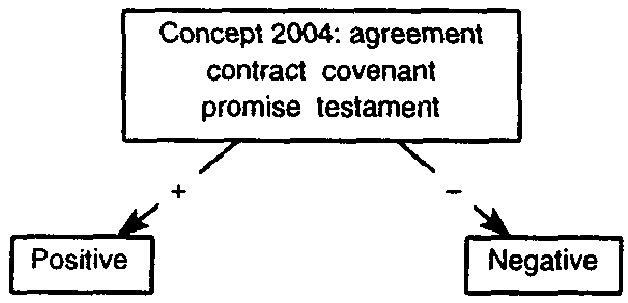 Figure: How adding a thesaurus simplifies the decision tree, enabling better generalization.
3. Structural Awareness
The authors highlight that legal language relies on structural logic. For example, the difference between "Plaintiff made a unique product" and "No other manufacturer made the product" is structural. SMILE's design points toward using dependency parsers to identify these relationships.
Experiments and Results
The authors tested SMILE on six factors from the CATO database (e.g., Unique-Product, Security-Measures).
Key Findings:
- Efficiency: The sentence-based approach achieved high performance (up to 80% precision/recall) despite the small dataset.
- Thesaurus Impact: It significantly improved results for "concrete" factors (like F15: Unique-Product) but was less effective for "broad" factors (like F6: Security-Measures) which involve a vast, unpredictable variety of real-world actions.
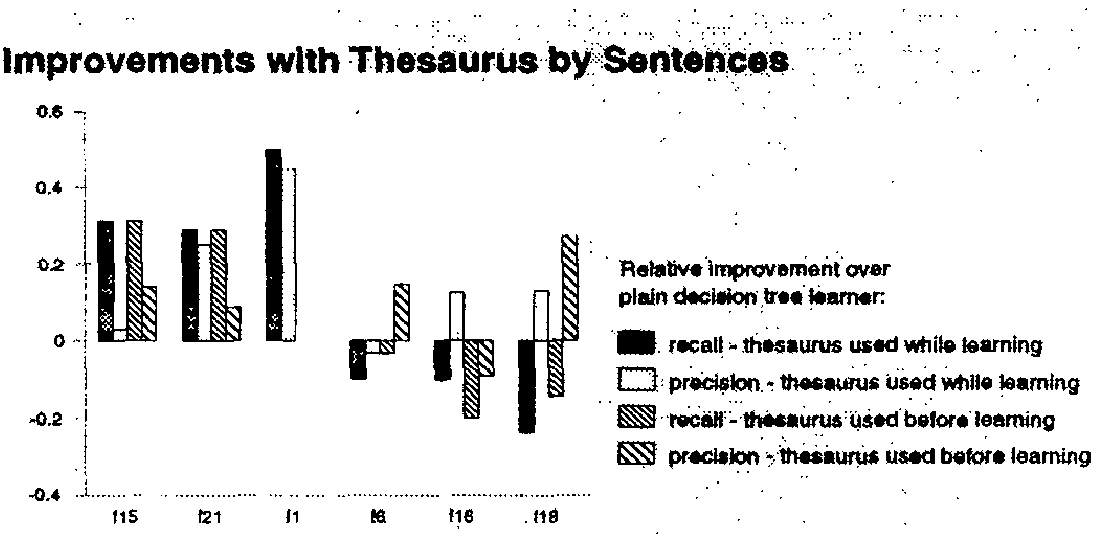 Table 1: Precision and recall for identifying factors using SMILE.
Critical Analysis & Conclusion
This paper was a vital step toward modern LegalTech. It recognized that Legal AI cannot be "purely" statistical; it must incorporate domain knowledge.
Limitations: The study was conducted on "squibs" (shortened case summaries) rather than raw, "messy" full opinions. While the authors argue the sentence patterns are similar, scaling to full-text documents presents a much harder "needle-in-a-haystack" problem.
Takeaway for Today: In the era of LLMs, we often forget the value of symbolic logic. This paper reminds us that identifying "why" a case matters (the factors) is as important as "what" the case says. Modern RAG (Retrieval-Augmented Generation) systems in Law could learn from this approach by focusing on granular, factor-based indexing rather than just document embeddings.