
Addressing False Identity Attacks: The Power of Decentralized Open Census
Addressing False Identity Attacks in Action-Based P2P Social Networks with an Open Census
This paper introduces a decentralized, peer-to-peer (P2P) census framework designed to detect and mitigate Sybil and false identity attacks in action-based social networks like electronic petition drives. By leveraging a hierarchy of "neighborhoods" and a "witness graph" where citizens vouch for each other's eligibility, the system enables an open census that observers can independently verify without relying on a central government authority.
TL;DR
In the digital age, electronic petitions and P2P social networks are plagued by Sybil attacks—where one person creates thousands of fake identities to sway public opinion. This paper proposes a solution: a citizen-driven Open Census. Instead of trusting a centralized government, the protocol uses hierarchical neighborhoods and a Witness Graph where neighbors verify each other. By applying probabilistic models, the system can distinguish real humans from bots with remarkable accuracy.
The Core Motivation: Who Can You Trust?
Centralized census data is often opaque and susceptible to "ballot stuffing" by the very governments that run them. Conversely, P2P systems like YouTube or discussion forums are "ideal environments" for false identity attacks. The authors argue that for a petition or poll to be meaningful, we need a way to verify the eligibility of participants without sacrificing decentralization.
The insight here is simple: Your neighbors know you exist. By formalizing this local knowledge into a mathematical model, the authors turn social connections into a verifiable security layer.
Methodology: The Witness Graph and Hierarchical Neighborhoods
To solve the Distributed Census Problem (DCP), the authors introduce two key structures:
- Hierarchical Neighborhoods: To ensure scalability, constituents are organized into a tree (e.g., Street -> City -> County). This allows users to verify their immediate neighbors with "reasonable effort" while maintaining a verifiable path to the global organization.
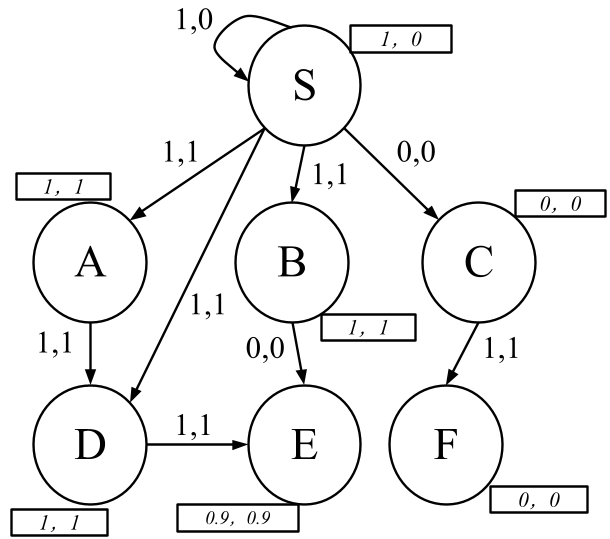
- The Witness Graph: This is a directed graph where edges represent "witness stances."
- Favorable Stance: "I vouch that this identity is real and eligible."
- Unfavorable Stance: "This identity is fake or doesn't belong here."
Inference Models: From Heuristics to Bayes
The paper explores several ways to calculate a user's Censability (Ψ) (the probability they are a valid participant) and Reliability (Φ) (the probability their witness status should be trusted).
- MAXAS (Max Amortized Support): Trust decays as it travels further from the reference user (amortization).
- PAS (Penalized Average Support): Penalizes identities that receive "unfavorable" witnesses from reliable sources. This was found to be the most human-aligned model in volunteer testing.
- Bayesian Networks: A more rigorous approach using random variables for every identity and witness stance, solved via Markov Chain Monte Carlo (MCMC) simulations.
Experimental Battle-Testing
The authors tested their system against simulated "State-level" Sybil attacks.
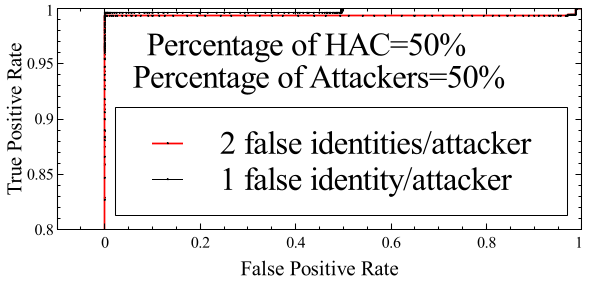
- Resilience: The system remains robust even when the proportion of honest active constituents (HACs) drops. As shown in the ROC curves, the model maintains a high True Positive Rate (identifying real people) while keeping False Positives low.
- Human Alignment: In a ten-person "live" experiment, the PAS model outperformed simpler heuristics, proving that a nuanced approach to "negative trust" is essential for accuracy.
Critical Insight & Future Outlook
The brilliance of this framework lies in its Semantic Statements. Unlike simple "upvote/downvote" systems, this census allows users to qualify why they trust a node (e.g., "The public key matches the address").
Limitations: The system relies on a "kernel" of honest users to start the trust chain. In a purely adversarial environment where attackers outnumber honest users locally, the system could struggle. Furthermore, protecting the privacy of users while they disclose "real identities" remains a delicate balancing act that requires further integration with zero-knowledge technologies.
Final Takeaway: This research moves us closer to a world of Direct Democracy, where citizens can prove their eligibility and count their own populations without needing permission from a central authority.