
TIR1/AFB Receptors: The Dual-Function Engines of Plant Growth
Adenylate cyclase activity of TIR1/AFB auxin receptors in plants
2022-10-26
Summary
Problem
Method
Results
Takeaways
This study identifies that the well-known TIR1/AFB auxin receptors in land plants possess dual enzymatic functionality, acting both as F-box subunits for E3 ubiquitin ligases and as adenylate cyclases (ACs). The research demonstrates that auxin, in conjunction with Aux/IAA co-receptors, stimulates cAMP production, establishing cAMP as a key second messenger in canonical plant hormone signaling.
## Executive Summary
**TL;DR**: For decades, TIR1/AFB proteins were categorized strictly as the substrate-recognition components of E3 ubiquitin ligases. This landmark paper reveals they are also **adenylate cyclases (ACs)**. Upon auxin binding, these receptors produce cAMP, which acts as a second messenger to drive core physiological processes like gravitropism and long-term root growth inhibition.
**Background**: This work shifts the paradigm of plant molecular biology by providing definitive genetic and biochemical evidence for the role of cAMP in plants—a topic that has been controversial for years due to the lack of clearly identified plant ACs.
## Problem & Motivation: Beyond Protein Degradation
The "canonical" auxin signaling pathway is elegant: Auxin acts as a molecular glue, bringing TIR1/AFB receptors together with Aux/IAA repressors, leading to the latters' degradation and a resulting burst of gene transcription.
However, researchers noticed a discrepancy: some auxin responses occur within seconds or minutes—too fast to be explained solely by transcription and translation. While these "rapid responses" (like Ca2+ transients) were known to require TIR1, the exact molecular mechanism remained a "black box." The authors hypothesized that TIR1 might have a hidden enzymatic function capable of generating rapid-acting second messengers.
## Methodology: Unveiling the Adenylate Cyclase Motif
By analyzing conserved sequences, the team identified a hidden **AC motif** in the C-terminal region of TIR1/AFB receptors across land plants, from mosses like *Physcomitrella patens* to *Arabidopsis*.
### 1. Structural Insight
Using molecular docking, the researchers found that ATP (the substrate for cAMP) fits perfectly into a pocket near the auxin-binding site. Interestingly, the Aux/IAA protein itself acts like a "latch" (via residue V84), stabilizing ATP and making the cAMP production more efficient.
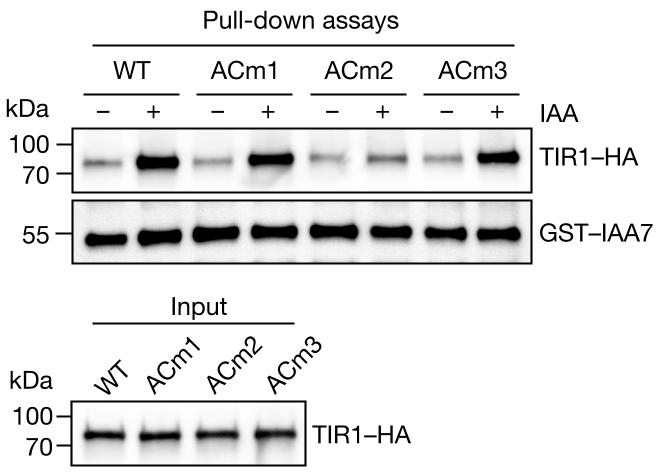
*Figure 1: Molecular docking showing ATP positioning within the TIR1 complex and the spatial proximity to the auxin-binding pocket.*
### 2. Biochemical Validation
The team used three primary methods to prove AC activity:
* **E. coli Complementation**: AC-deficient bacteria turned red on MacConkey agar when expressing TIR1 variants.
* **LC-MS/MS**: Direct measurement of cAMP levels produced by purified TIR1 proteins.
* **In Planta Testing**: Measuring cAMP levels in whole roots, which showed a steady increase 1-6 hours after auxin treatment—an effect that vanished in TIR1/AFB mutants.
## Experiments & Results: Genetic Proof of Function
To prove that this AC activity actually *matters* for the plant, the authors created "AC-dead" versions of TIR1 (mutations m1, m2, and m3).
### Sustained Growth vs. Rapid Response
The results were striking:
* **Sustained Inhibition**: While wild-type TIR1 restored root growth inhibition in mutants, the AC-dead versions could not. The roots continued to grow even in the presence of auxin.
* **Gravitropism**: Plants with AC-deficient TIR1 failed to reorient their roots properly in response to gravity (Fig 4e).
* **The Surprise**: Rapid Ca2+ spikes and initial pH changes were *not* affected by the AC mutations. This suggests that while AC activity is vital, there is yet *another* unidentified mechanism handling the sub-minute "ultra-fast" responses.
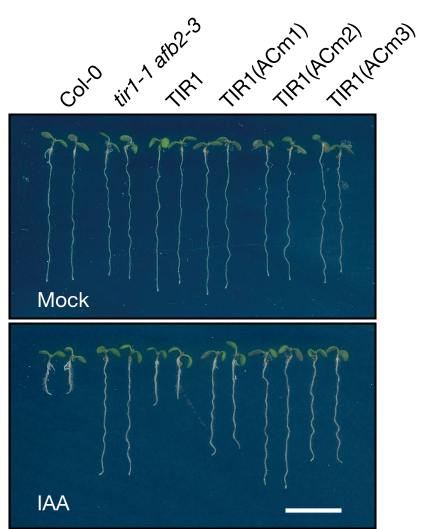
*Figure 2: Genetic complementation shows that while TIR1 (WT) restores auxin sensitivity, AC-motif mutants (m1, m3) remain partially resistant to auxin-induced growth inhibition.*
## Critical Analysis & Conclusion
### Takeaway
The discovery of TIR1/AFB as an adenylate cyclase solves a long-standing mystery in plant biology regarding the existence and relevance of cAMP. It places cAMP at the center of the most important growth hormone signaling pathway in the plant kingdom.
### Limitations & Future Work
* **The "Ultra-Fast" Gap**: Since AC activity didn't explain the 30-second Ca2+ spikes, the search for the absolute fastest auxin signaling component continues.
* **Downstream Effectors**: We now know cAMP is produced, but we don't yet know exactly *which* proteins cAMP binds to (e.g., specific ion channels or protein kinases) to execute the growth arrest.
This research rejuvenates the study of cyclic nucleotide signaling in plants and suggests that many other "F-box" proteins might be hiding enzymatic "moonlighting" functions that have been overlooked for decades.