
To Share or Not to Share? Decoding the Pulse of Adolescent Self-Disclosure on Facebook
To share or not to share? Adolescents’ self-disclosure about peer relationships on Facebook: An application of the Prototype Willingness Model
This study applies the Prototype Willingness Model (PWM) to analyze adolescents' self-disclosure regarding peer relationships on Facebook. Using Structural Equation Modeling (SEM) on a sample of 1,314 adolescents, it identifies the relative influence of rational intentions versus impulsive social reactions on online sharing behavior.
TL;DR
Is adolescent oversharing on Facebook a calculated choice or a spur-of-the-moment lapse in judgment? This study employs the Prototype Willingness Model (PWM) to reveal that while teens mostly follow a "reasoned path" driven by their personal attitudes, a significant "social-reaction path"—fueled by their desire to match social prototypes—often bypasses rational intent, leading to impulsive disclosure.
Background: The Privacy Paradox in Adolescence
For adolescents, social media is not just a tool; it is a laboratory for identity construction and relationship maintenance. However, this developmental need often clashes with digital safety. Previous research focused on what they share (contact info, birthdays), but this study dives into the why regarding their most sensitive topic: peer relationships.
The core tension lies in whether these digital natives are "rational actors" who weigh risks, or if the "digital social pressure" makes them willing to share even when they didn't intend to.
Methodology: The Dual-Pathway Approach
The researchers utilized a sample of 1,314 Belgian adolescents to test the Prototype Willingness Model. Unlike older models that assume humans are purely rational, PWM suggests two ways behavior happens:
- The Reasoned Path: Driven by Attitude (Is this good?) and Subjective Norms (Do my friends/parents think I should?).
- The Social-Reaction Path: Driven by Prototypes (What is the "cool" person doing?) and Willingness (If the situation arises, would I join in?).
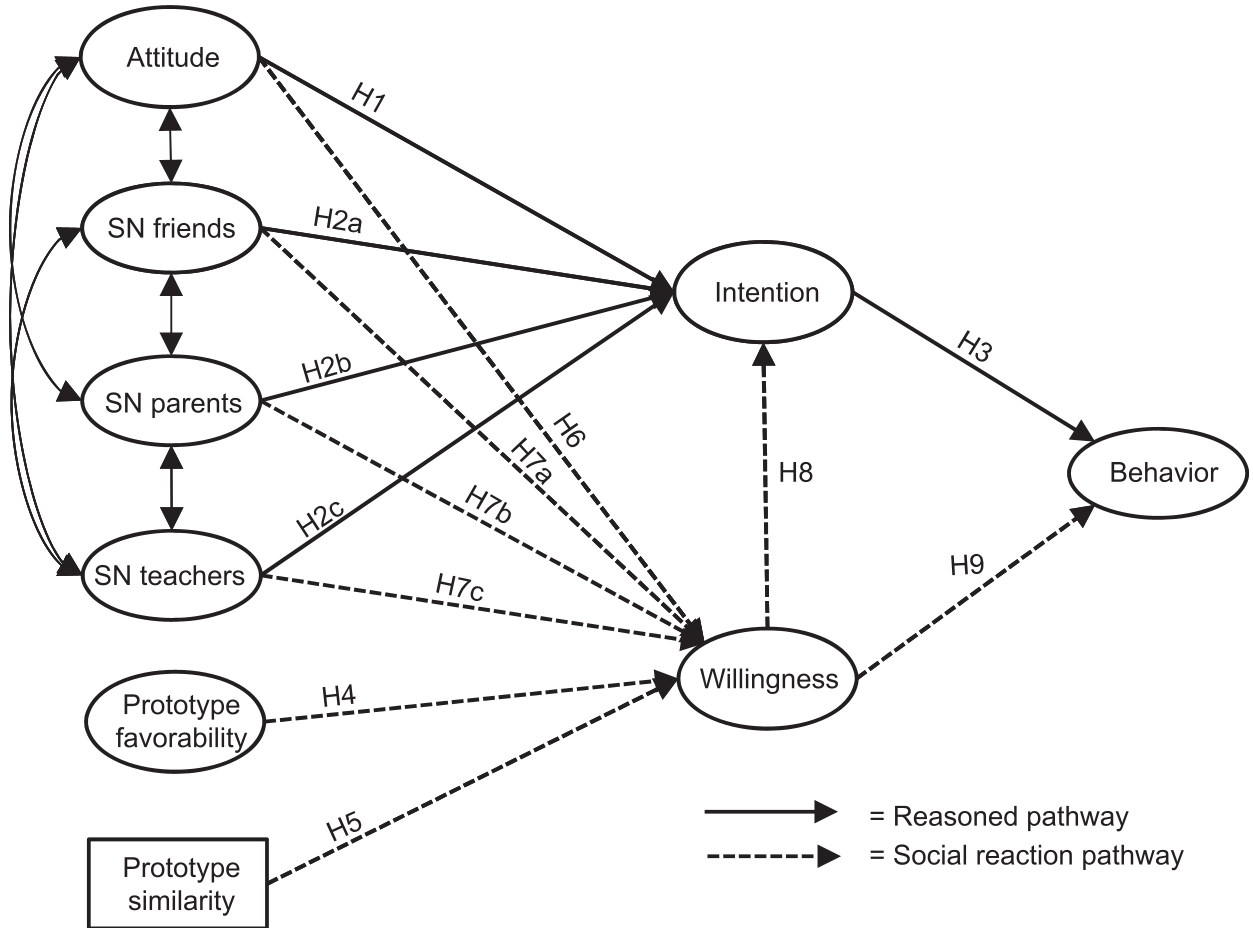 Figure 1: The theoretical framework illustrating the interaction between the Reasoned and Social-Reaction pathways.
Key Insights: Why They Post
The study’s SEM (Structural Equation Modeling) analysis yielded several striking findings:
1. Intention is King, but Attitude is the Power Behind the Throne
Attitude was found to be the strongest predictor of the intent to share. If an adolescent views self-disclosure as "harmless" or "good," they are highly likely to plan their posts. This suggests that by age 16-17, adolescents are becoming more self-reliant in their decision-making.
2. The Influence of the "Prototype"
Adolescents who identified with the "image" of a typical Facebook sharer (evaluating them as smart, cool, or popular) showed much higher Willingness to disclose. Even if they didn't intend to post on a given day, seeing peers post creates a scenario where their "spontaneous willingness" takes over.
3. The Parent/Teacher Gap
Interestingly, while Peer Norms and Parental Norms influenced behavior, Teacher Norms had zero significant impact. Adolescents simply do not associate their teachers with their Facebook social sphere, making school-based "privacy lectures" potentially ineffective if they rely solely on teacher authority.
 Table 1: Statistical breakdown showing strong correlations between Prototype Similarity, Intention, and actual Behavior.
Deep Insight: The Gender and Age Factor
The data revealed that female adolescents have a higher intention to self-disclose and actually share more about relationships than boys. This aligns with offline developmental trends where girls often prioritize dyadic intimacy. Furthermore, as adolescents age, they paradoxically feel more similar to the "sharer" prototype, increasing their risk-taking potential online.
Critical Analysis & Conclusion
Takeaway for Parents and Educators
The dominance of the Reasoned Path is actually good news—it means adolescents are capable of rational thought regarding their privacy. However, the presence of the Social-Reaction Path explains why "accidental oversharing" happens in the heat of a social moment.
- Move Beyond Rules: Since "Attitude" is the strongest driver, simply banning certain behaviors won't work. We must change how adolescents perceive the value and risk of their data.
- Peer-Led Intervention: Since friends influence "Intention" more than teachers do, peer-mentorship programs for digital citizenship may be more effective than traditional curriculum.
Limitations
The study is cross-sectional, meaning it’s a snapshot in time. We cannot definitively say if a positive attitude causes sharing or if sharing leads to a more positive attitude through social reinforcement. Future longitudinal studies are needed to map this trajectory as platforms evolve from Facebook to more ephemeral media.
Final Thought: Adolescents are not just "clueless" about privacy; they are making calculated social trade-offs. The goal for practitioners is to sharpen those calculations by building a more critical "privacy attitude" from within the peer group itself.