
The Crowd Will See You Now: Understanding Adoption Drivers for Medical Crowdsourcing Platforms
Adoption Factors for Crowdsourcing Based Medical Information Platforms
The paper investigates the adoption factors for medical crowdsourcing platforms, proposing an extended Technology Acceptance Model (TAM) that integrates perceived risks and specific crowdsourcing features. Through a survey of 349 respondents (physicians, students, and patients), the study validates a structural equation model identifying critical antecedents to Perceived Usefulness.
TL;DR
Crowdsourcing in medicine promises high-quality diagnostics at low costs, yet adoption remains a challenge. This research identifies that while the "wisdom of the crowd" (large user bases) increases a platform's perceived value, this is constantly threatened by "unintentional risks" like distracted doctoring and groupthink. Success lies in a "trust-by-design" approach—integrating restrictive features like physician-only posting and anonymity to offset perceived risks.
Perspective: The Paradox of Medical Crowdsourcing
Crowdsourcing traditionally thrives on openness and massive participation. However, medicine is a high-stakes, "delicate environment." The researchers pinpoint a core conflict: the very features that make crowdsourcing powerful (open, large-scale interaction) create risks that can deter professional and patient adoption. This paper moves beyond the standard Technology Acceptance Model (TAM) to explore the friction between Feature Richness and Perceived Risk.
Problem & Motivation: Why Doctors and Patients Hesitate
Prior work focused heavily on "Ease of Use." But in medicine, "Useful" does not just mean "Easy"—it means "Safe." The authors identify several unique pain points:
- Distracted Doctoring: The fear that mobile-based crowdsourcing fragments a physician's attention, leading to errors in both digital and physical care.
- The Knowledge Gap: A professional's unwillingness to expose what they don't know in a public forum.
- Responsibility Ambiguity: Who is liable when a crowd helps diagnose a patient?
Methodology: Mapping the User's Mind
The researchers proposed a model where Perceived Usefulness (PU)—the ultimate driver of adoption—is influenced by four pillars:
- Perceived Ease of Use (PEoU) (The Classical Path).
- Motivational Factors (Intrinsic vs. Extrinsic).
- Importance of Crowdsourcing Features (IoCF) (e.g., Large User Base, Anonymity).
- Perceived Risk (PR) (A combination of unintentional risks and the need for restrictive features).
Conceptual Model
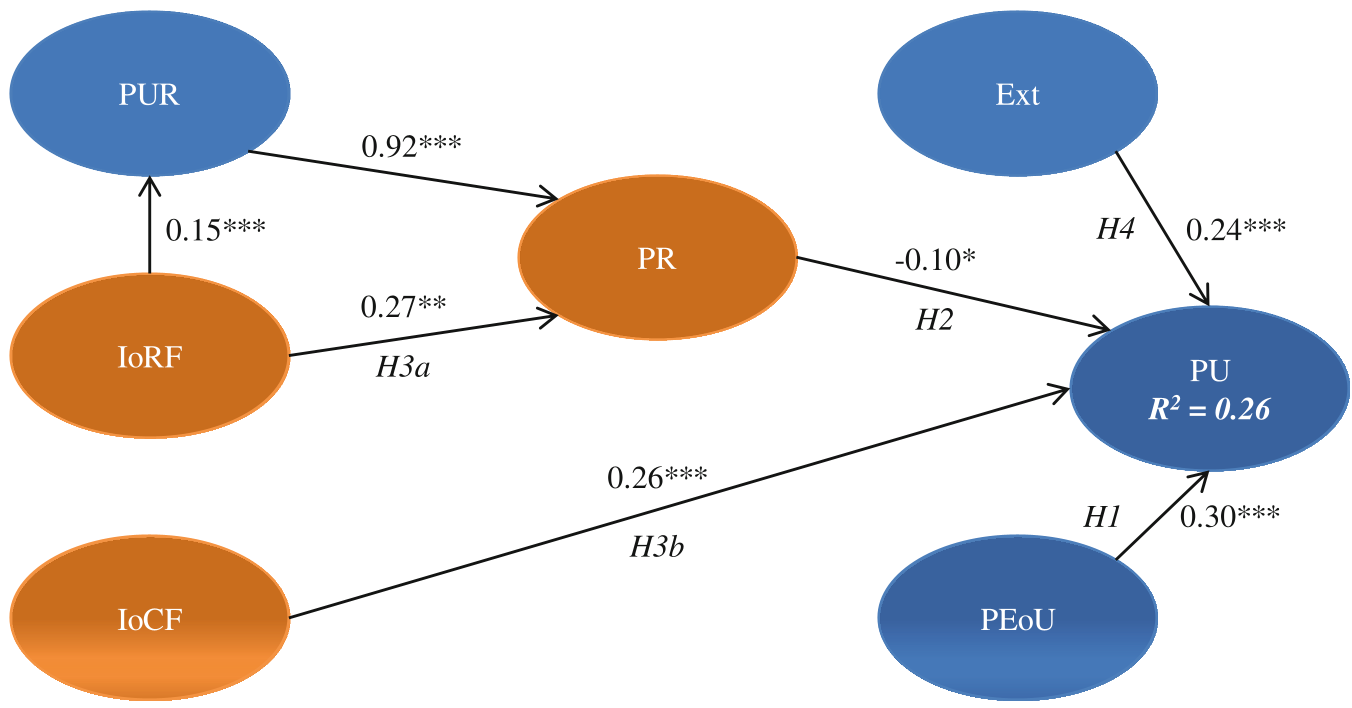
The study utilized a survey of 349 respondents, including 95 physicians and 144 medical students, providing a robust cross-section of the medical community.
Key Results: Finding the "Sweet Spot"
The analysis confirmed that users are sophisticated: they recognize that risks and features are interrelated.
- The Negative Weight of Risk: Perceived Unintentional Risk (PUR) and the lack of restrictive features (IoRF) create a significant negative pressure on how useful a platform feels.
- Extrinsic Incentives Matter: Interestingly, while many altruistic motives exist in medicine, Extrinsic Motivation (reputation, career benefits) was a significantly stronger predictor of perceived usefulness than intrinsic satisfaction.
- The Anonymity Requirement: Features like anonymity were found to be essential to mitigate the "risk of exposing knowledge gaps."
SOTA Comparison & Factor Analysis
The researchers used Principal Axis Factoring (PAF) to ensure their new constructs (PUR, IoRF, IoCF) were statistically distinct from traditional TAM constructs.
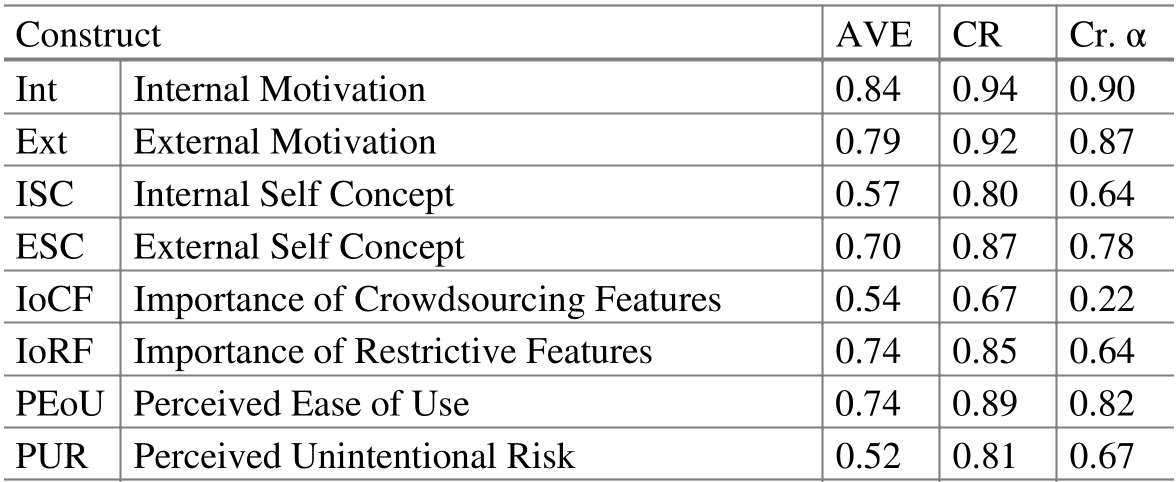 Table: Reliability metrics (AVE and Composite Reliability) confirming the validity of the new constructs.
Critical Insight: Safety is a Feature
The most profound takeaway is the concept of a Second-Order Risk Construct. The perception of risk isn't just about "bad things happening"; it's a calculation of "threat vs. avoidability." If a platform shows it has Restrictive Features (e.g., verifying that only doctors can answer certain cases), users perceive the platform as significantly more useful because the "Avoidability" of the threat is higher.
Conclusion & Future Outlook
This paper provides a blueprint for the next generation of medical platforms (like SERMO or CrowdMed). To move toward Health 2050, developers must:
- Implement Quality Indicators: Display contributor experience levels to reduce perceived risk.
- Design for Professional Dignity: Use anonymity to protect experts from the social cost of asking questions.
- Focus on Extrinsic Rewards: Acknowledge that professional reputation and career growth are major drivers for high-quality crowd contributions.
Limitations: The study is exploratory and relies on survey data rather than behavioral logs. Future research should investigate whether these perceptions align with actual platform usage over time.