
Beyond Keywords: A Dynamic Watchdog Strategy for Adult Content Filtering
Adult content filtering: Restricting minor audience from accessing inappropriate internet content
This paper introduces a server-side reinforced strategy for adult content filtering to protect minors. The core method, called a scenario-based detection strategy, utilizes a watchdog mechanism that tracks user identity via IP, MAC addresses, and Date of Birth (DOB) consistency to achieve a 78% average classification accuracy.
TL;DR
The pervasive nature of smartphones has given minors unprecedented—and often unintentional—access to "Not Safe For Work" (NSFW) content. Traditional filters like blacklists and keyword blocks are failing. This paper proposes a server-side Reinforced Strategy that uses a multi-layered identification process (IP/MAC/DOB) to track user behavior and block inappropriate access with 78% accuracy, regardless of the device used.
Problem & Motivation: Why Current Filters Fail
The internet is growing too fast for humans to categorize. With over 100,000 new websites appearing daily, manual URL-based Blacklisting is an exercise in futility. Furthermore:
- Keyword Filtering often lacks context—blocking a health education page because it contains the word "sex."
- Metadata (PICS/POWDER) is easily manipulated by unscrupulous site owners to lure traffic.
- Parental Controls are often "resource-hogs" and can be bypassed by tech-savvy teens using local account conversions or proxy servers.
The authors' insight is that we need a Server-Side Watchdog that doesn't just look at what is being accessed, but how the user interacts with the system over time.
Methodology: The Scenario-Based Detection Strategy
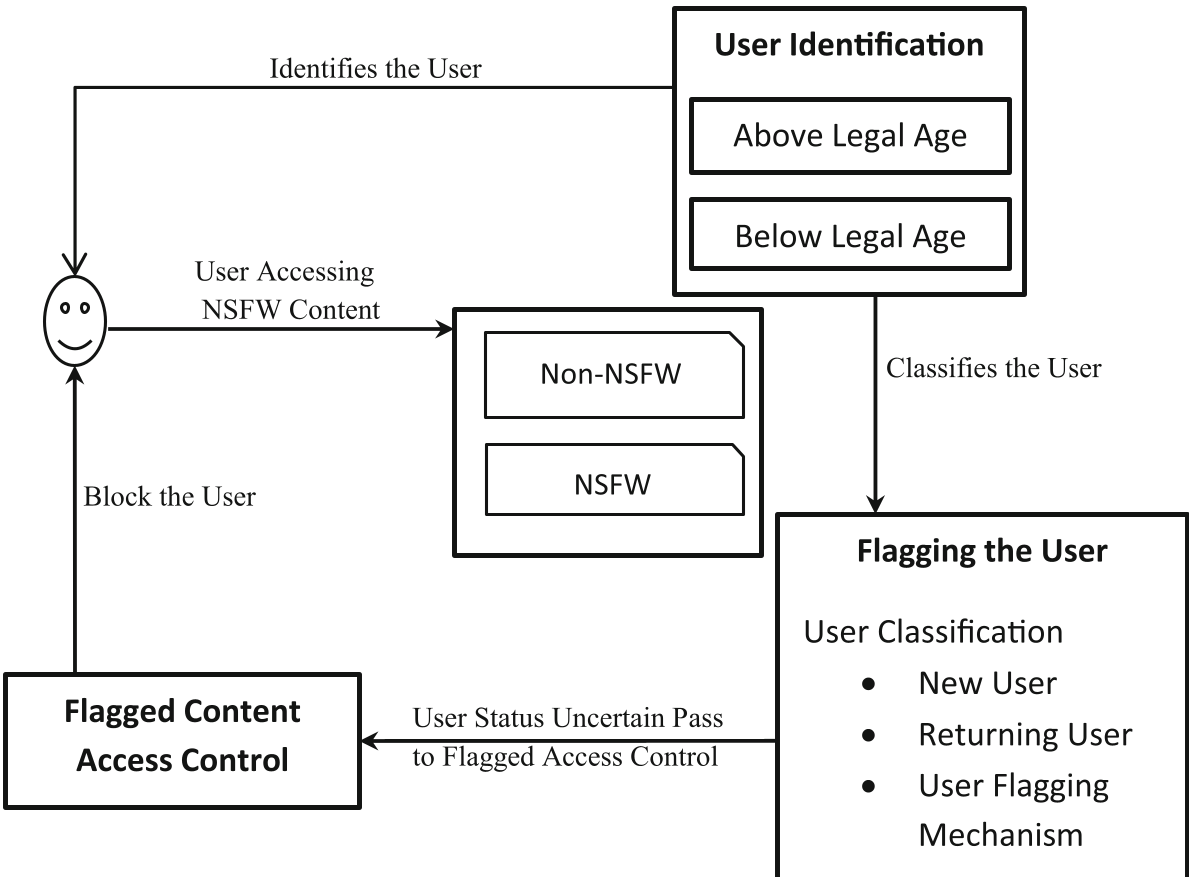
The proposed system moves away from simple "Yes/No" filters toward a state-machine approach consisting of three phases:
1. User Identification
The system maps users () to web links () using a surjective function. It identifies users via a unique tuple: . Even anonymous users are tracked using their MAC ID () and IP address ().
2. The Flagging Mechanism
- New Users: Prompted for DOB. If they meet age requirements, their status is set to (authorized).
- Returning Users: If an anonymous user visits frequently, the system checks for DOB consistency. If a user provides different birthdates across sessions, they are moved to (flagged).
- Timestamp Logic: To prevent a child from using a parent's logged-in session, the system implements an automatic logout and forces re-verification.
3. Access Control
The system calculates an Activity Value (av) based on the frequency and nature of flagged content requests. Once exceeds a threshold (), the specific {IP, MAC} combination is blocked from NSFW content indefinitely.
Experiments & Performance
The researchers tested the model against four cases of varying scale (25 to 100 users), including Registered Genuine Users (RGU), Anonymous Genuine Users (AGU), and Non-Genuine Users (NGU/Minors).
Key Results:
- Identification Speed: Non-genuine users with inconsistent credentials were typically caught and blocked within 2 to 4 attempts.
- Stability: System accuracy stabilizes after the 8th attempt, signaling that the watchdog "learns" user patterns effectively over a short period.
- Accuracy: The cumulative average accuracy was 0.78. The slight dip below 1.0 is primarily due to the difficulty in distinguishing "Anonymous Genuine Users" from sophisticated non-genuine ones.
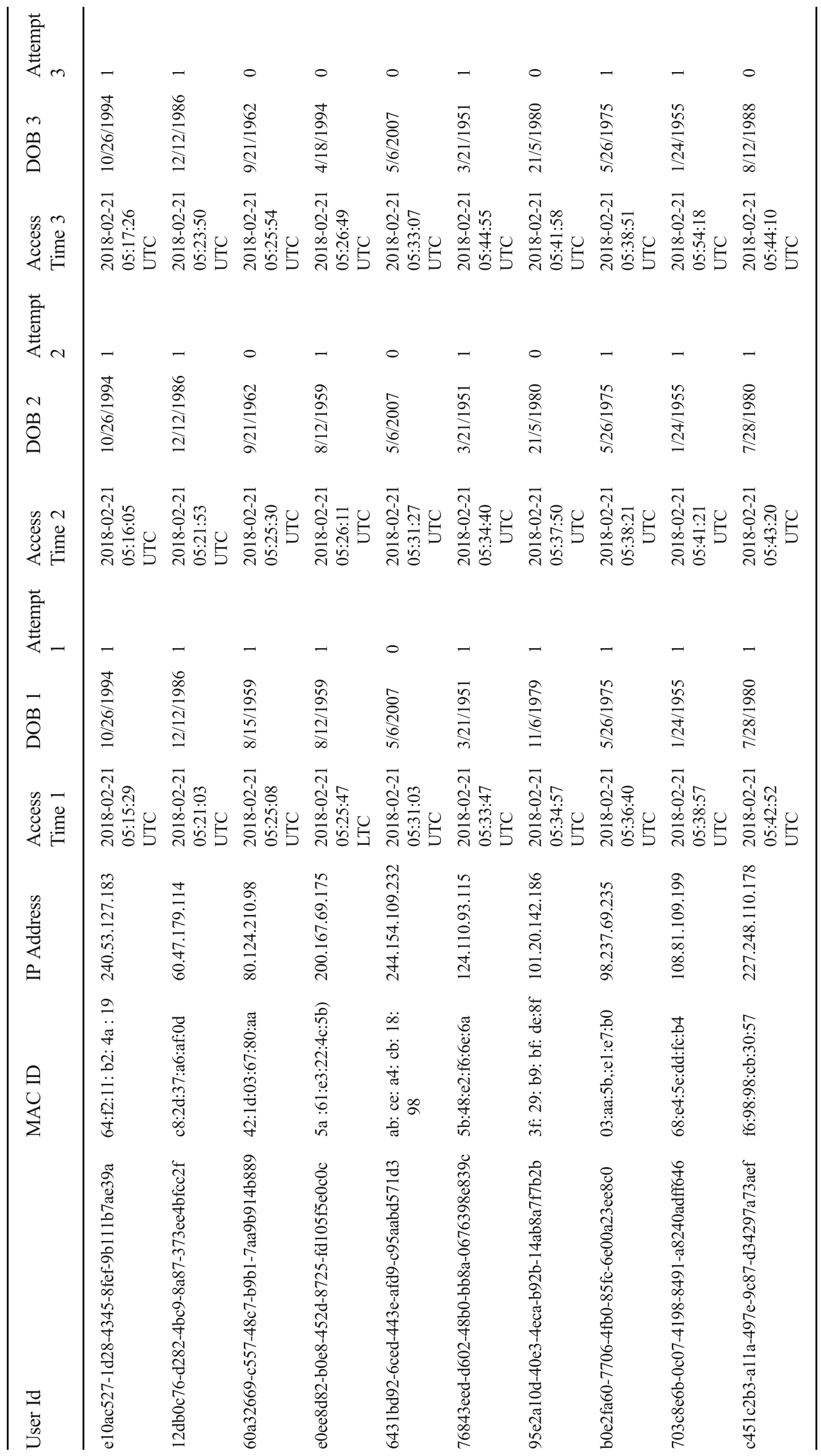 Above: Example of how the system tracks inconsistent DOB entries to flag suspicious users.
Critical Insight & Future Work
The real value of this work lies in its device-agnostic nature. Because the watchdog resides on the server/ISP level, a minor cannot escape the filter by switching from a laptop to a smartphone, a common loophole in client-side software.
Limitations: The reliance on MAC addresses is a potential weak point in an era of MAC randomization (often used by modern iOS and Android versions for privacy). Additionally, the system currently struggles slightly with legal users who prefer to remain anonymous (AGU).
The Future: The authors suggest that integrating Blockchain for user profiles could further enhance security and privacy, creating a tamper-proof ledger of age verification that doesn't sacrifice the user's actual identity.
Summary: This paper provides a robust framework for content moderation that prioritizes behavioral consistency over easily bypassable local rules. It’s an essential step toward a "Global Watchdog" for internet safety.