
Adult or Child? Decoding Age Through Smartphone Touch Signatures
Adult or Child: Recognizing through Touch Gestures on Smartphones
This paper presents a user identification study focused on distinguishing between children and adults based on smartphone touch gestures. By analyzing six fundamental gestures from 60 participants, the researchers developed a supervised machine learning framework that can automatically identify if a child is using the device with up to 86.66% accuracy.
TL;DR
Can your phone tell if a toddler is holding it just by the way they swipe? This study proves it can. By capturing the unique "touch signatures" of 30 children and 30 adults, researchers developed an implicit identification system that achieves over 86% accuracy, specifically identifying children under six years old without requiring a single password.
Context & Positioning
In the landscape of Human-Computer Interaction (HCI), this work sits at the intersection of Behavioral Biometrics and Child-Computer Interaction. While most security research focuses on who the specific user is (authentication), this paper focuses on what group the user belongs to (classification), positioning itself as a foundational step toward "age-aware" smartphones that can automatically activate parental controls or child-safe modes.
The "Why": Why Children Touch Differently
The research is driven by a simple biological intuition: Motor Skills. Children under the age of 6 have different finger dexterity, hand geometry, and coordination compared to adults.
- The Problem: Parents worry about battery drainage (70%) and unwanted app access (40%).
- The Insight: Adults tend to be more precise and efficient. Children, due to developing motor control, often produce more "noise" in their gestures—more touch points, more distance from the center of buttons, and wider variances in movement.
Methodology: The Core Mechanism
The researchers designed a custom Android application to capture six basic gestures: Tap, Swipe, Rotation, Slide, Zoom In, and Zoom Out.
Feature Extraction
For every gesture, the system doesn't just look at where the finger landed; it analyzes the entire Touch Signature—a sequence of (x, y) coordinates. They extracted 11 features per task, including:
- Number of touches (data points captured per gesture)
- Coordinate Extremes (Max/Min X and Y)
- Statistical Deviations (Standard Deviation and Mean Absolute Deviation of X/Y)
Model Architecture
The problem was treated as a Supervised Binary Classification task. Since the dataset (60 subjects) is relatively small for Deep Learning, the authors utilized classical Machine Learning models:
- Logistic Regression (Checking for linear separability)
- Support Vector Machines (SVM) (Effective in high-dimensional feature spaces)
- K-Nearest Neighbors (KNN)
- Decision Trees
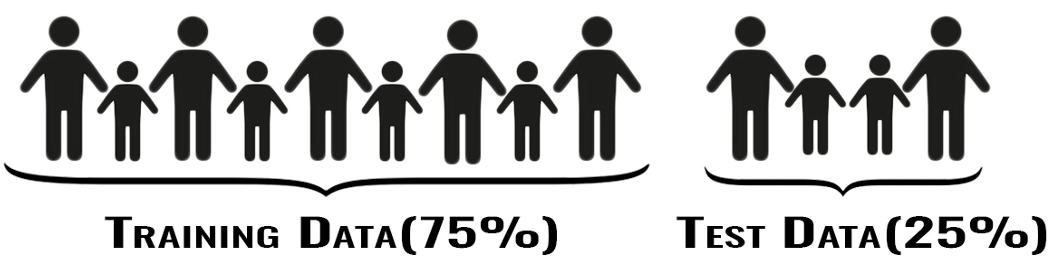 Figure 1: The workflow of data split and classification for adult vs. child identification.
Experimental Insights & Results
The study revealed that not all gestures are created equal when it comes to identifying age.
1. The Power of the "Swipe"
The "Swipe" task (drawing a plus sign) was the star performer.
- Adults: Averaged ~51 touches.
- Children: Averaged ~117 touches.
- Why? In unconstrained tasks, children show significantly more "hand jitter" and less direct paths, making the swipe a perfect biometric marker.
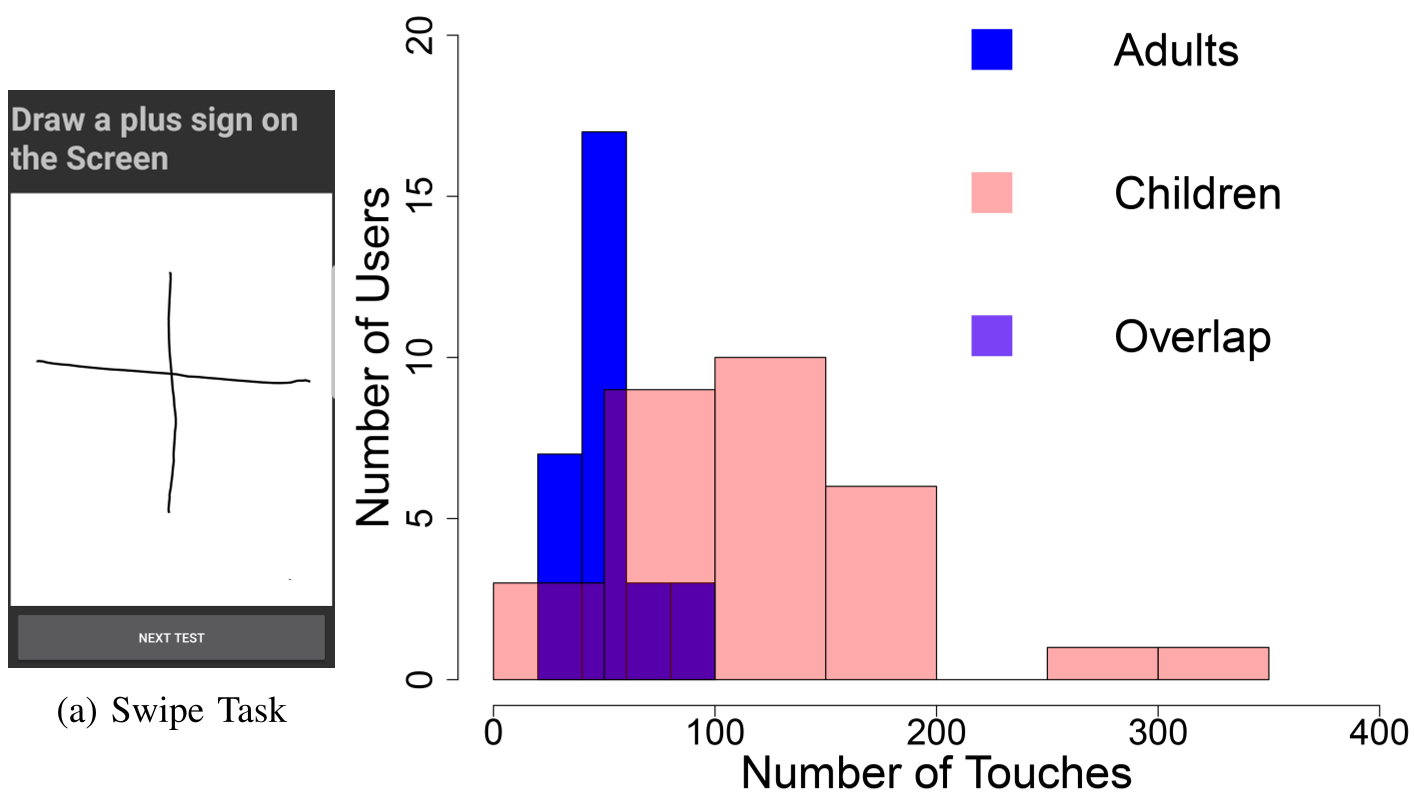 Figure 2: Distribution of touches in the Swipe task, showing a clear separation between user groups.
2. The Precision of the "Tap"
In the Tap task, adults were much more centered. Children’s taps were, on average, 8.3 pixels further from the target center than adults, highlighting the difference in fine motor control.
3. Classification Performance
| Model | Feature Set | Accuracy | Precision |
|---|---|---|---|
| Logistic Regression | Swipe Only | 86.66% | 92.00% |
| SVM | Combined Tasks | 86.66% | 100.00% |
The SVM model on combined tasks reached a 100% Precision, meaning when the system identified someone as a child, it was never wrong—a crucial requirement for parental control software to avoid frustrating adult users.
Critical Analysis & Future Outlook
Limitations
The study notes that highly constrained tasks (like Zooming or Rotating to a specific target) actually reduce the differences between adults and children. When the interface forces a specific movement, the "behavioral signature" is masked by the UI constraints.
Takeaway
The value of this paper lies in its proof-of-concept for Seamless Authentication. Future smartphones could potentially run this classification in the background during the first few seconds of use, automatically switching to a "Kids Mode" without the child ever seeing a lock screen.
Future Work
The next frontier is "In-the-wild" data. Real-world usage involves walking, different holding angles, and various emotional states, all of which will test the robustness of these touch signatures.