
Dynamic Skies: Optimizing MEC and Social Caching in UAV-Assisted Vehicular Networks
SPECIAL SECTION ON ADVANCED BIG DATA ANALYSIS FOR VEHICULAR SOCIAL NETWORKS
This paper proposes an energy-aware dynamic resource allocation framework for UAV-assisted Mobile Edge Computing (MEC) within Social Internet of Vehicles (SIoV). The core method jointly optimizes vehicle transmit power and UAV trajectories using dynamic programming and a localized search algorithm to maximize total system utility, encompassing computation and social content caching.
TL;DR
The Social Internet of Vehicles (SIoV) demands high-intensity computation and rapid content delivery. This paper introduces a dynamic, energy-aware framework that uses UAVs as "flying RSUs." By jointly optimizing vehicle power and UAV flight paths, the researchers achieved significant improvements in total utility compared to fixed-trajectory baselines.
Context: The SIoV Bottleneck
Modern vehicles are no longer just transport pods; they are social nodes. From real-time navigation to media sharing, the computational load is massive. However, OBUs have limited "brains," and fixed Roadside Units (RSUs) are expensive to blanket everywhere. UAVs offer a flexible solution, but their mobility introduces a complex math problem: How do we move the UAV and manage vehicle power simultaneously to keep the network efficient?
Methodology: The Three-Layer Solution
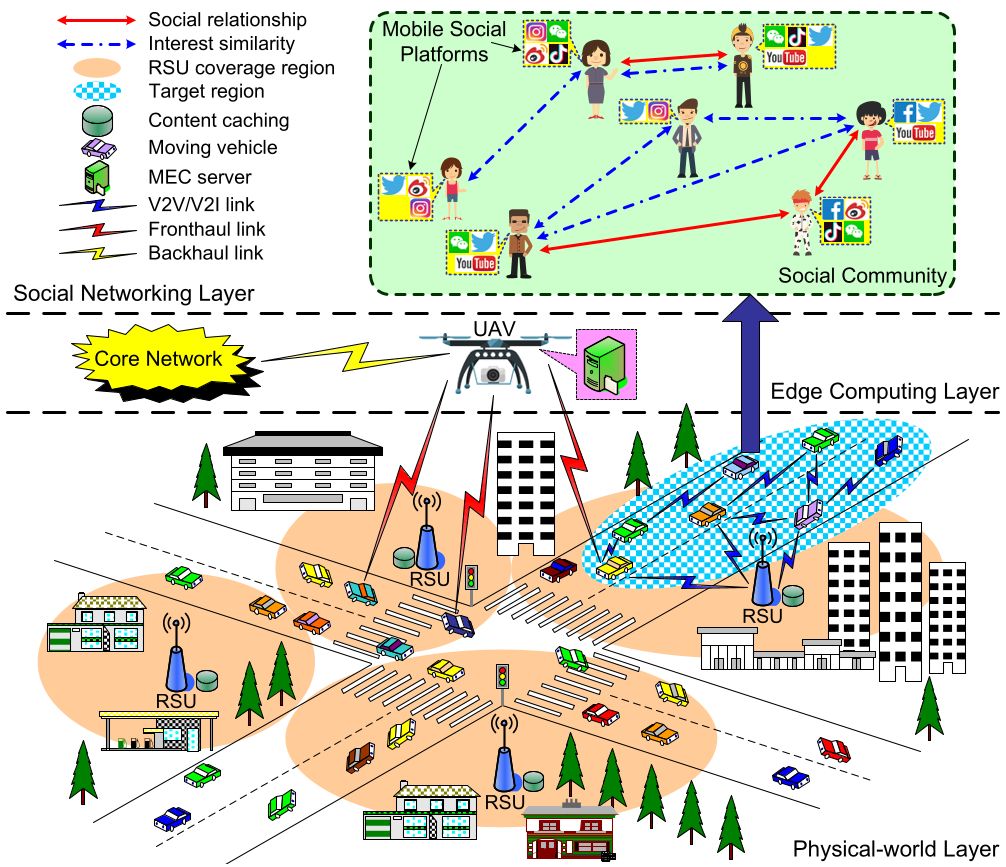
The authors propose an integrated architecture:
- Physical Layer: V2V and V2I communications.
- Edge Computing Layer: UAV-mounted MEC servers handling offloaded tasks.
- Social Networking Layer: Analyzing social ties and content popularity to manage caching.
1. Social Content Caching
The paper introduces a "Popularity Factor" () based on Access Efficiency (AE). If a content is socially popular, it's cached in the RSU to reduce backhaul latency.
2. Joint Optimization Framework
The core challenge is solving for (Transmit Power) and (UAV Trajectory). Since the problem is non-convex, the authors split it:
- Sub-problem A (Power): Using Bellman's Dynamic Programming, they derive optimal power for two scenarios: Non-cooperation (selfish vehicles) and Cooperation (socially aligned groups).
- Sub-problem B (Trajectory): A search algorithm adjusts the UAV's position based on a ground-distance metric to maximize the bits offloaded.
Insights from Experiments
The experiments simulated vehicles moving along a 150m road segment. Key findings included:
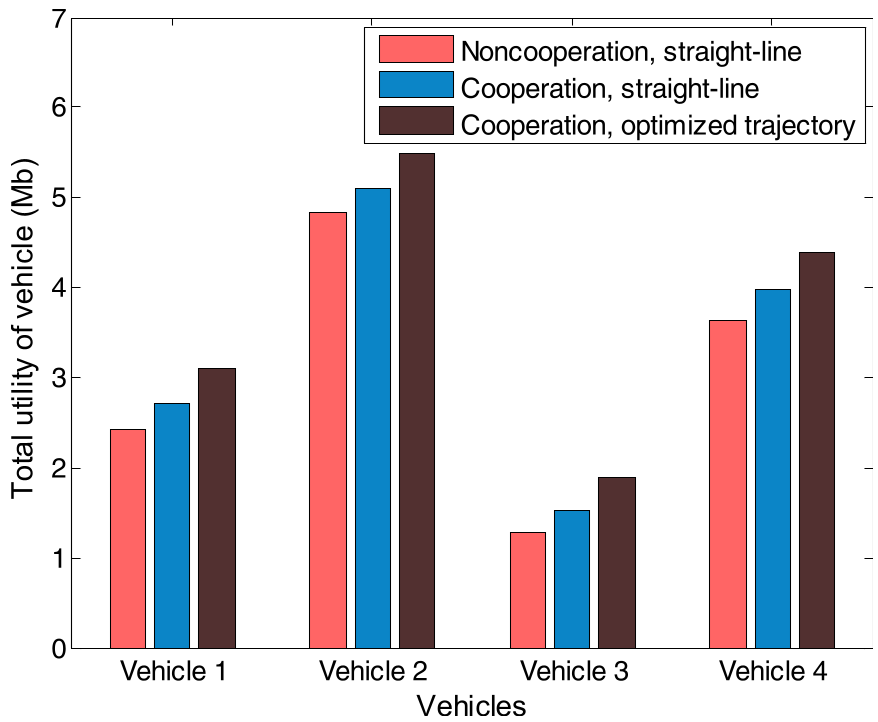
- Trajectory Matters: Pre-determined paths (like circles or straight lines) are sub-optimal. The "Optimized" path dynamically adjusts to vehicle clusters, maximizing the Signal-to-Noise Ratio (SNR).
- The Cooperation Dividend: When vehicles cooperate, the total transmit power required is lower than in competitive settings, preserving vehicle battery life.
- Altitude Sensitivity: Higher UAV hovering altitudes () increase path loss. The study suggests keeping UAVs as low as safely possible to maintain high data rates.
Critical Analysis & Conclusion
While this work provides a robust mathematical foundation using Dynamic Programming, it assumes a linear differential equation for energy consumption—an idealization of battery physics.
Future Work: The authors point toward refining these energy models and potentially integrating AI/Machine Learning to handle the high-dimensional state space of even larger vehicular fleets.
Key Takeaway
For 6G and future smart cities, UAVs won't just be "delivery drones"; they will be dynamic extensions of the cloud, positioned precisely where our social and computational needs are highest.