
VSEC: Optimizing Vehicular Social Edge Computing through Strategic Resource Management
SPECIAL SECTION ON ADVANCED BIG DATA ANALYSIS FOR VEHICULAR SOCIAL NETWORKS
This paper introduces the Vehicular Social Edge Computing (VSEC) architecture, a framework that integrates edge computing and social networking to optimize resource management in vehicular networks. By leveraging a two-stage optimization process using Lagrangian theory, the scheme achieves maximized network utility and minimized processing latency for multi-resource tasks (CPU, RAM, and Storage).
TL;DR
To tackle the latency and bandwidth issues of centralized vehicular clouds, this paper proposes Vehicular Social Edge Computing (VSEC). By merging edge processing with social cooperative incentives, the authors develop a two-stage mathematical framework that minimizes delay and maximizes network utility for CPU, RAM, and Storage tasks simultaneously.
Background & Motivation: Moving Beyond the Cloud
Modern vehicles are essentially mobile sensor hubs (GPS, cameras, infotainment), generating massive data volumes. Uploading all this to a centralized cloud is inefficient—it's slow and clogs the core network.
While Vehicular Edge Computing (VEC) attempts to solve this by moving compute to the "edge," it often lacks:
- Social Cooperation: A mechanism to incentivize drivers to share local resources.
- Holistic Resource Management: Most models focus only on CPU, ignoring the interplay between RAM and Storage requirements.
The authors introduce VSEC to bridge these gaps, viewing the vehicular network as a social ecosystem where resources are managed as a multi-dimensional pool.
Methodology: The Two-Stage Lagrangian Optimization
The core of the paper is a two-step optimization process designed to balance user budget with system performance.
Stage 1: Payment Optimization
The goal is to minimize total processing time. Given a fixed budget for user , the model determines the optimal payment to each edge device for specific resources.
Stage 2: Utility Maximization
Once the optimal payments are known, the system must decide exactly how much CPU, RAM, and Storage to allocate. The utility model follows an elastic service logic: This ensures diminishing returns for resource allocation, promoting fairness across users.
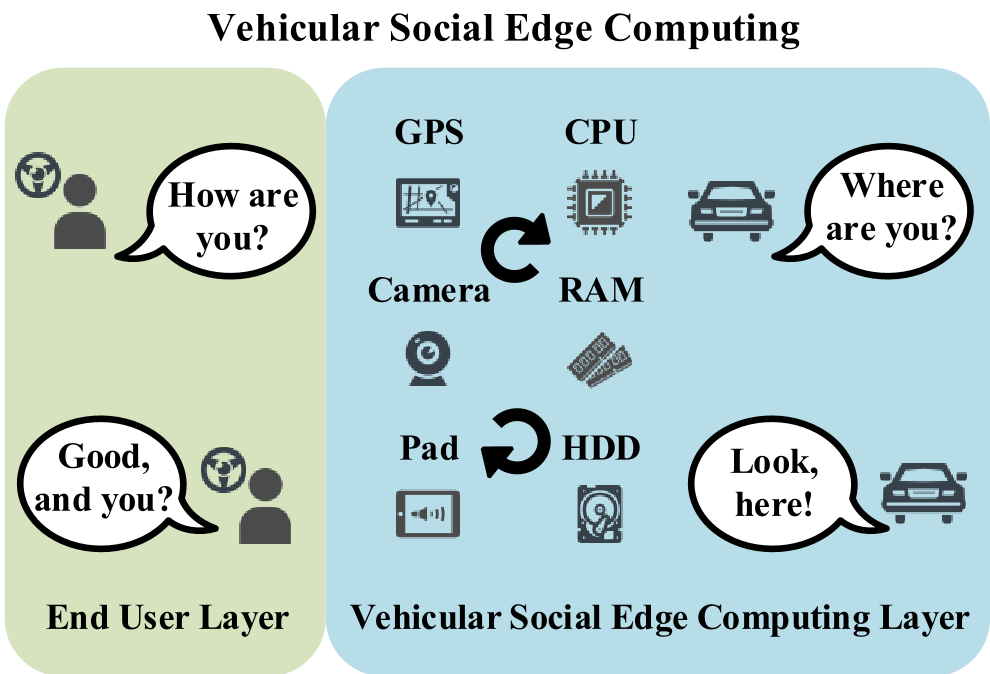 Figure 1: The hierarchical VSEC architecture showing the interaction between end-users and the vehicular edge layer.
Experimental Insights
The researchers tested the model across different scenarios: Identical Prices vs. Hierarchical Prices (where different edge nodes charge differently).
- Budget Sensitivity: As a user’s total budget increases, the shared budget for all resources increases proportionally to reduce processing time.
- Price Resilience: Interestingly, the simulation showed that the budget allocation trends are remarkably similar regardless of whether prices are identical or hierarchical. Users naturally shift more budget to "expensive/dominant" resources to ensure task completion.
- Resource Fairness: Even with varying payments, the resource sharing trends across 10 different users remained consistent, indicating a stable and predictable system behavior.
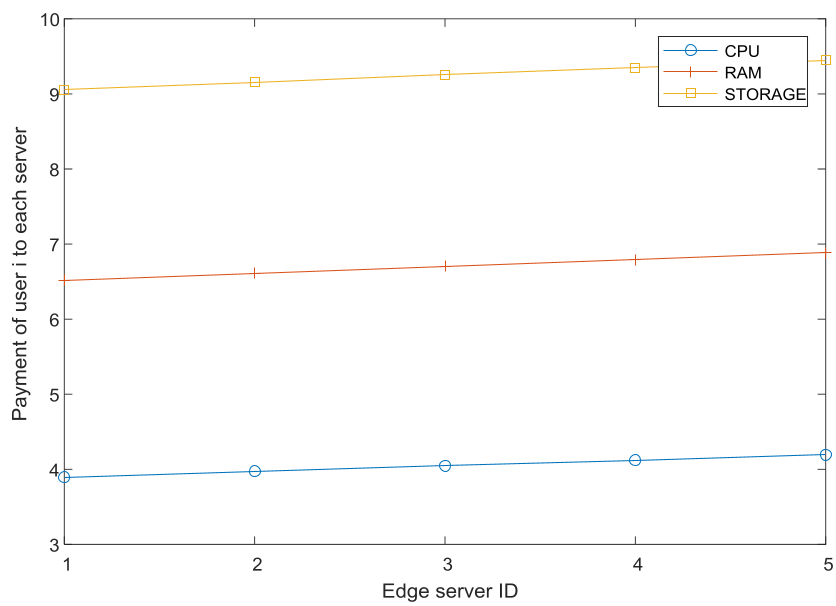 Figure 2: User payment distributions under varying resource costs, highlighting the system's adaptive nature.
Critical Perspective: Stationary vs. Dynamic
The mathematical rigor of the Lagrangian closed-form solutions is the highlight of this work—it provides a deterministic way to allocate resources without computationally heavy iterations.
However, the current model assumes a stationary situation. In a real-world highway or urban environment, the "social edge" is highly dynamic. The topology changes as cars move in and out of range. While VSEC provides the foundation, future iterations must integrate mobility models (e.g., Markov chains or Reinforcement Learning) to maintain utility as vehicles travel.
Conclusion
VSEC represents a significant step toward "Social IoT." By treating vehicles not just as data generators, but as cooperative nodes in a social edge, we can achieve substantial gains in Intelligent Transportation Systems (ITS) and mobile infotainment.
Index Terms: Edge computing, network utility, social activity, vehicular network.