
SoInfRec: Beyond Static Links — Leveraging Direct Interactions for Social Recommendation
SPECIAL SECTION ON ADVANCED DATA ANALYTICS FOR LARGE-SCALE COMPLEX DATA ENVIRONMENTS
This paper introduces SoInfRec, a social recommendation framework that integrates direct user interactions into matrix factorization. By quantifying Microscopic Social Influence (MISI) from interpersonal interactions and Macroscopic Social Influence (MASI) from network-wide presence, the model significantly outperforms SOTA baselines in rating prediction accuracy.
TL;DR
Most social recommender systems assume that because you "follow" someone, you share their tastes. SoInfRec challenges this by proving that direct interactions—specifically mentions and comments—are far more accurate predictors of influence than simple links. By introducing Microscopic and Macroscopic influence weights into Matrix Factorization, this model reduces recommendation error (RMSE) by up to 9.2% over previous SOTA methods.
Problem & Motivation: The Illusion of Friendship
In the world of social media, "friends" aren't always influential. Current systems often rely on indirect factors such as community detection or static trust links. This creates a significant bias:
- Invalid Links: You might follow a celebrity or an old high school friend but haven't interacted with them in years. Treating their preferences as relevant to yours creates noise.
- Unidirectional Influence: Influence is rarely equal. A "mention" or a "comment" represents an active engagement that signals a much stronger alignment of interests than a passive follow.
The authors observed that while reposts are frequent, they don't necessarily correlate with shared interests. However, mentions and comments follow a specific mathematical trend (hyperbolic tangent) relative to user similarity, providing a "smoking gun" for measuring real influence.
Methodology: The Dual-Influence Framework
The core of the paper is the division of influence into two distinct scales, integrated into a Matrix Factorization (MF) objective function.
1. Microscopic Social Influence (MISI)
MISI focuses on the pair-wise interaction. The authors use a tanh function to transform the raw count of mentions () and comments () into an influence score.
This score, combined with Vector Space Similarity (VSS), ensures that only friends who actually interact and share similar tastes get to influence the recommendation.
2. Macroscopic Social Influence (MASI)
MASI measures a user’s global authority. Using the number of followers as a proxy, the model assigns a global weight to the loss function. Users with high MASI (the "influencers") are given more weight during the training of the latent feature space because their preferences propagate further across the network.
 Figure: The SoInfRec training algorithm integrating MISI and MASI calculations.
Experiments & Results: Performance Leap
The model was tested on real-world data from the Tencent Microblog (KDD Cup 2012).
SOTA Comparison
SoInfRec was compared against standard baselines (UserAvg, ItemAvg) and advanced models like RSTE, SocialMF, and SoReg.
- Accuracy: SoInfRec consistently achieved the lowest MAE and RMSE across all training data splits (65%, 75%, 85%).
- RMSE Improvement: On Dataset 1, with 85% training data, SoInfRec improved RMSE by 9.2% compared to the strongest baseline (RSTE).
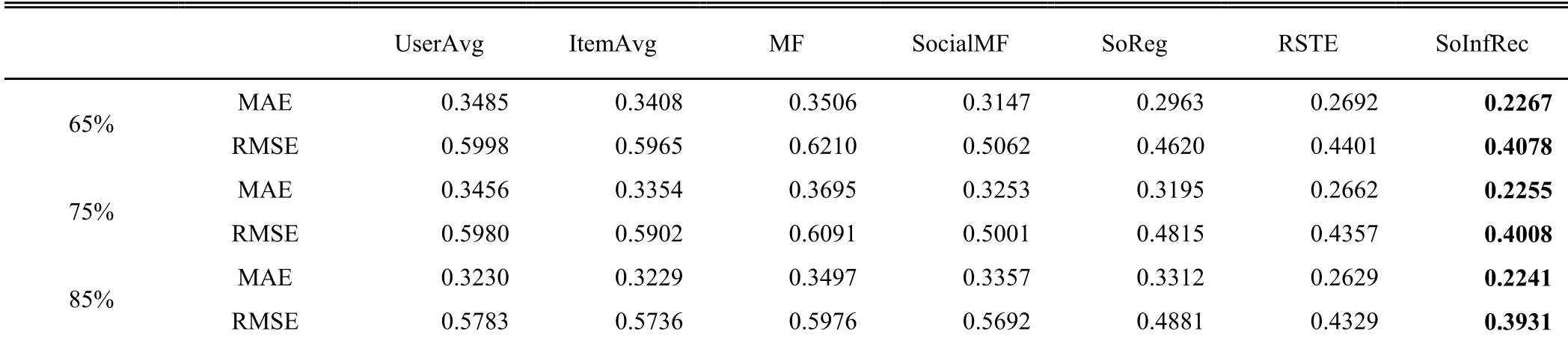 Table: Accuracy results showing SoInfRec's dominance in MAE and RMSE.
Convergence Speed
Beyond accuracy, SoInfRec demonstrates superior efficiency. The inclusion of influence weights helps the Stochastic Gradient Descent (SGD) find the optimal latent vectors for users () and items () much faster than the Probabilistic Factor Analysis used in RSTE.
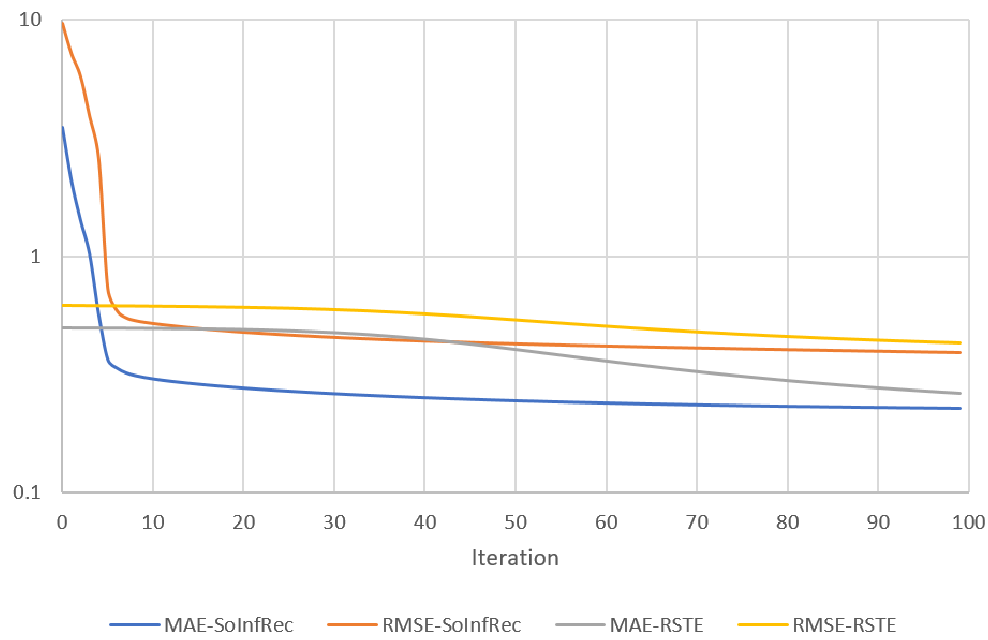 Figure: Convergence speed comparison showing SoInfRec reaching lower error rates in fewer iterations.
Critical Insight & Conclusion
The fundamental takeaway of this work is that link density does not equal influence density. By filtering "social noise" through direct interaction analysis (MISI) and recognizing network hierarchy (MASI), SoInfRec creates a more faithful representation of how social information actually flows.
Limitations: The model currently treats all comments and mentions with equal weight. Future iterations could benefit from Sentiment Analysis—if a user comments negatively on a post, the MISI should reflect a divergence in interest rather than a convergence.
Future Outlook: Integrating these microscopic interaction features into Graph Neural Networks (GNNs) could further capture the multi-hop propagation of influence in even more complex, real-time social ecosystems.