
SIoT Optimization: Maintaining Global Reachability in a Trillion-Object World
Advanced Heuristics for Selecting Friends in Social Internet of Things
This paper introduces four advanced heuristics for friend selection in the Social Internet of Things (SIoT) to enhance network navigability while managing computational constraints. The proposed strategies (Friendship Suggestion, Oldest Friend Removal, and Priority-based Selection) aim to maintain a high "Giant Component" while restricting the maximum number of connections (Nmax) for heterogeneous IoT nodes.
TL;DR
With the Internet of Things transitioning into the Social Internet of Things (SIoT), devices now form autonomous "friendships" to share services. However, too many friends crash the system. This paper provides four advanced heuristics to prune these connections without breaking the network's "Small World" connectivity, ensuring every device remains reachable through short paths.
The Problem: The SIoT "Friendship Explosion"
In a world where even your coffee maker and food packages are addressable nodes, SIoT leverages the Small World Phenomenon—the idea that any two nodes are separated by only a few "handshakes."
The dilemma is that searching for services across trillions of objects is computationally expensive. If a node keeps too many friends, its memory and processing power are overwhelmed. But if it prunes friends indiscriminately, the network fragments into isolated islands, and services become undiscoverable. Existing methods (like simply capping the number of friends) often fail because they don't consider the "Giant Component"—the set of nodes that are globally reachable.
Methodology: Pruning with Intelligence
The authors suggest that we shouldn't just delete friends; we should manage them like a dynamic social network. They propose four key strategies:
- Friendship Suggestion (Strategies I & II): When a node must remove a friend because it reached its limit (), it doesn't just cut the cord. If is about to become isolated (degree 0), suggests to its other 1-hop or 2-hop neighbors.
- Oldest Friend Removal (Strategy III): Based on the insight that IoT devices are often mobile, this strategy removes the oldest connection to make room for new, potentially more relevant topological links.
- The Combined Approach (Strategy IV): It merges the suggestion mechanism with the removal of the oldest friend.
- Priority-Based Selection (Strategy V): This mimics real-world logic—nodes keep friends based on the frequency of communication, service quality, or security trust scores.
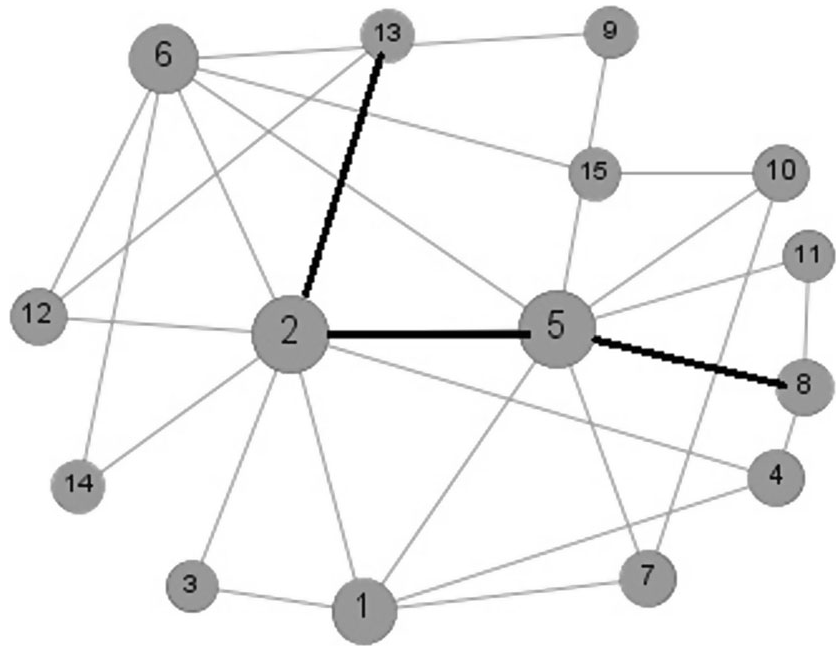 Figure 1: A decentralized search path from node 8 to node 13 via mutual friends.
Experiments & Results
The researchers used the Barabási–Albert (BA) model to simulate a scale-free network of 15,000 nodes. This model is crucial because it mimics human social networks where "the rich get richer"—or in this case, the highly-connected nodes (hubs) stay connected.
Key Findings:
- Connectivity (Giant Component): The proposed Strategy-II significantly outperformed the existing "Maximum Clustering" heuristic. While traditional methods led to network fragmentation, the suggestion-based approach kept the Giant Component near 100%.
- Latency (Average Path Length): Even as connections were strictly limited to , the average path length remained between 4.5 and 6.5, confirming that the "Six Degrees of Separation" holds even in pruned IoT networks.
- Resource Efficiency: By keeping the average degree low (around 10), the strategies ensure that even low-power sensors can participate in the SIoT without running out of memory.
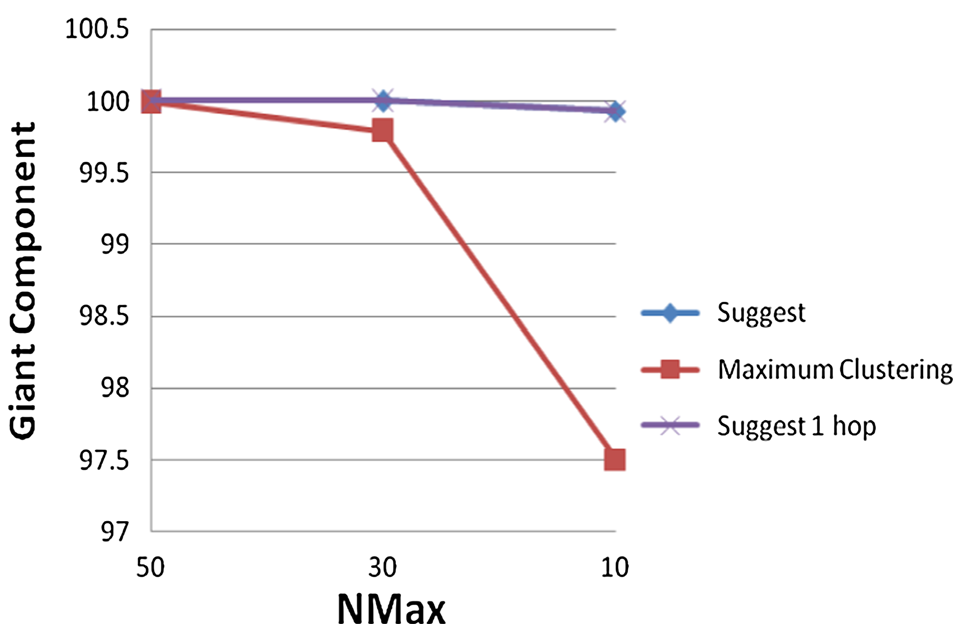 Figure 2: The proposed strategies (i and ii) maintain a much higher giant component than traditional max-clustering pruning.
Critical Insight & Conclusion
The genius of this work lies in the Suggestion Mechanism. By treating the network as a living structure where "leaving" a friend means "introducing them to someone else," the network maintains its Navigability.
Takeaway: In future IoT deployments, we cannot treat connections as static. We need "socially aware" algorithms that understand that the strength of a network isn't just how many connections a node has, but how well those connections preserve the global path to everyone else.
Limitations: The paper primarily uses random priorities for its fifth strategy. Future work should integrate actual Trust and Security metrics into these heuristics to see how malicious nodes might impact navigability.