
SecDefender: Winning the Adversarial Arms Race in Malware Detection
Adversarial Machine Learning in Malware Detection: Arms Race between Evasion Attack and Defense
This paper investigates the adversarial arms race in malware detection, focusing on evasion attacks against machine learning classifiers. It introduces EvnAttack, a bi-directional feature manipulation strategy, and SecDefender, a secure-learning paradigm that combines progressive retraining with a security regularization term to achieve SOTA resilience against adversarial samples.
TL;DR
The security of machine learning (ML) models is under fire as malware authors shift from simple code obfuscation to "Adversarial Machine Learning." This paper introduces EvnAttack, a sophisticated evasion strategy that mimics benign software behaviors, and SecDefender, a defensive framework that uses Security Regularization to make it mathematically expensive for malware to hide. SecDefender successfully restores detection F1-scores to over 95% even when under heavy adversarial siege.
Problem: The Fragile Assumption of IID
Most ML-based malware detectors rely on the assumption that training and testing data are "Independently and Identically Distributed" (IID). In the real world, an adversary actively violates this. By subtly adding "benign" API calls (like RegCloseKey) or removing "malicious" ones (like CreateFileW), an attacker can shift a malware sample across the decision boundary into the "benign" zone without changing the file's actual destructive capability.
Methodology: The Core Innovations
1. EvnAttack: Bi-directional Manipulation
Instead of random noise, EvnAttack uses Max-Relevance scores to prioritize features. It performs a bi-directional search:
- Forward Addition: Injecting API calls that characterize benign software.
- Backward Elimination: Removing API calls that are "red flags" for malware.
This greedy wrapper approach ensures maximum detection drop with minimum "evasion cost" (the number of changes made).
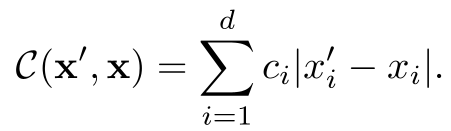 Evasion cost formula: Balancing manipulation vs. functionality preservation.
2. SecDefender: Hardening the Decision Boundary
Standard retraining makes a model "see" the attack, but often at the cost of precision. SecDefender introduces a Security Regularization Term ().
The intuition here is brilliant: by adding a cost penalty to the optimization problem, the model learns a decision boundary that is physically farther away from the points that are "cheap" to modify. To evade SecDefender, an attacker would have to change so many features that the malware would likely break or become fundamentally different.
 The modified objective function: Integrating security directly into the learning process.
Experiments & Results
The authors tested their methods against 10,000 samples from the Comodo Cloud Security Center.
- The Attack Impact: A standard classifier (OrgDefender) saw its False Negative Rate (FNR) skyrocket from 3.96% to nearly 70% under EvnAttack with a maximum cost of 22 manipulations.
- The Defense Recovery: SecDefender brought the F1 measure back to 0.9561, nearly matching the pre-attack performance of 0.9613.
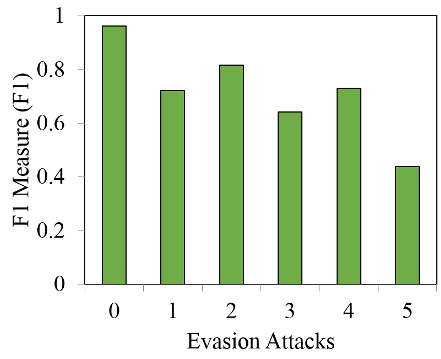 Experimental Comparison: SecDefender (red line) shows significantly better F1 recovery compared to standard retraining (blue line).
Competitive Analysis
In a head-to-head scan against industry giants like McAfee and Kaspersky using the same adversarial samples, SecDefender achieved a True Positive Rate (TPR) of 0.9335, outperforming all tested commercial products. This suggests that "security-aware" training is currently more effective than signature-based or standard heuristic updates used by traditional vendors.
Critical Insight: The Value of Evasion Cost
The most important takeaway of this work is the formalization of Evasion Cost. In the world of cybersecurity, perfect security is impossible; the goal is to make the cost of an attack higher than the gain. By treating "security" as a measurable regularization term rather than a checkbox, we can build ML models that are natively resilient.
Limitations: The study focuses on Windows API calls. While highly effective, future work should address "feature-less" or "raw-byte" based deep learning models where feature relevance is harder to interpret manually.
Conclusion
As AI becomes the backbone of cybersecurity, adversarial robustness is no longer optional. SecDefender provides a mathematically grounded blueprint for building classifiers that don't just detect malware, but actively resist being fooled by it.