
ADETermino: Automating Medical Safety through Multi-class SVM and Ontology Population
An Adverse Drug Events Ontology Population from Text Using a Multi-class SVM Based Approach
This paper introduces ADETermino, an automated system for populating Adverse Drug Events (ADE) ontologies by extracting concept instances and relationships from textual drug leaflets. The approach combines a dictionary-based Named-Entity Recognition (NER) system for entities (drugs, diseases, classes) with a multi-class Support Vector Machine (SVM) classifier to detect complex medical relations, achieving a SOTA-level F-score of 89% on cardiac drug data.
TL;DR
Knowledge in the medical domain is expanding faster than humans can catalog it. This paper presents ADETermino, an automated approach to populate Adverse Drug Event (ADE) ontologies using information extraction from drug leaflets. By merging dictionary-based entity recognition with a sophisticated 17-class SVM classifier, the authors achieve an 89% accuracy in identifying critical warnings and prohibitions that prevent medical errors.
Problem & Motivation: The Bottleneck in Medical Knowledge
Adverse Drug Events are not just medical risks—they are economic ones, extending hospital stays by an average of 2.2 days and costing hundreds of thousands of dollars per facility. While ontologies (structured knowledge maps) are the gold standard for managing this data, they are notoriously difficult to update.
Earlier attempts at automation focused on clinical records, which are often riddled with:
- Shorthand and cryptic abbreviations.
- Grammatically incomplete sentences.
- Noisy data from various electronic health record (EHR) systems.
The authors pivot to Drug Leaflets. Unlike clinical notes, leaflets are authoritative, structured, and contain the definitive "Warning" and "Prohibition" logic required for drug safety.
Methodology: The Hybrid Information Extraction Pipeline
The ADETermino system functions in two distinct phases:
1. Named-Entity Recognition (NER)
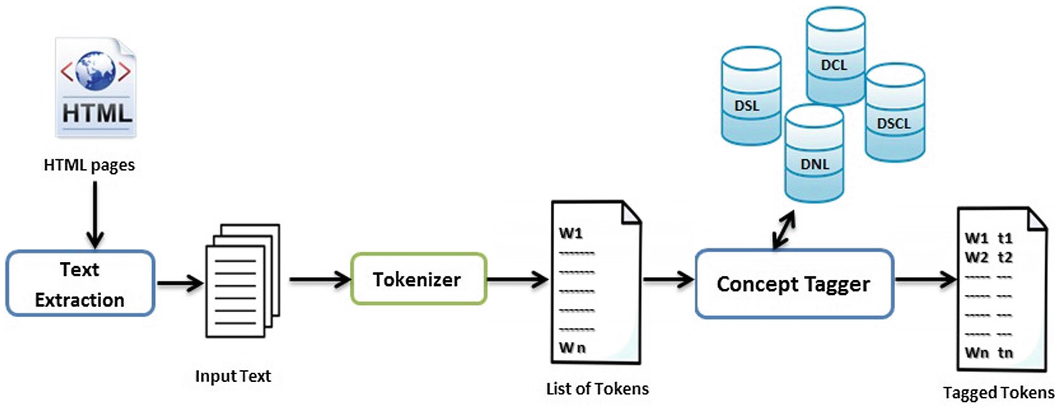
The system identifies four key entities: Drug Names, Drug Classes, Diseases, and Disease Classes. Instead of relying solely on statistical models which might hallucinate medical terms, it uses a Knowledge-Base driven approach using French medical lexica.
2. Multi-class Relation Detection
This is the core innovation. Usually, relation extraction is treated as a binary "Yes/No" interaction. ADETermino classifies relations into 17 distinct classes, distinguishing between:
- Direct Prohibitions/Warnings: "Do not use Drug A with Disease B."
- Conditioned Prohibitions/Warnings: "Do not use Drug A if Disease B presents with specific symptoms."
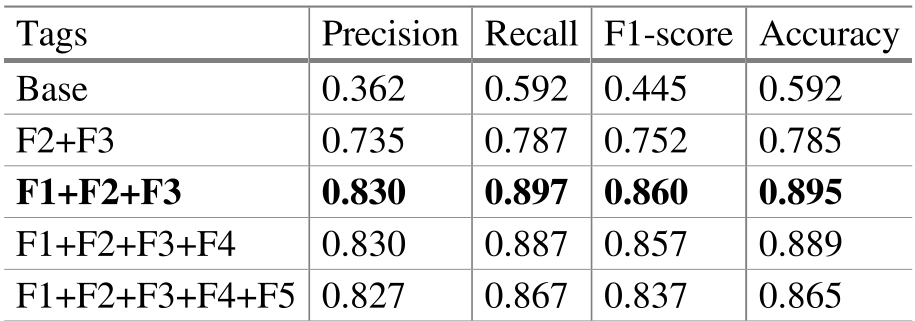
The SVM classifier relies on five strategic features:
- Window Position: Where the text snippet appears in the leaflet.
- Entity Type: Is the target a disease or another drug?
- Indicator Type: Does the sentence contain "negative" triggers?
- Distance: Number of words between the entity and the indicator.
- Exceptions: Presence of words like "except" or "unless."
Experiments & Results
The model was validated on 102 cardiac drug instructions. The results underscore the importance of feature selection in medical NLP.
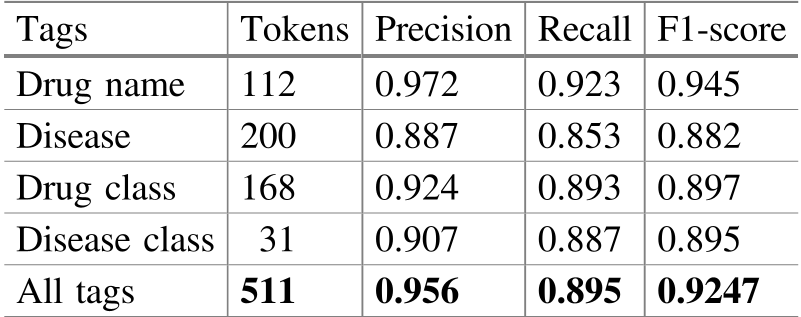
The NER system achieved a high F-Score of 0.92, proving the reliability of lexical-based tagging in specialized domains. Specifically, for relation extraction, the combination of Window Position (F1) and Indicator Type (F3) proved critical. Without these, accuracy dropped significantly to 60%, but with them, it peaked at 89.5%.
Critical Analysis & Conclusion
The ADETermino approach is highly effective because it respects the domain-specific structure of medical writing. However, the study reveals some limitations:
- Lexical Dependency: Its NER performance is bound to the completeness of its dictionaries. Missing a synonym means missing an ADE.
- Ambiguity: Natural language still poses challenges when conditions are linguistically complex, occasionally confusing "systematic" vs "conditioned" prohibitions.
Future Outlook: The authors suggest that moving toward Deep Learning (Neural Networks) and integrating Morphosyntactic analysis (to handle plurals and synonyms) could push these scores even higher. As e-health transitions to cloud-based systems like ADEPS, such automated pipelines will become the backbone of real-time clinical decision support.
Takeaway: Accuracy matters more than anything in medicine. By focusing on high-quality drug leaflets and robust SVM features, ADETermino provides a blueprint for safely scaling medical knowledge.