
Segment-Aware Sentence Classification: Unmasking the "Hidden" Ads in Content Marketing
Advertisement Extraction from Content Marketing Articles via Segment-Aware Sentence Classification
The paper proposes a novel segment-aware sentence classification framework to extract advertising content from Content Marketing (CM) articles. It introduces the Topic-Enhanced Deep Neural Network combined with a segment-aware optimization method to achieve state-of-the-art performance in identifying covert marketing sentences.
TL;DR
Researchers have developed a specialized deep learning framework to extract advertising sentences from Content Marketing (CM) articles. By combining BiLSTM-Attention with Biterm Topic Models (BTM) and a unique segment-aware optimization strategy, the model achieves a 74.1% F1-score, significantly surpassing standard text classifiers in identifying covert promotional content.
Background & Motivation: The "Advertorial" Problem
In social media ecosystems like WeChat, "Content Marketing" has evolved into an art of deception. Unlike traditional ads, CM articles start with engaging "hot spots" or news and gradually pivot to product promotion.
The technical challenges are two-fold:
- Topic Camouflage: The transition from normal content to ads is designed to be seamless.
- Class Imbalance: Advertising sentences are far fewer than normal narrative sentences (averaging only ~17 ad sentences vs ~70 normal sentences per article).
Methodology: The Architecture of Detection
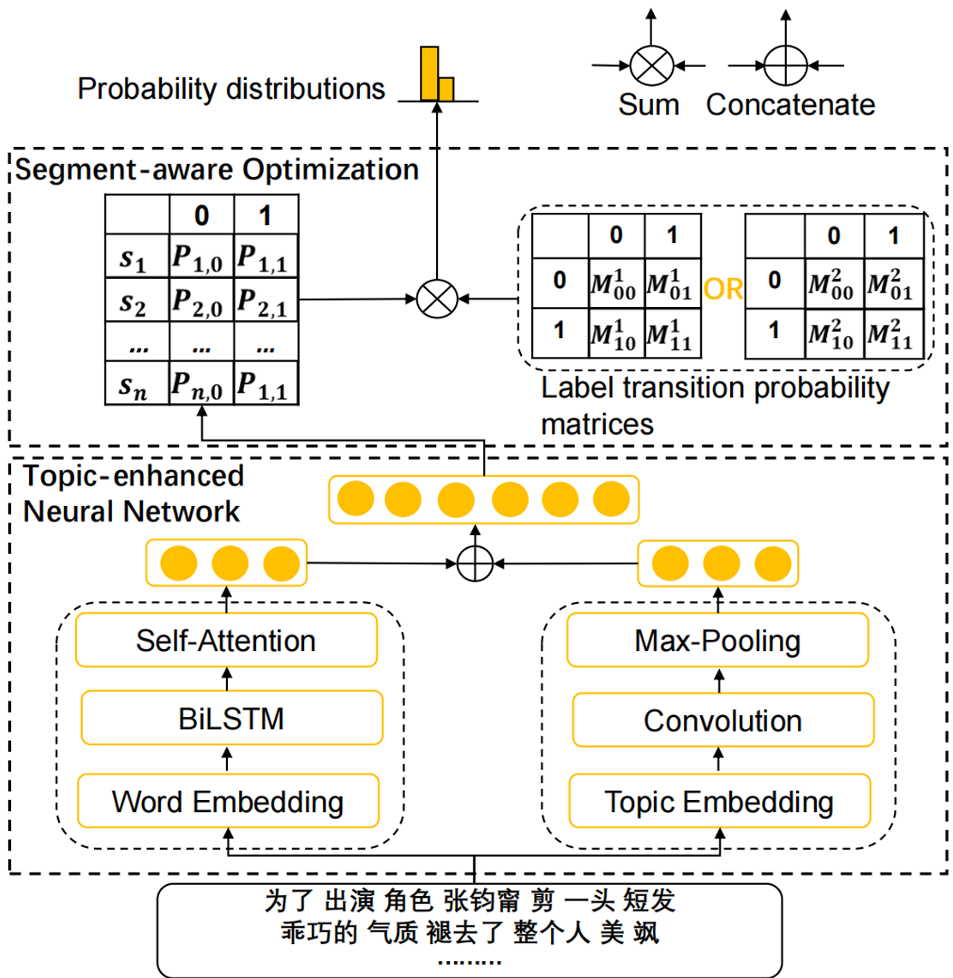
The proposed model focuses on two dimensions: what a sentence says (Semantics/Topic) and where it stays (Segment Position).
1. Topic-Enhanced Neural Network
Instead of relying solely on word embeddings, the authors use a dual-stream encoder:
- Semantic Stream: Uses BiLSTM and Scaled Dot-Product Self-Attention to capture internal sentence structure.
- Topic Stream: Employs a Biterm Topic Model (BTM) processed via a CNN to capture latent topic distributions. This helps identify the subtle "shift" in vocabulary when an author starts selling a product.
2. Segment-Aware Optimization
The most "Academic Professional" insight in this paper is the Segment-Aware Transition Matrix. Standard CRF or transition models assume the probability of one label following another is constant throughout a document.
The authors prove this is false for CM articles. They divide articles into segments (using parameter ) and calculate separate transition matrices. Since ads are significantly more likely to appear at the end (the "A -> A" transition probability peaks in the final portions), this segment-aware approach prevents the sparse ad labels from being "washed out" by the majority of normal text.
Experimental Validation
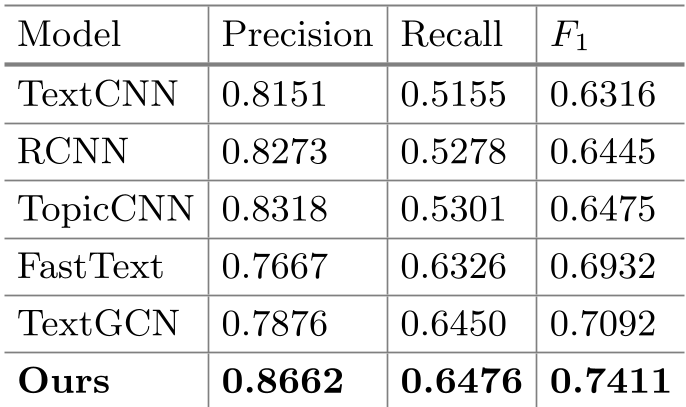
The model was tested against industry standards including TextGCN, FastText, and RCNN.
Key Findings:
- SOTA Performance: The "Full Model" reached an F1 of 0.7411, a clear margin over TextGCN's 0.7092.
- Ablation Insight: Removing the "Topic" module or the "Segment" module resulted in a drop of ~2% in F1-score each, proving they are complementary.
- The Power of Positioning: The statistical analysis confirmed that the transition probability from Normal to Ad sentences peaks at the 90th percentile of an article's length.
Critical Analysis & Future Outlook
Strengths: The methodology is grounded in a deep understanding of the human behavior behind content marketing (i.e., the tactical placement of ads). The use of BTM is an excellent choice for the short-text nature of individual sentences.
Limitations:
- The model uses a fixed segment split (). In reality, transitions are dynamic.
- The dataset size (700 articles) is relatively small for deep learning, suggesting potential for improvement with larger-scale pre-training or LLM augmentation.
Future Work: This research paves the way for "cleaner" social media feeds. Integrating this with Large Language Models (LLMs) could lead to an even more nuanced understanding of "persuasive intent," potentially identifying not just ads, but also political propaganda or biased reporting.
Conclusion
By treating an article not just as a bag of sentences, but as a structured sequence with predictable "marketing trajectories," the authors have provided a robust tool for platform integrity and user protection.