
Aegis: Bridging Social Theory and Semantic Web for Contextual Privacy
Aegis: A semantic implementation of privacy as contextual integrity in social ecosystems
This paper introduces Aegis, an ontology-based privacy framework that implements Helen Nissenbaum's Contextual Integrity (CI) theory to social ecosystems. By utilizing Semantic Web tools (OWL/SPARQL), it automatically generates default privacy policies that align with social norms across fragmented data sources like Facebook and LinkedIn.
TL;DR
Aegis is a semantic privacy framework that automates the generation of "default" privacy policies based on the theory of Contextual Integrity. By organizing social data into ontologies, it ensures that your professional contacts can't access your gaming history, and shared content remains protected without manual user intervention. It achieves this with negligible latency (approx. 10ms overhead), proving that complex social norms can be enforced at scale.
The "Default" Trap: Why Privacy Settings are Broken
In the current social media landscape, users are plagued by "Privacy Fatigue." Statistical evidence shows that the vast majority of users—over 99% in the case of Twitter—never change their default privacy settings. These defaults are typically designed by platforms to be as open as possible to fuel data-driven business models.
The problem intensifies in "Social Ecosystems" where data is aggregated from multiple sources (LinkedIn, Facebook, activity trackers). When your professional life and personal hobbies collide in a single data stream, how does a system know what is "appropriate" to share?
The Insight: Privacy as Contextual Integrity
The authors leverage Helen Nissenbaum’s Contextual Integrity (CI). CI argues that privacy isn't about secrecy, but about the appropriateness of information flow.
- Norms of Appropriateness: It's okay to share medical history with a doctor, but not a boss.
- Norms of Distribution: If Bob shares a photo with Alice, Alice shouldn't be able to re-share it with Charlie without Bob’s consent.
Methodology: Coding Social Norms into Ontologies
Aegis uses Semantic Web technologies to turn these abstract norms into executable code.
1. The Contextual Data Model
Aegis organizes data into a hierarchy of ontologies. An "Upper Ontology" defines general spheres (Professional, Friendship, Gaming), while "Domain-Specific Ontologies" handle the granular details.
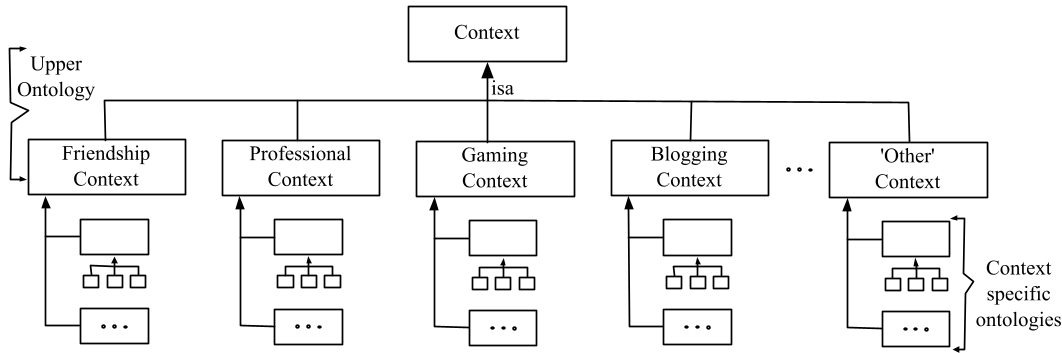 Fig 1: The hierarchical structure of social contexts used to label user data.
2. Policy Enforcement via SPARQL
Instead of hard-coded rules, Aegis uses SPARQL (a query language for RDF). When a request is made, the Policy Evaluator checks if the requester’s role matches the resource’s context.
For example, if Alice (a colleague) tries to view Bob’s professional group:
- The system checks the Social Ecosystem Knowledge Base (SEKB).
- If the triple
<Alice, isColleagueOf, Bob>exists within theProfessionalContext, access is granted. - If a requester tries to jump contexts (e.g., a gaming friend trying to access work files), the query fails, and access is denied.
Performance: Can It Handle Real-World Traffic?
One of the biggest critiques of Semantic Web solutions is that they are "too slow" for real-time applications. The authors tested Aegis against three massive datasets: Slashdot, BlogCatalog, and Facebook.
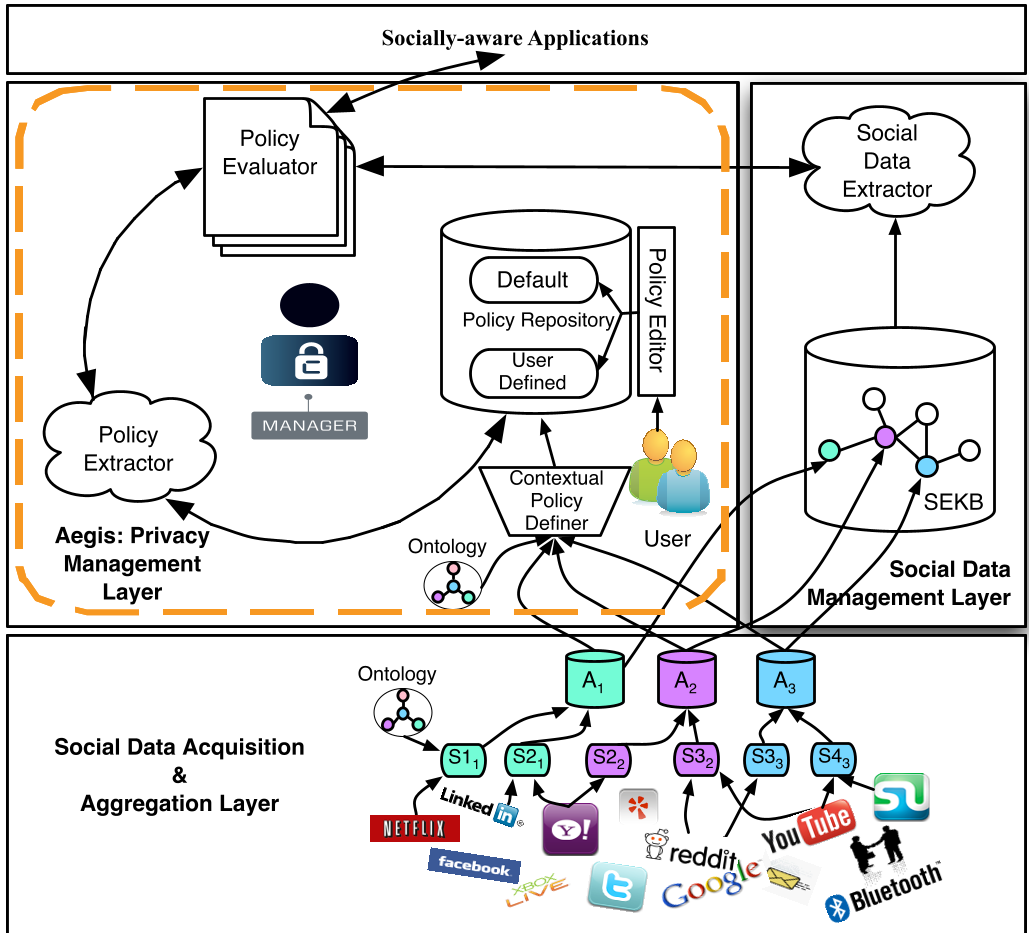 Fig 2: The Aegis Architecture, sitting between raw social sensors and third-party applications.
Key Findings:
- Scalability: Request fulfillment time increases linearly with the number of users.
- Low Overhead: The difference between a request with no privacy checks and an Aegis-protected request was a mere 3ms to 12ms.
- Statistical Significance: A t-test showed a p-value of 0.81, meaning the overhead is virtually unnoticeable to the end-user.
Critical Analysis & Future Outlook
Aegis represents a significant shift from "Control-based Privacy" (where the burden is on the user) to "Context-based Privacy" (where the system understands social norms).
Strengths:
- Extensibility: New social "sensors" (e.g., for a new VR social app) can be added simply by updating the ontology.
- Semantic Precision: Unlike trust-based systems that use vague "distance" metrics (e.g., 2nd-degree friend), Aegis understands the nature of the relationship.
Limitations:
- Identity Mapping: The authors admit that "unifying identities" across different platforms (e.g., knowing Bob on Twitter is the same Bob on LinkedIn) remains a major implementation challenge.
- Institutional Privacy: While Aegis stops users from seeing the wrong things, the central aggregator still sees everything—potentially creating a "honeypot" for surveillance.
Conclusion
Aegis demonstrates that we don't have to choose between rich social features and privacy. By using Semantic Web tools to encode the "common sense" of social interactions, we can build ecosystems that are both open for innovation and inherently respectful of human boundaries.