
Aesthetic Fluency: The Hidden Bridge Between AI Creativity and Human Emotion
Discussing the Aesthetic Emotion of Artworks by AI and Human Artists with the Mediating Variable of Aesthetic Fluency
This study investigates the emotional impact of AI-generated abstract art compared to human art, specifically examining the mediating role of "Aesthetic Fluency" (artistic expertise). Utilizing the Geneva Emotion Wheel (GEW 3.0), the research identifies that experts experience richer, more diverse, and more positive aesthetic emotions when engaging with AI art than novices.
TL;DR
Does your background in art history change how you feel about a painting made by an algorithm? This study reveals that it does. While novices often feel confused or indifferent toward AI art, experts with high Aesthetic Fluency find AI-generated works more interesting, joyful, and emotionally complex, proving that the viewer's expertise is a critical mediator in the "man vs. machine" art debate.
The "Black Box" of Art Appreciation
As Generative Adversarial Networks (GANs) and Creative Adversarial Networks (CANs) flood the art market, a central question arises: Can a machine truly evoke aesthetic emotion?
Previous research has focused on whether humans can distinguish AI art from human art. However, Rui Xu's research shifts the focus to the viewer. The core problem is that AI art is often highly abstract; for a novice, this abstraction feels "rigid" or "imitative," leading to a lack of emotional resonance. The study suggests that the missing link is Aesthetic Fluency—the knowledge base that allows a person to process artistic information easily and quickly.
Methodology: Mapping Emotions
The study utilized two primary psychological tools:
- Aesthetic Fluency Scale: Categorizing viewers based on their knowledge of terms like Fauvism, Impressionism, and specific artists.
- Geneva Emotion Wheel (GEW 3.0): A sophisticated tool that moves beyond simple "like vs. dislike" to map 20 discrete emotions (e.g., Pride, Disappointment, Admiration) on a circular grid.
The Stimuli
The researchers selected 10 iconic AI works, including the famous Portrait of Edmond de Belamy by Obvious Art and works by Mario Klingemann.

Results: Experts vs. Novices
The findings were visualized using Emotional Heat Maps. The contrast was stark:
-
The Novice Group: Their heat map (Fig. 1) showed a relatively homogeneous distribution of moderate emotions. They felt higher levels of simple pleasure but also significant levels of Disappointment and Confusion. Their emotional range was restricted, likely because they lacked the "conceptual fluency" to decode the AI’s abstract output.
-
The Expert Group: Their map (Fig. 2) lit up in areas like Pride, Joy, Love, and Amusement. Experts weren't just "tolerant" of AI; they were actively engaged by it. They were able to evaluate the work through the lens of style, form, and historical context rather than just "what it looks like."
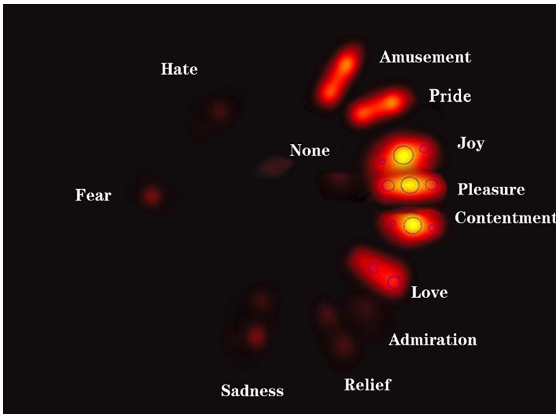 Fig 1. The Novice group exhibits a more scattered, less intense emotional response.
Critical Insight: Why Does Expertise Matter?
The study confirms two key hypotheses:
- Hypothesis 1: Higher artistic expertise leads to higher interest in AI creation.
- Hypothesis 2: Lower expertise leads to confusion and decreased interest.
From a technical perspective, this is a matter of Information Processing. Experts possess the "decoders" to find meaning in abstract AI outputs. While a novice sees a "rigid imitation," an expert might see a "novel deviation from style norms." This suggests that AI art's perceived "value" is highly dependent on the cultural capital of its audience.
Conclusion and Future Outlook
Rui Xu’s work highlights that the "aesthetic experience" of AI art is a co-creation between the algorithm and the viewer's brain.
Key Takeaways for the AI Industry:
- Education is Key: If AI art is to be commodified, the industry must invest in audience education to bridge the "fluency gap."
- Algorithm Design: Developers should consider how to incorporate "familiarity" or "narrative" into AI outputs to help novices reach a state of aesthetic fluency.
Limitations: The study focuses on abstract art. Whether these findings hold true for representational or hyper-realistic AI art remains a question for future research.
Written by the Senior Academic Tech Editor