
The Halo Effect in Your Pocket: Why Beauty Trumps Function in Mobile Web Credibility
The Interplay of Aesthetics, Usability and Credibility in Mobile Websites and the Moderation by Culture
This research investigates the interplay between aesthetics, usability, and credibility in mobile websites across different cultures (Canada vs. Nigeria). Using Partial Least Square Path Modeling (PLSPM), the authors demonstrate that aesthetics is the primary driver of credibility and significantly influences perceived usability, validating the "what is beautiful is usable" phenomenon in the mobile domain.
TL;DR
Is a usable website more credible than a beautiful one? According to a study of 233 participants across Canada and Nigeria, the answer is a resounding "No." The research reveals that Aesthetics is the primary engine of Credibility in the mobile domain. While usability matters, it often acts as a secondary path, frequently filtered through the lens of how "pleasing" the interface looks—a phenomenon intensified by cultural background.
The "Usability vs. Aesthetics" Paradox
In the HCI world, a civil war has long simmered between usability purists (who cite Craigslist as proof that "ugly works") and aesthetics advocates (who argue that visual appeal creates a "halo effect"). In the mobile world, where space is a premium, this tension is even tighter.
The authors of "The Interplay of Aesthetics, Usability and Credibility" sought to settle this by asking:
- Does beauty make a mobile site more believable?
- Does culture (High-Context vs. Low-Context) change this relationship?
- Does a beautiful design trick us into thinking a site is more usable than it actually is?
Methodology: A Systematic UI Transformation
Unlike many studies that use random existing websites, the researchers used an Artifact-Action Framework to create four systematically varied mobile UIs. This allowed them to isolate visual treatments (colors, icons, layouts) from content.
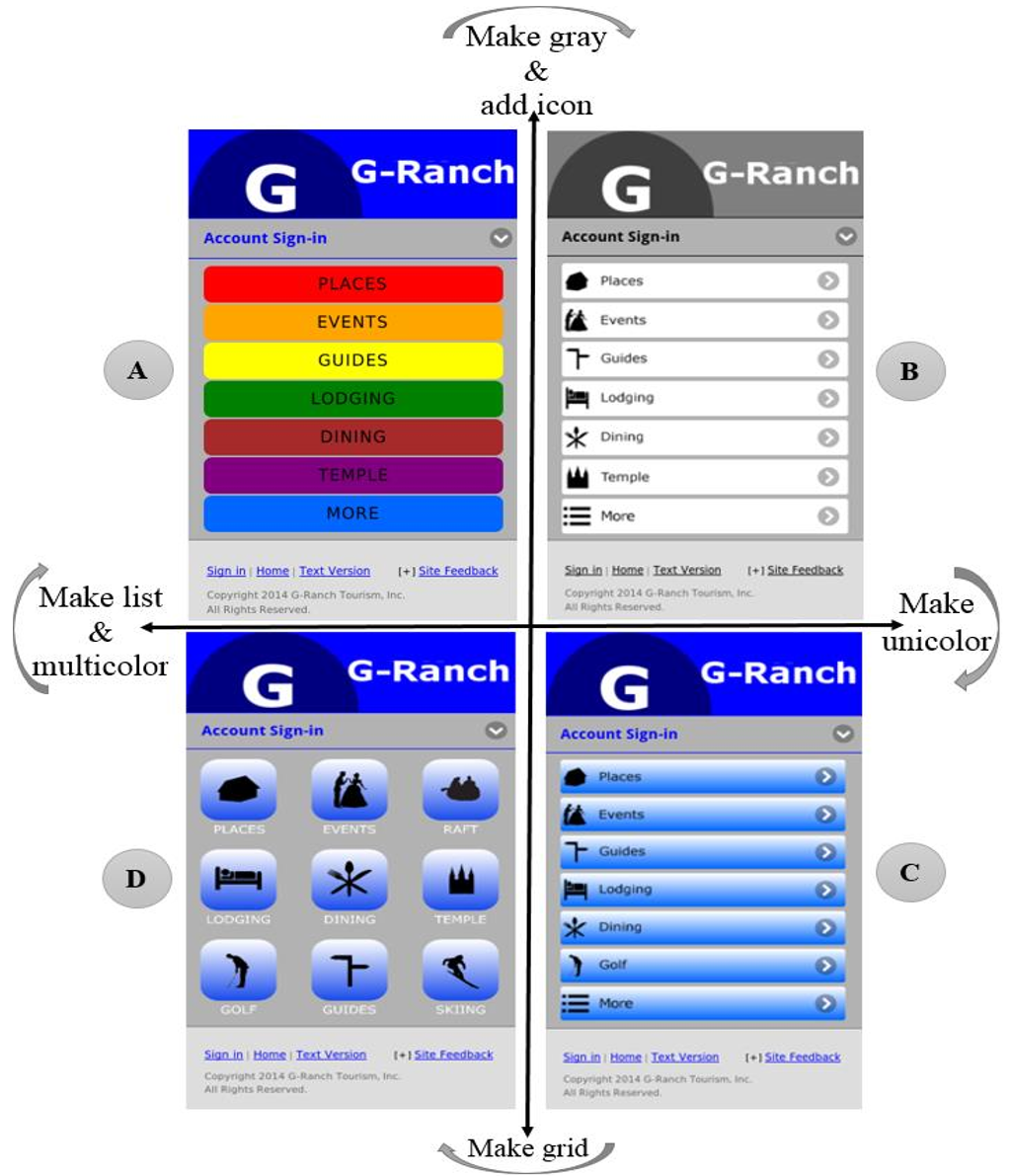 Figure 1: The four mobile website variants (A, B, C, D) used to test user perceptions.
The study utilized Partial Least Square Path Modeling (PLSPM) to map the causal links between Perceived Aesthetics (Classical and Expressive), Usability, and Credibility.
Key Insights: Cross-Cultural Divergence
1. The Universal Dominance of Aesthetics
Across both the Canadian (Low-Context) and Nigerian (High-Context) groups, aesthetics was the strongest predictor of credibility. If the site didn't look "clean" or "fascinating," users simply didn't trust the information it contained, regardless of how easy it was to navigate.
2. High-Context Cultures and the "Aesthetic-Usability" Link
One of the most striking findings was that the Nigerian group showed a much stronger correlation between Aesthetics and Usability (A→U).
- Insight: In High-Context cultures, visual cues are more than just "decoration"—they are critical context. Nigerian participants were more likely than Canadians to judge a site as "functional" simply because it was "beautiful."
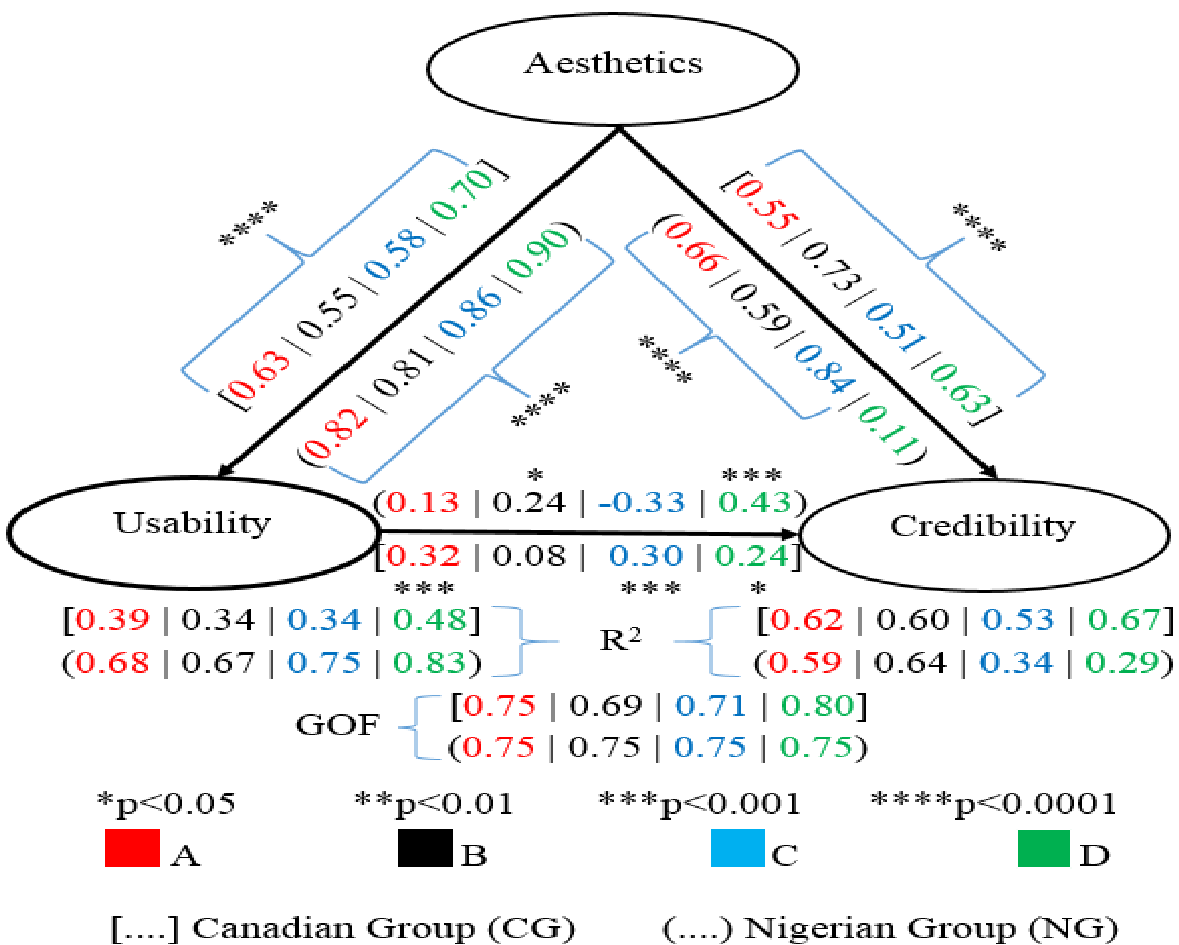 Figure 2: The path model showing how culture moderates the influence of aesthetics on usability and credibility.
3. The Grid Layout Exception
The researchers found a "Decoy Effect" with the grid layout (Design D). Only when the usability was perceived as exceptionally high (as in the grid design preferred by most participants) did Usability begin to significantly mediate Credibility.
Experimental Analysis: Effect Sizes
By calculating Cohen’s , the study found that the effect size of Aesthetics on Credibility was "large" for Canadians but "medium" for Nigerians. Conversely, the influence of Aesthetics on Usability was consistently "very large" for the Nigerian group.
 Table 1: Path coefficients showing the significant differences between groups.
Conclusion and Professional Takeaways
The study confirms that first impressions are visceral. For mobile developers and designers, the takeaways are clear:
- Aesthetics is not "fluff": It is the foundation of trust. Users judge the credibility of your content within seconds based on visual "orderly design" (Classical) and "originality" (Expressive).
- Culture Matters: When designing for High-Context markets (Africa, Asia, South America), the "Aesthetics-Usability" link is tighter. A visual failure is perceived as a functional failure.
- Usability as a Mediator: Usability plays its strongest role in credibility after the initial aesthetic hurdle is cleared, particularly when using preferred layouts like grids.
Future Outlook: As we move toward more automated mobile experiences, understanding how visual "trust markers" vary by culture will be the difference between global adoption and local rejection.