
Unmasking the "Labile" Ribosylome: A New Paradigm for Immune Signaling
Deciphering cytokine-driven ADP-ribosylation signaling networks via Af1521-based mass spectrometry analysis of labile Glu/Asp-linkages
The study presents a novel acidic mass spectrometry workflow using an engineered Af1521 mutant (K35E/Y145R) to stabilize and map labile glutamate and aspartate-linked ADP-ribosylation (Glu/Asp-ADPr). Applying this to cytokine-stimulated A549 and HeLa cells, the authors identified over 900 high-confidence ADPr sites, revealing a major regulatory network in innate immune signaling.
TL;DR
ADP-ribosylation (ADPr) is a critical signaling modification, yet its most common form—linkages to Glutamate and Aspartate—has been largely "invisible" to science due to its extreme instability in standard lab conditions. By re-engineering the enrichment workflow to be purely acidic and using a mutant binder, researchers have finally mapped this hidden landscape, uncovering a massive, interferon-driven network that regulates how our cells fight viruses.
The "Invisible" Modification Problem
For decades, researchers studying ADP-ribosylation were looking at an incomplete map. While Serine-linked ADPr (Ser-ADPr) is robust and thrives in the alkaline buffers used in mass spectrometry (MS), Glutamate and Aspartate linkages (Glu/Asp-ADPr) are notoriously fragile. Under standard pH 8.5 conditions, these ester bonds hydrolyze (break) rapidly.
The technical paradox was even deeper: the very tool used to "catch" these modifications—the Af1521 macrodomain—acts as an "eraser" (hydrolase) that destroys the modification it is meant to enrich. Consequently, biological processes relying on Glu/Asp-ADPr remained underrepresented and poorly understood.
Methodology: The Acidic Shield
The authors pivoted to an "Acidic Workflow." By maintaining a pH below 6.3 and using lower temperatures, they chemically stabilized the ester bonds. Crucially, they employed an engineered Af1521 mutant (K35E/Y145R). This version "grabs" the ADPr but cannot "cut" it, acting as a scavenger that preserves the modification for the mass spectrometer.
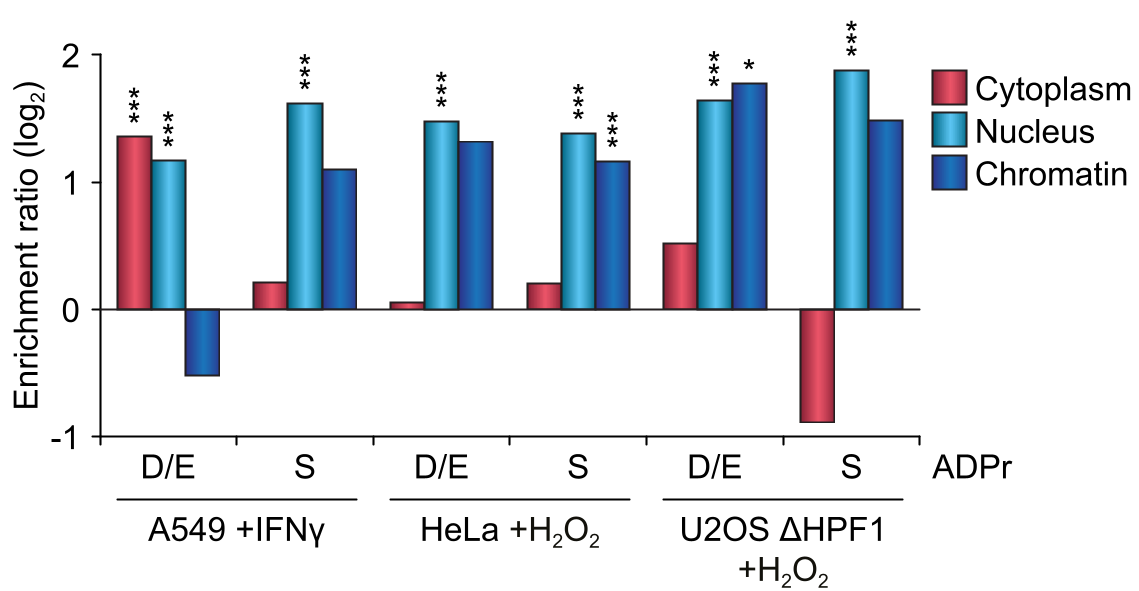 Figure 1: Comparison of alkaline vs. acidic workflows. The acidic approach with the mutant macrodomain is the only method that successfully captures Glu/Asp-ADPr.
For detection, they utilized EThcD (Electron Transfer higher-energy Collision Dissociation). Unlike standard fragmentation that often knocks the ADPr group off before it can be measured, EThcD breaks the peptide backbone while keeping the ADPr moiety attached, allowing for precise pinpointing of which amino acid was modified.
Core Insights: Cytoplasmic Warfares
The study revealed a sharp spatial division in the cell:
- Nuclear ADPr: Dominated by Serine residues, typically linked to DNA damage responses.
- Cytoplasmic ADPr: Dominated by Glu/Asp and Cys residues, specifically triggered by cytokines like Interferon (IFN).
The Antiviral Hub
In interferon-treated A549 cells, the authors mapped a massive interconnected network. PARP14 emerged as a central hub, with dozens of modification sites on its macrodomains. Interestingly, while PARP1 targets Serine, its antiviral cousins (PARP9, 12, 13, 14) show a stark preference for Glu/Asp and Cys residues.
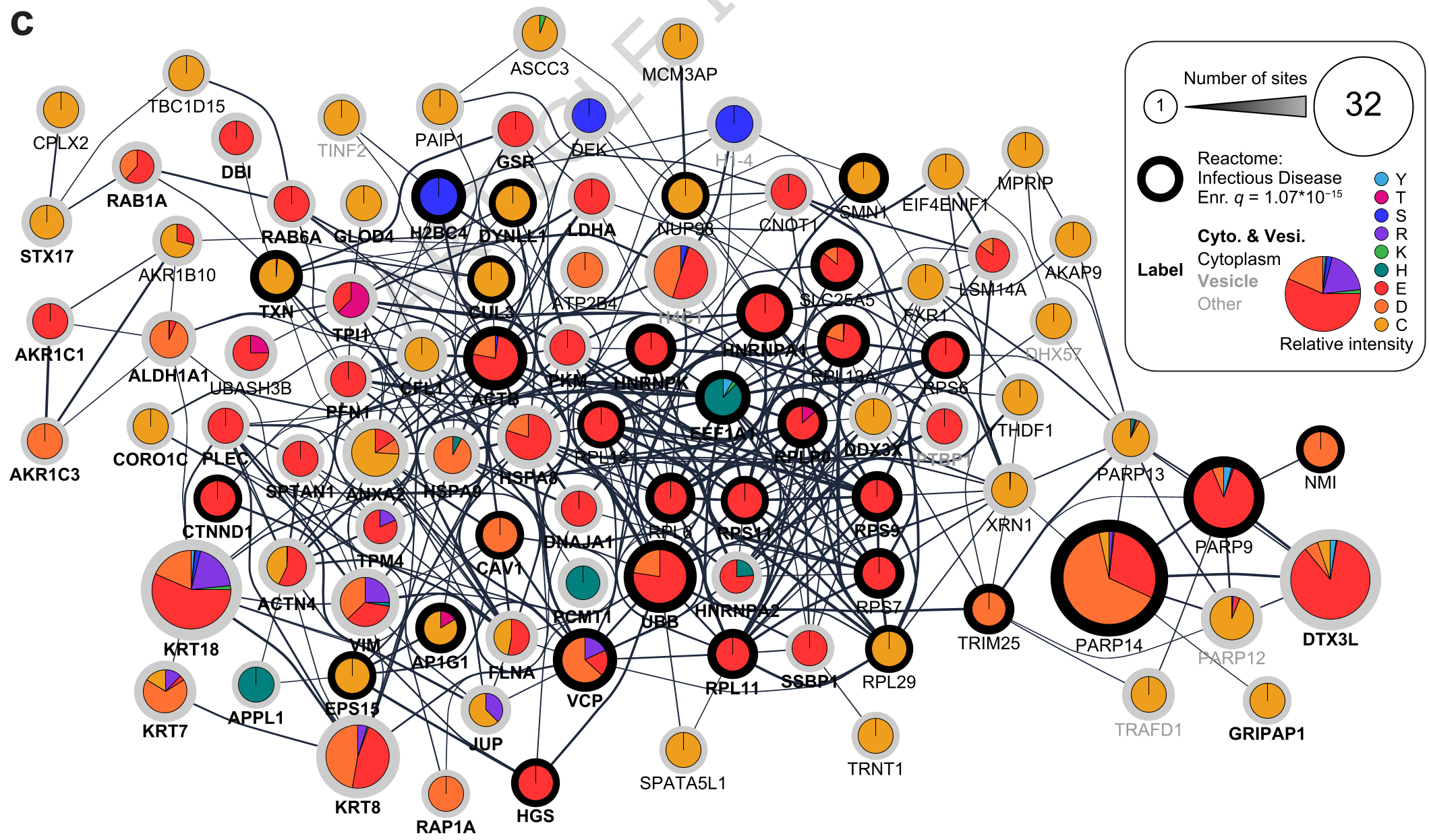 Figure 2: STRING network analysis showing the massive upregulation of Glu/Asp/Cys-ADPr on immune proteins following interferon treatment.
The Ubiquitin Connection
One of the most striking "Why" moments in the paper involves ubiquitin. The authors found that PARP10 specifically modified ubiquitin on residues E24, D32, and E51. These are located on a surface patch opposite the site where ubiquitin usually connects to other proteins. This suggests a "molecular switch" where ADPr controls how ubiquitin itself is recognized or degraded, potentially regulating the global protein turnover during an immune response.
Deep Insight: Is Cys-ADPr Real or an Artifact?
A lingering question in the field was whether Cys-ADPr is a biological signal or a chemical artifact caused by ADPr jumping from Glu/Asp to Cys during lab work. Through rigorous in vitro "stay-put" experiments—simulating all lab conditions with auto-modified PARP1—the authors proved that no such transfer occurs. This confirms that Cys-ADPr is a genuine biological modification, particularly prevalent on RNA-binding proteins.
Conclusion and Future Outlook
This study is more than a catalog of sites; it is a technological "correction" for the field. It demonstrates that the amino acid specificity of ADP-ribosylation is a highly regulated, context-dependent language.
Key Takeaways for the Field:
- Stop using pH 8.5: Researchers looking for cytoplasmic ADPr must adopt acidic protocols.
- The PARP-IFN Axis: The core antiviral response is executed via Glu/Asp-ADPr, not Ser-ADPr.
- Ubiquitin Crosstalk: The discovery of site-specific ADPr-Ub opens a new chapter in understanding how the cell's two most powerful signaling systems (ADPr and Ubiquitin) communicate.
By shifting the pH, the authors have shifted our understanding of the innate immune response, providing a high-resolution map for future drug targeting in viral diseases and inflammation.