
The Happiness Paradox: How Affective Priming and Self-Awareness Impact Crowdsourced Creativity
Affect and Creative Performance on Crowdsourcing Platforms
This paper investigates the impact of affect on creative performance in crowdsourcing environments, specifically focusing on Amazon’s Mechanical Turk (MTurk). It demonstrates that while positive music priming significantly boosts convergent creativity (Remote Associates Task), explicit affective self-reporting (SAM/PANAS) leads to a surprising decrease in creative performance.
TL;DR
Is a happy worker a more creative worker? In the world of crowdsourcing, the answer is a nuanced "yes, but only if they don't know why they are happy." This study reveals that while brief positive music priming can boost creative output on platforms like Amazon Mechanical Turk by over 10%, asking workers to explicitly report their positive mood actually impairs their performance.
Problem: The "Artificial AI" Blind Spot
Microtask crowdsourcing platforms often treat human workers as "computational units"—predictable, emotionless, and rote. While current tasks are dominated by image labeling and transcription, the future of crowd work lies in high-level creativity. However, the industry lacks the tools to optimize for the human element: Affect. While we know positive affect broadens attention and facilitates cognitive flexibility, we don't know how to reliably trigger it in a digital, distributed workforce without backfiring.
Methodology: Primes vs. Reports
The researchers conducted three experiments using the Remote Associates Task (RAT)—a test of convergent creativity where participants find a common link between three disparate words.
1. The Power of the 30-Second Prime
Instead of lengthy mood induction, the authors embedded 30-second music clips into "verification tasks" (used to catch bots).
- Positive Prime: Bach’s Brandenburg Concerto No. 3.
- Negative Prime: Slowed-down Prokofiev.
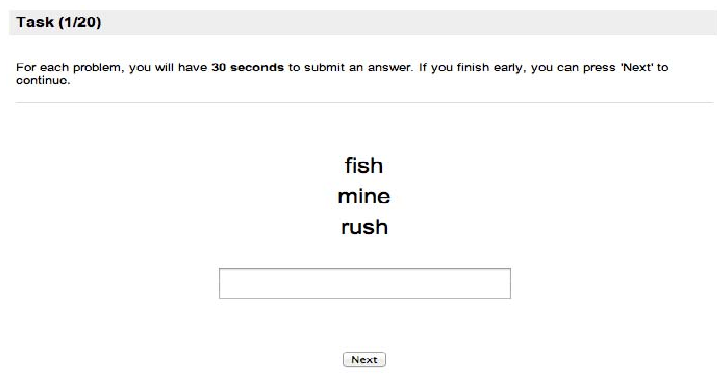 Figure 2: The Remote Associates Task (RAT) interface used in the study.
2. The Trap of Self-Reflection
In Experiments 2 and 3, they pivoted to Affective Pre-screening. Using the Self-Assessment Manikin (SAM) and the Positive and Negative Affect Schedule (PANAS), they asked workers to report how they felt before working. The logic was simple: if happy people are creative, let's just hire the happy ones.
Results: A Divergent Reality
The results provided a startling contrast between internal state and external stimulus.
- Priming Success: Positive music worked. Workers primed with Bach outperformed the control group significantly (67.54% vs 57.35% accuracy).
- Pre-screening Failure: In both the SAM and PANAS experiments, those who claimed to be happy performed worse. In the PANAS study, "High Positive Affect" individuals scored roughly 7% lower than their less-happy counterparts.
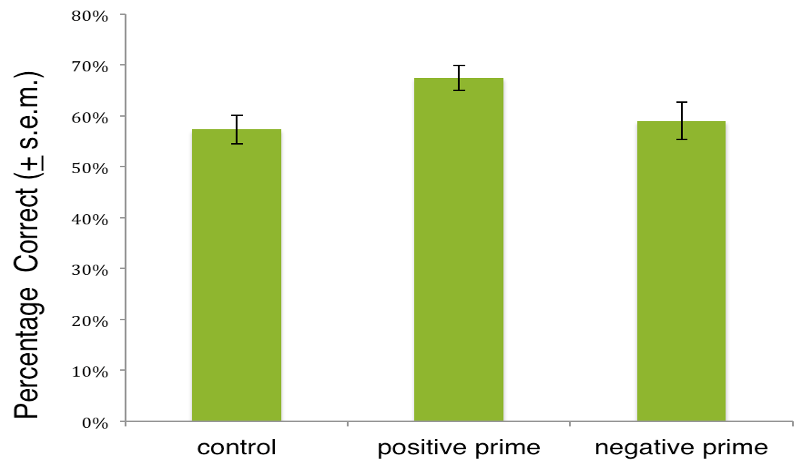 Figure 3: Creative performance across conditions, highlighting the success of the positive music prime.
Deep Insight: Mood-As-Information
Why does reported happiness kill creativity? The authors point to the Mood-As-Information Model.
When a worker is asked to reflect on their mood (making it "salient"), they become aware of their happiness. This awareness acts as a cognitive heuristic: "I feel good, therefore my performance must already be adequate." This leads to decreased motivation and effort. In contrast, priming works beneath the level of conscious reflection, allowing the cognitive benefits of positive affect (breath of attention) to function without the negative impact on motivation.
Conclusion & Application
This research offers a critical lesson for the design of future HCI and crowdsourcing systems:
- Don't Ask, Do Prime: If you want a creative crowd, don't filter for "happy" people via surveys. Instead, subtly influence the environment using positive stimuli (music, images) hidden in routine tasks.
- Saliency Matters: The mere act of measurement can change the behavior being measured. In affective computing, explicit self-reports are not neutral; they are interventions in themselves.
- Efficiency: We don't need 10-minute induction sessions. A 30-second "audio check" is enough to shift the creative needle.
For the crowdsourcing industry to move beyond "artificial AI" into true "cognitive collaboration," it must master the subtle art of the affective nudge.