
How Your Mood Shadows Your Social World: The Affective Basis of Network Activation
The affective antecedents of cognitive social network activation
This research investigates the affective antecedents of cognitive social network activation, demonstrating how momentary feelings shape the mental recall of social ties. Integrating the Broaden-and-Build Theory with network science, the authors show that positive affect leads individuals to activate larger, more sparsely connected networks, while negative affect results in smaller, more redundant mental structures.
TL;DR
Why do we reach out to the same three people when we're down, but feel like "networking" with a wide circle when things are great? This research demonstrates that our affective states act as cognitive filters. Positive affect broadens our mental horizon, allowing us to recall large, diverse networks, while negative affect acts like a microscope, narrowing our focus to small, tight-knit, and redundant social circles.
Background: Beyond the "Cage" of Social Structure
For decades, sociologists viewed social networks as relatively stable "cages" that determine how we feel. If you are central, you feel powerful; if you are isolated, you feel lonely. But this paper flips the script. Inspired by Darwin's observations on physical expansion in joy and contraction in sadness, the authors ask: Does our internal feeling dictate the social structure we see?
The researchers introduce a Tri-partite Model of networks:
- Potential Network: Your total "rolodex."
- Activated Network: Who you actually think of at a specific moment.
- Mobilized Network: Who you actually contact.

Methodology: Inducing "Microsopes" and "Telescopes"
To move beyond simple correlation, the authors conducted experiments to isolate incidental affect—feelings unrelated to the task at hand.
- The Manipulation: Participants wrote about the "best" or "worst" thing that happened to them recently.
- The Activation Task: They were then asked to list contacts they would go to for advice (Academic in Study 2a, Workplace in Study 2b).
- The Metrics:
- Size: How many people did they remember?
- Density: To what extent did those people know each other? (High density = a redundant clique; Low density = diverse contacts or "structural holes").
Key Findings: The Architecture of Feeling
The results across three datasets (including the General Social Survey) were remarkably consistent:
1. Positive Affect = Broadening
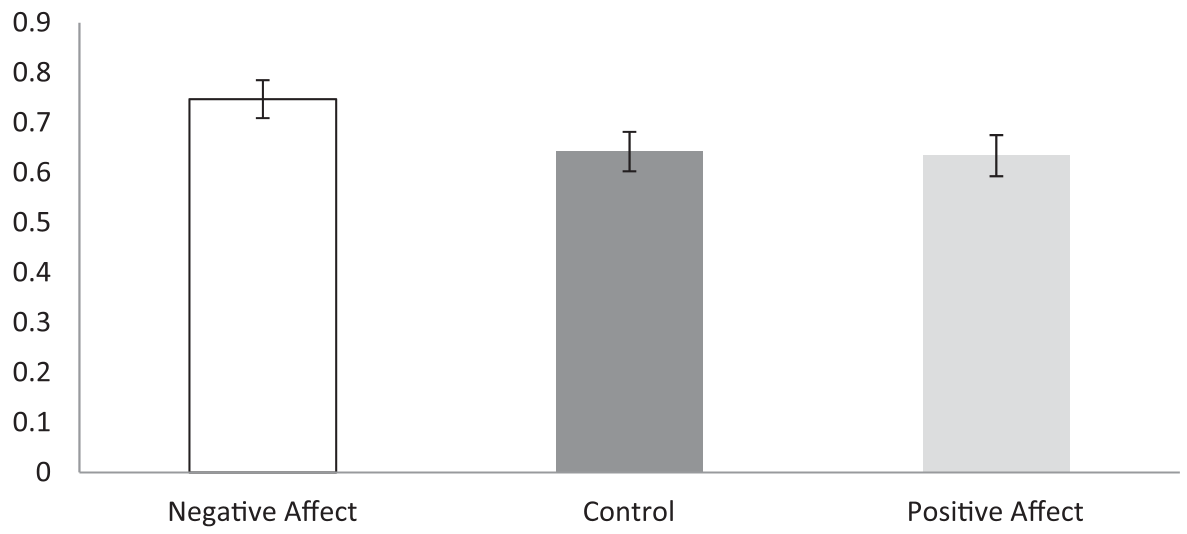
When people felt happy, they activated larger networks. More importantly, these networks were sparser. They mentally accessed individuals who didn't necessarily know each other, providing a "bridge" to diverse information and novel ideas.
2. Negative Affect = Constriction
In states of sadness or "misery," participants retreated mentally into small, dense cliques. They recalled people who were already highly interconnected. While this might offer emotional support, it functionally narrows the variety of information and help they can access.
Deep Insight: Why Does This Matter?
This paper provides a structural explanation for a well-known psychological phenomenon: Creativity. We know positive affect boosts creativity. This study suggests a "Social Structural Pathway" for that boost—if you can mentally "see" more diverse contacts, you can synthesize more diverse ideas.
Conversely, it sheds light on Social Inequality. If lower socio-economic individuals experience more chronic stress and negative affect, they may systematically "narrow" their networks, missing the very "weak ties" needed to find new jobs or opportunities, creating a devastating feedback loop of network contraction.
Critical Analysis & Future Outlook
While the study is robust, it primarily looks at generalized positive/negative valence. Future research must tackle discrete emotions. Does "Anger" (which is negative but high-power) act differently than "Sadness" (negative and low-power)? One might expect an angry person to broaden their network to find "allies," whereas a sad person might only seek "comfort."
Furthermore, linking these findings to physiological markers like cortisol would provide a bio-structural map of how stress physically constrains our social capabilities.
Conclusion
We are not just passive inhabitants of our social networks. Our emotions act as the lens through which we view our social web. By understanding that "feeling low" naturally constricts our social vision, we can consciously work to "re-broaden" our perspectives, ensuring that momentary moods don't lead to permanent social isolation.