
Toward Empathetic AI: How Affect-Sensitive Robots are Revolutionizing Social Skill Training for Underserved Groups
Towards an Affective Computing Feedback System to Benefit Underserved Individuals: An Example Teaching Social Media Skills
The paper introduces an affect-adaptive feedback system using physiological signals and humanoid robots (NAO) to teach social skills to individuals with Autism Spectrum Disorder (ASD) and Intellectual Disabilities (ID). By integrating real-time biofeedback with robotic instruction, it achieves a high affect recognition accuracy (83%) and successfully teaches social media etiquette to underserved populations.
TL;DR
Researchers at the University of Louisville are bridging the gap between behavioral therapy and robotics by creating an Affective Computing Feedback System. By monitoring physiological signals (like heart rate and skin conductance), a NAO humanoid robot can "sense" the anxiety or engagement of individuals with Autism (ASD) or Intellectual Disabilities (ID) and adapt its teaching style in real-time. This approach saw one student master social media communication skills in just 30 minutes.
Background Positioning: This work moves beyond traditional static computer-aided instruction (CAI) into the realm of Closed-Loop Human-Robot Interaction (HRI), where the machine is an active, emotionally-aware participant.
The Problem: The "One-Size-Fits-All" Failure in Behavioral Therapy
Intervention for ASD and ID is notoriously difficult because symptoms exist on a broad continuum. A social prompt that encourages one student might trigger an "escape response" or high anxiety in another.
Current digital tools are often "blind" to these internal states. They continue to deliver instructions even when the student is overwhelmed, lacking the human therapist's ability to pause, simplify, or provide encouragement based on a child’s non-verbal cues. This lack of individual-specific adaptation is the primary bottleneck in scaling technology-led therapy.
Methodology: The Closed-Loop Feedback System
The researchers proposed a system that combines wearable biofeedback with autonomous robotics.
1. Data Collection & Modeling
As the student interacts with the robot, wearable Biopac sensors track physiological changes. The team used Support Vector Machines (SVM) and K-Nearest Neighbor (KNN) algorithms to process these signals.
- The Insight: By correlating physiological spikes (like skin conductance peaks) with clinical observations of anxiety, the system creates a digital signature of the user’s emotional state.
2. The NAO Robotic Instructor
The system doesn't just record data; it acts on it. The NAO robot uses a multi-layered architecture to decide on its next movement:
- Attention Cues: NAO uses face tracking to ensure the student is looking at it before proceeding.
- Errorless Learning: The robot employs "simultaneous prompting," providing the correct answer immediately after a prompt to prevent frustration and ensure success.
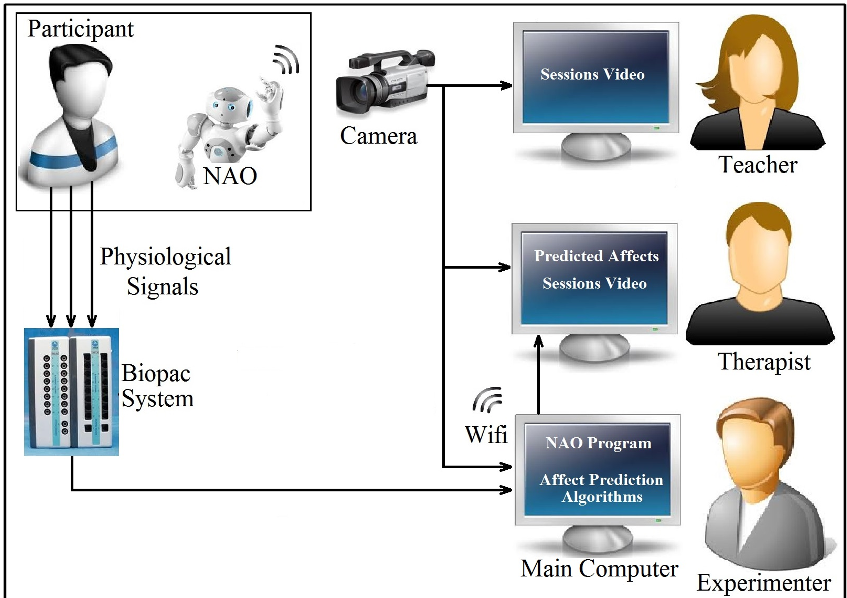 Figure 1: The experimental setup showing the interaction between the student, wearable sensors, and the NAO robot.
Experiments & Key Findings
The Social Media Case Study
The team tested the system on a 19-year-old with Down Syndrome who struggled with unidirectional, repetitive texting.
- Task: Learn a three-part text structure (Greeting + Personal Statement + Closing).
- Result: The student met the success criterion after only seven teaching sessions, totaling less than 30 minutes of interaction.
- Quantitative Boost: Use of the affect-sensitive model improved task performance and reported "enjoyment" significantly compared to non-sensitive sessions.
The Challenge of "Group Models" vs "Individual Models"
A critical discovery was that while group models work for "typical" adults (reaching ~90% accuracy), they underperform for the ASD/ID population (scoring only 54–65% accuracy). This highlights the extreme heterogeneity of these individuals, proving that individual-specific modeling is non-negotiable for future clinical applications.
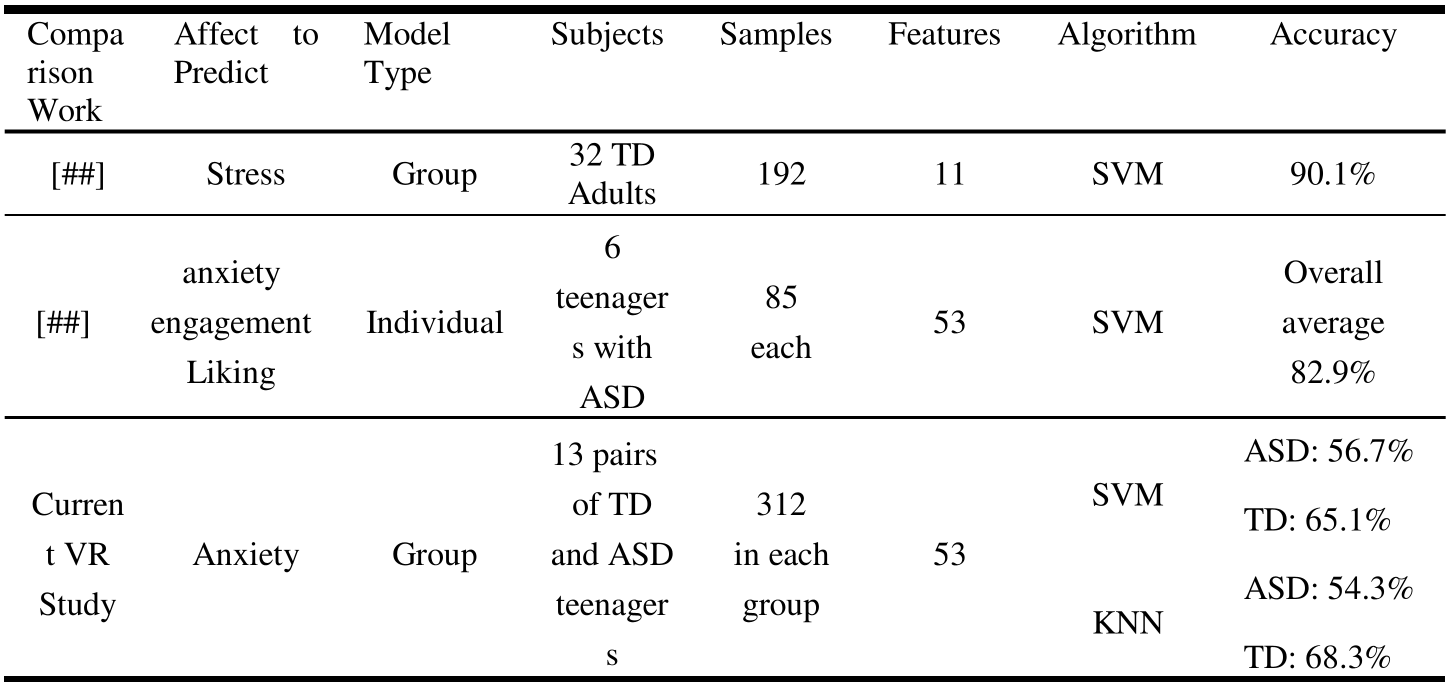 Table 3: Comparison of affect prediction accuracy across different subject groups.
Critical Analysis & Future Outlook
Takeaway
The integration of physiological biofeedback into HRI allows for a "Naturalistic" teaching environment. It reduces the teacher-to-student ratio and allows for intensive, repetitive intervention that can eventually be moved from the clinic to the home.
Limitations
- Generalizability: The social media study was a single-case pilot. Broader longitudinal studies are needed.
- Algorithm "Cold Start": Because group models are less effective, the system must "learn" the user from scratch on day one, which presents a challenge for immediate deployment.
Future Prospect
The authors envision these robots teaching a variety of chained tasks, such as job interview preparation or navigating workplace social dynamics. By making robots "emotionally literate," we can provide underserved individuals with a safe, patient, and highly effective way to learn the complexities of the social world.
Keywords: Affective Computing, ASD, HRI, Biofeedback, Special Education.