
The Affective Connection: Do We Perform Emotions for Our Machines?
The affective connection: how and when users communicate emotion
The paper investigates human emotional communication during HCI using a Wizard-of-Oz (WOZ) experimental framework. It presents the "Affective Connection" study, which evaluates how users alter their emotional displays—such as posture, facial expressions, and vocalizations—when they believe a system is capable of recognizing and responding to their emotions.
TL;DR
This seminal work from CHI 2004 explores the "Affective Connection"—the phenomenon where users consciously or subconsciously alter their emotional expressions when they believe a computer is watching and "understanding" them. Using a clever Wizard-of-Oz (WOZ) setup, the study reveals that humans aren't just passive users; we are social communicators who adapt our body language, sounds, and facial expressions to suit the perceived intelligence of our digital partners.
Motivation: Moving Beyond Tech-First Affective Computing
In the early 2000s, affective computing was largely a technical challenge: Can we build a sensor to detect a frown? However, Lesley Axelrod argued that we were missing the "human" in Human-Computer Interaction.
The core problem was a lack of user-centric data. If we build a system that responds to frustration, will users actually show frustration in a way the machine can understand? Or do they suppress it? The research intuition here is based on the Media Equation, suggesting that people follow social rules when interacting with media. If a computer seems "empathetic," do we treat it with the same emotional etiquette we afford a human?
Methodology: The "Wizard" Behind the Curtain
To test this, the researcher designed a word game designed to be intentionally frustrating—featuring time pressure and "sticky" mouse controls.
The 2x2 Experimental Matrix
The study used a two-factor factorial design with four matched groups to isolate whether the expectation of affect or the actual behavior of the system drove user emotion.
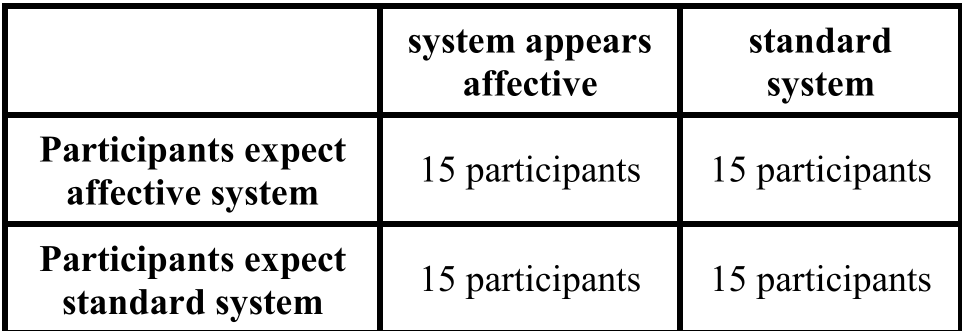
The Setup
- The "Wizard": A researcher behind a two-way mirror judged the participant's emotional state in real-time.
- The Adaptive Response: In the "affective" condition, the system provided tailored clues and messages based on the Wizard’s observations, making the machine appear emotionally intelligent.
- Multimodal Data: The study didn't just look at clicks; it captured posture, body movement, vocalizations, and facial actions.
Key Insights & Results
While the analysis was in its early stages during publication, the initial data revealed several profound trends:
- Increased Affective Display: Participants showed more overt emotional signs when they believed the system was capable of recognition.
- Subtle Modalities: Emotion wasn't just about "smiling" or "crying." Users communicated through postural shifts and subtle vocal cues—channels that traditional "facial-recognition-only" systems often miss.
- The Belief Factor: The mere belief that a system is affective changes user behavior, creating a feedback loop between human expression and machine response.
Critical Analysis: Why This Matters Today
Though this paper dates back to 2004, its implications for modern AI agents and LLMs are staggering. Today, we interact with "emotional" AI daily (like ChatGPT or Hume AI). Axelrod’s work warns us that:
- User Modeling is Dynamic: We cannot design affective systems for "static" users. The user's behavior changes because the system is affective.
- The Need for Multimodal Inputs: To truly capture the "affective connection," systems must look beyond text or face-tracking and consider the "messy" data of body language and sound.
Limitations
The study relies on a relatively small sample size (60 participants across 4 conditions) and the "frustration" triggers (sticky mouse) may not translate to more complex, modern AI interactions. Furthermore, the cultural specificity of emotional display was not deeply explored.
Conclusion
The "Affective Connection" reminds us that HCI is a two-way street. As we build more "emotional" machines, we are effectively training humans to communicate in new, tech-mediated ways. The success of future affective interfaces depends less on perfect emotion-recognition algorithms and more on understanding the social dance between human and machine.
Senior Editor’s Note: This paper remains a cornerstone for understanding the psychological "expectancy effects" in human-centered AI design.