
Spectral Conditioning: A New Era of Social Norm Evolution
The Affective Evolution of Social Norms in Social Networks
This paper introduces an affective model for the evolution of social norms by adapting the Rescorla–Wagner conditioning theory to social networks. By representing norm spread as a Markov chain transition process, the authors propose a polynomial-time algorithm, MaxSNSP, to identify the optimal set of initial adopters for maximizing societal norm adherence.
TL;DR
Researchers have bridged the gap between behavioral psychology and network science by adapting the Rescorla–Wagner model into a Markov chain framework. By treating social norm adoption as a form of "classical conditioning," they developed a polynomial-time algorithm (MaxSNSP) that identifies the perfect "champions" to maximize norm spread, consistently outperforming standard network metrics like PageRank and Centrality.
Motivation: Why Laws Are Not Enough
Establishing formal laws and regulations is expensive and often requires heavy-handed enforcement. Social norms—the "social grammar"—offer a lower-cost alternative for regulating behavior. However, the mechanism by which a behavior transitions from a niche practice to a society-wide standard is poorly understood. Existing models often overcomplicate the "human" element with complex game theory or simplify it to binary "contagion."
The authors ask: Can we model social influence using the same associative learning rules that explain how organisms learn habits?
Methodology: From Pavlov's Dog to Social Networks
The heart of this work is the adaptation of the Rescorla–Wagner (RW) formula. In the original RW model, an organism learns when there is a discrepancy between what it expects and what it experiences.
The Formalism
The authors define the "Unconditional Stimulus" (US) for an individual as the average adherence of their neighbors. The update rule for a node at time is:
Where:
- is the vector of norm adherence ([0 to 1]).
- is the normalized adjacency matrix.
- is a diagonal matrix of "learning factors" ().
By proving that the resulting transition matrix is row-stochastic, the authors move the problem into the realm of Spectral Analysis. The steady state of the society is dictated by the largest eigenvector of the matrix.
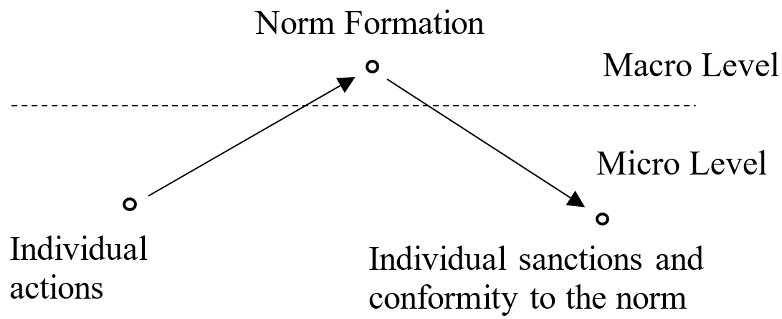 Figure 1: Coleman’s model showing the transition from micro-level interactions to macro-level norm formation.
The MaxSNSP Algorithm
Because the model is linear, finding the best initial adopters (the "MaxSNSP" problem) doesn't require exhaustive searching or NP-hard approximations. Instead, the authors show that:
- The steady state is a constant vector .
- The value depends linearly on the initial state .
- By calculating the change-of-basis matrix (from the eigenvectors of ), the problem becomes a simple task of picking the top coefficients in the first row of .
Experiments and Proof of Superiority
The authors tested their algorithm against five common heuristics: MaxDegree, MaxClusteringCoefficient, MaxBetweenness, PageRank, and MaxCloseness.
Key Findings:
- Structural Blindness: Standard structural metrics (like finding the most "connected" person) frequently fail because they don't account for the unique "learning factors" () of individuals.
- Robustness: On Scale-free (Barabasi–Albert), Small-world (Watts–Strogatz), and real-world company networks (BuisNet), MaxSNSP achieved significantly higher global adherence.
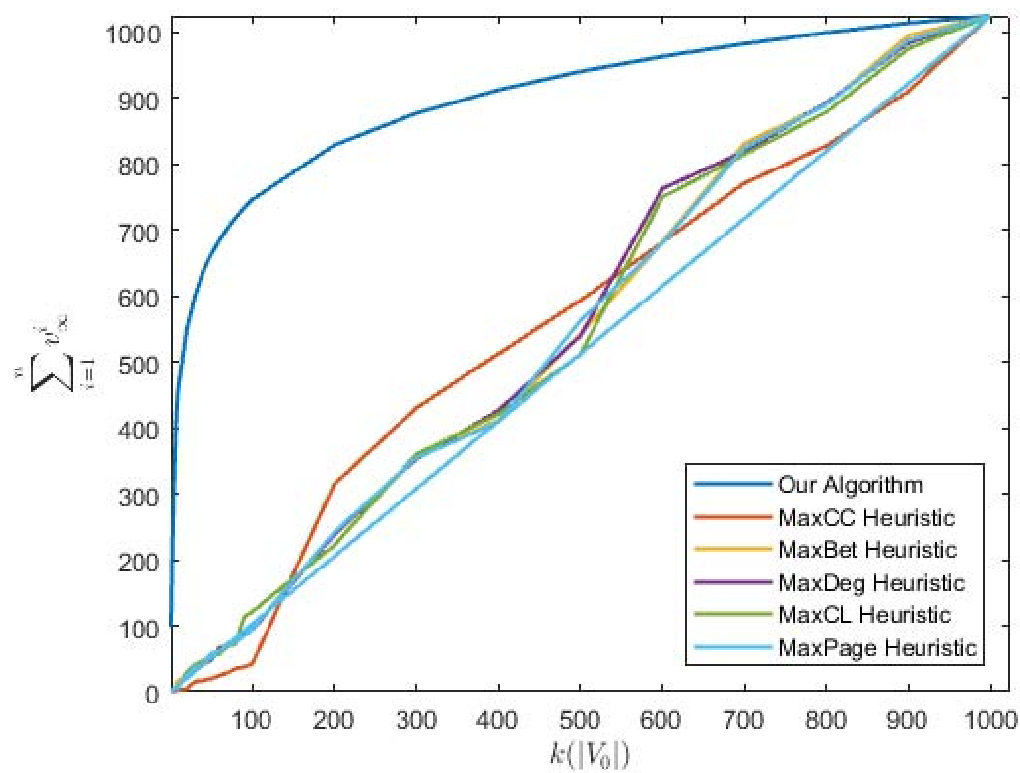 Figure 2: Comparison in a real-world Business Network. The spectral algorithm (Top Curve) maintains a dominant lead over traditional centrality measures.
Critical Insight: The Affective Bias
The unique contribution of this paper is the removal of Cognition from the initial model. By focusing purely on Affective Conditioning, the authors show that a massive portion of social behavior can be modeled as a repetitive stimulus-response loop.
Limitations
While powerful, the model assumes a static network. In reality, social ties are dynamic—people might cut ties with those who pressure them to adopt norms they dislike. Additionally, the "learning factor" is treated as a constant, whereas in humans, it might fluctuate based on the specific norm (e.g., it's harder to condition someone to a dietary norm than a dress code).
Conclusion
This study provides a rigorous mathematical bridge between reflexive learning and macro-social patterns. For organizations looking to implement "algorithmic social contracts" or foster innovation, the takeaway is clear: don't just target the most connected people; target the people whose social position provides the strongest spectral influence on the community's learning state.