
AffectivelyVR: Decoding the Individual—The Power of Personalized Emotion Recognition in VR
AffectivelyVR: Towards VR Personalized Emotion Recognition
AffectivelyVR is a real-time, personalized emotion recognition system for Virtual Reality (VR) that utilizes EEG and GSR sensors to classify user affect during 360° video immersion. By training user-specific models rather than a one-size-fits-all approach, the system achieves a high SOTA accuracy of 96.5% using a personalized KNN algorithm.
TL;DR
AffectivelyVR introduces a framework for real-time emotion detection in Virtual Reality by leveraging personalized machine learning models. Using a combination of EEG (brainwaves) and GSR (skin conductance), the system achieves a remarkable 96.5% accuracy by training models tailored to the individual, proving that in the world of human emotion, one size definitely does not fit all.
Background & Positioning
In the landscape of Affective Computing, Virtual Reality (VR) is the ultimate "emotion machine." Unlike 2D screens, VR provides the presence and immersion required to trigger genuine, real-world-like emotional responses. However, most existing systems attempt to build generalized models—trying to predict everyone's emotions with a single algorithm. AffectivelyVR shifts this paradigm, positioning itself as a pioneer in personalized affective VR, where the system learns your specific physiological language.
The Problem: The "Interpersonal Gap"
Why is recognizing emotion so hard?
- Subjectivity: "Pleasantness" for one person might be "boredom" for another.
- Physiological Variance: One person’s stress might manifest as a spike in skin conductance (GSR), while another might show specific alpha-wave suppression in the pre-frontal cortex.
- Immersion Deficit: Previous studies used weak stimuli (like photos), which don't elicit the strong physiological signals needed for robust real-time detection.
Methodology: The Personalized Pipeline
The authors employed a sophisticated multi-stage pipeline to turn raw biological signals into emotional insights.
1. Hardware & Stimuli
Users were immersed in 360° VR videos while wearing an OpenBCI EEG Cap (16 channels) and a Shimmer GSR sensor. The focus was on the pre-frontal cortex and occipital/parietal lobes—areas closely linked to emotional processing and visual immersion.
2. Signal Refinement
To strip away "noise" (like eye blinks or muscle movements), the team used:
- Independent Component Analysis (ICA): To isolate brain signals from muscle artifacts.
- Yeo-Johnson Transformation: To normalize data distributions and stabilize variance.
- SMOTE (Synthetic Minority Oversampling Technique): To balance the dataset, ensuring the model doesn't become biased toward a single dominant emotional state.
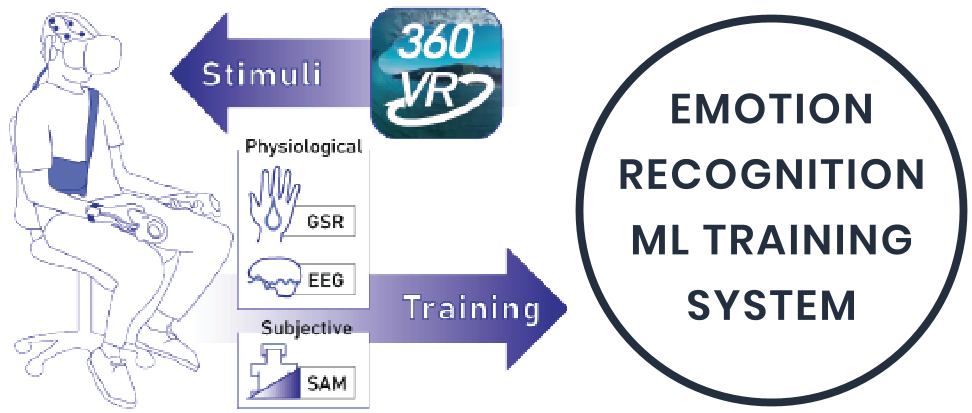 Figure 1: The AffectivelyVR framework, integrating physiological data and subjective self-assessment (SAM) into a closed-loop ML pipeline.
Experimental Results: Personalization Wins
The study compared generalized models (trained on everyone) against personalized models (trained per participant). The results were definitive:
- Personalized KNN: 96.5% Accuracy
- Generalized SVM: 83.7% Accuracy
Using k-Nearest Neighbor (KNN) as the primary classifier yielded the best results, suggesting that emotional states in high-dimensional physiological space tend to cluster uniquely for each individual.
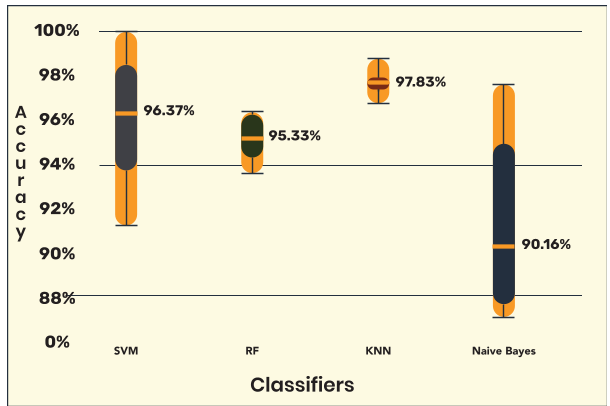 Figure 2: Performance comparison of various ML classifiers. KNN consistently outperforms SVM and Random Forest in personalized settings.
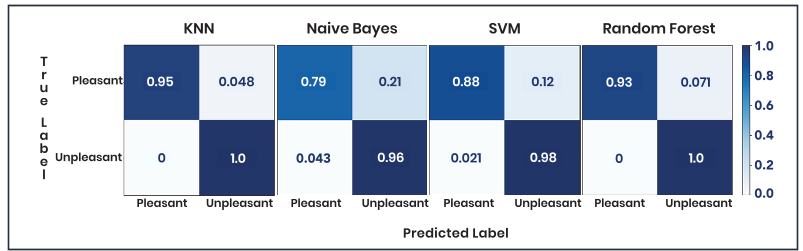 Figure 3: 10-fold cross-validated confusion matrices showing high true-positive rates for both Pleasant and Unpleasant states.
Critical Insight: Why Does It Work?
The success of AffectivelyVR lies in its Inductive Bias. By acknowledging that the mapping from "Physiology → Emotion" is a subjective function, the authors avoided the "noise" introduced by trying to average across multiple different nervous systems. The use of Grid Search for hyperparameter tuning further ensured that each individual's model was optimized for their specific signal-to-noise ratio.
Future Outlook & Limitations
Despite the high accuracy, the study was limited by a small sample size (). The next steps involve:
- Automated Artifact Removal: Moving away from manual "eyeballing" of data towards accelerometer-based motion correction.
- Emotion-Adaptive VR: Creating environments that change their lighting, sound, or narrative difficulty in real-time based on the detected emotion.
Conclusion
AffectivelyVR proves that for the next generation of "Empathic VR," we must build systems that understand the user as an individual. Achieving 96.5% accuracy isn't just a technical win; it's a roadmap for creating virtual worlds that truly feel what we feel.