
Affinity Groups: Decoding Social Identity Through the Lens of Grammar
Affinity Groups: A Linguistic Analysis for Social Network Groups Identification
This paper introduces a methodology to identify "Affinity Groups"—individuals with similar interests and linguistic patterns—on Twitter, even if they lack direct structural connections. By combining LIWC-based grammatical profiling with Affinity Propagation clustering and NMF topic modeling, the authors successfully categorized 620 Ecuadorian users into distinct functional groups such as entrepreneurs and journalists.
Executive Summary
TL;DR: This research shifts the focus of social network analysis from who you follow to how you speak. By analyzing the grammatical "fingerprints" of Twitter users using LIWC and Affinity Propagation clustering, the authors can group like-minded individuals (entrepreneurs, journalists, sports fans) even if they have zero direct interaction on the platform.
Context: This work sits at the intersection of Computational Linguistics and Social Computing. It challenges the "Topology-First" status quo by proving that syntactic patterns—often overlooked as "background noise"—are powerful predictors of professional and social identity.
Problem & Motivation: The Limits of the Social Graph
Most community detection algorithms rely on the Social Graph (nodes and edges). If User A doesn't follow User B, traditional algorithms assume they aren't part of the same community. However, social cohesion often manifests through shared language rather than explicit links.
The authors argue that "Affinity Groups" exist in a latent space. The challenge lies in the fact that social media text is noisy and informal. Prior work often focused on what people say (keywords), which changes rapidly. This paper focuses on how they say it (grammatical structure), which is a more stable psychological trait.
Methodology: From Syntax to Similarity
The methodology is built on the premise that our use of function words (pronouns, articles, prepositions) is a subconscious reflection of our social role.
1. Vectorization via LIWC
The researchers used the Linguistic Inquiry and Word Count (LIWC) tool to extract 14 grammatical dimensions from 735,000 tweets. These include:
- Pronouns: (I, We, They) - indicators of self-focus vs. collective identity.
- Formal Markers: Articles and Prepositions - indicators of complex, structured thinking.
- Quantitative Markers: Numbers.
2. Clustering without Priors
Instead of pre-defining groups, they used Affinity Propagation. Unlike K-Means, which requires a pre-set number of clusters, Affinity Propagation passes messages between data points to find "exemplars" and lets the natural number of clusters (35 in this case) emerge from the data.
Experiments & Results: The "We" of the Entrepreneur
The study validated the clusters using Non-negative Matrix Factorization (NMF) to extract representative keywords and a survey of 200 participants.
Key Insights from Linguistic Analysis:
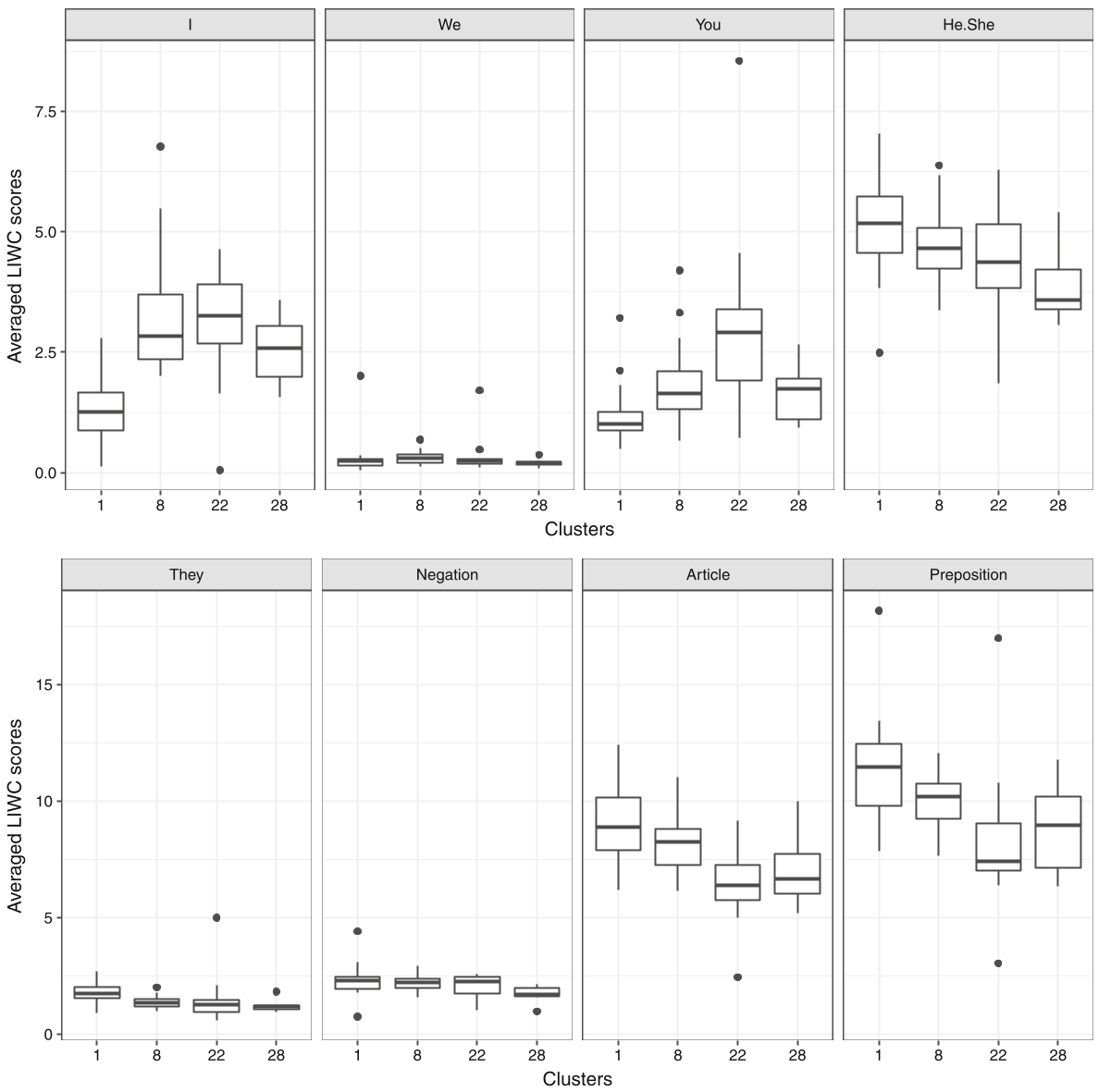
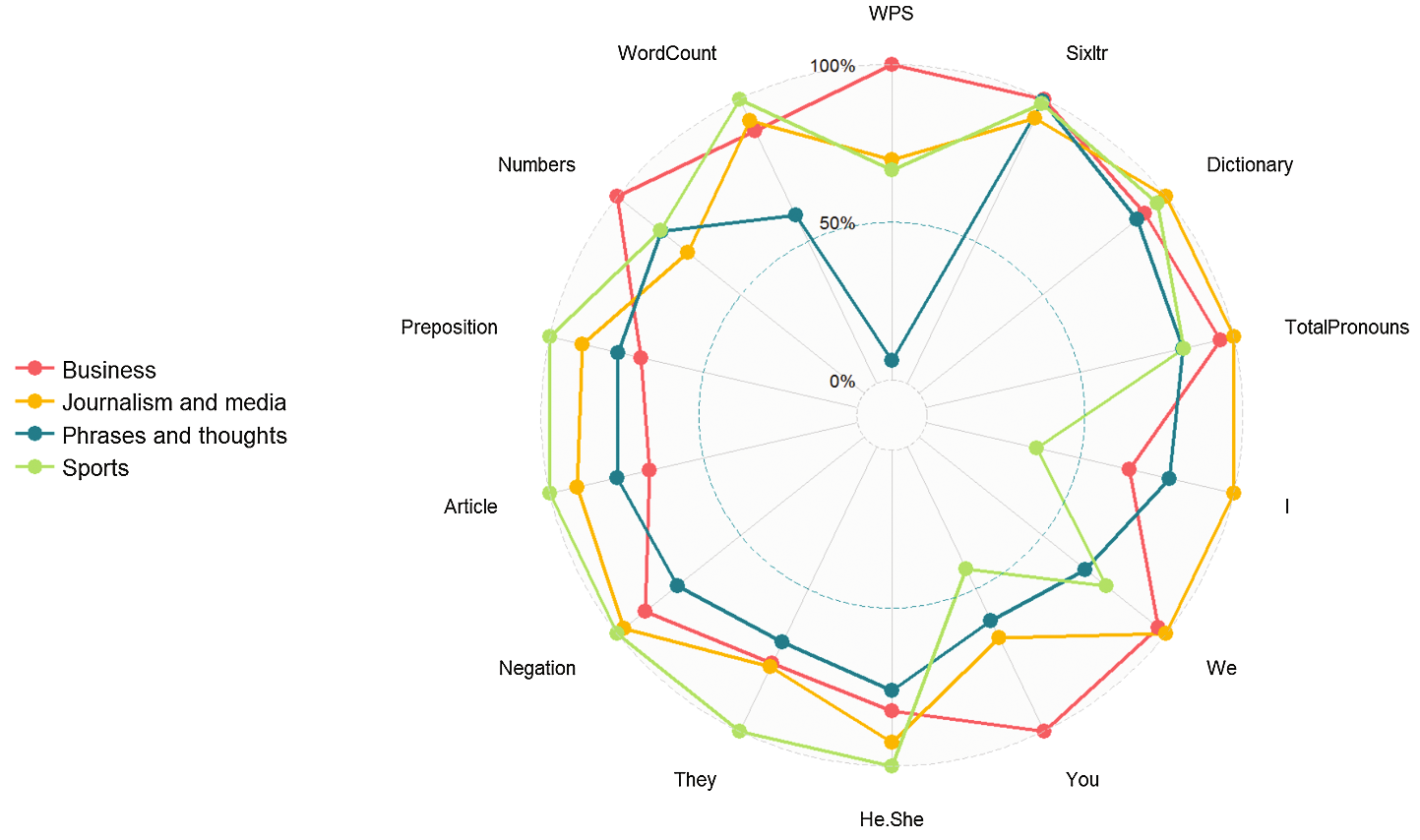
- Entrepreneurs: Displayed a high frequency of "We" and "Numbers". This aligns with rhetorical strategies intended to build stakeholder engagement and report metrics.
- Journalists & Media: Used significantly more third-person pronouns (He, She, They), prepositions, and articles, reflecting a formal, objective reporting style.
- Validation: In clusters 22 (Sports) and 28 (Phrases/Thoughts), human agreement reached a staggering 97% and 94%, respectively.
Critical Analysis & Conclusion
Takeaway
The study proves that Linguistic Affinity is a viable alternative to Structural Affinity. This is particularly useful for "Cold Start" problems in recommendation systems where interaction data is sparse but user content is available.
Limitations
- Dialect Specificity: The study focused on Ecuadorian Spanish. While the methodology is transferable, LIWC dictionaries and grammatical markers vary significantly across languages and cultures.
- Temporal Stability: The data was collected over a specific period. It remains to be seen if these linguistic "signatures" remain stable over years as a user's professional life evolves.
Future Outlook
The next frontier for this research is the integration of Pre-trained Language Models (PLMs). While LIWC provides psychological interpretability, Transformer-based embeddings could capture even more nuanced stylistic features, potentially identifying even smaller, more niche affinity groups.