
Bridging the Socio-Technical Gap: How Perceived Affordances Can Predict Your Next Social Media Post
Using affordances to improve AI support of social media posting decisions
This paper introduces an affordance-based modeling approach to predict user posting decisions across various Social Network Sites (SNSs). By operationalizing "affordances"—the perceived utilities of a system—the authors developed an SVM-based model that achieves an 82.59% F1 score in predicting which platforms a user will choose for specific communication needs.
TL;DR
Researchers have developed a way to predict which social media platform you'll choose for a specific post by modeling your perception of those platforms—known as affordances. By moving beyond rigid feature lists and focusing on how users view "visibility" or "audience," their SVM-based model achieves an impressive 82.59% F1 score, outperforming traditional popularity-based baselines.
Context: The Multi-Platform Struggle
In the modern digital landscape, we don't just use one social network; we navigate an ecosystem. We might post professional news on LinkedIn, a fleeting thought on Twitter, and a personal photo on Instagram. However, managing this creates a cognitive burden. We often face "context collapse"—the fear that a post intended for friends might "leak" to professional connections.
Current AI assistants are "rigid." They see an email or a post as a collection of keywords, but they don't understand the social utility you seek. This creates what the paper describes as the socio-technical gap: the distance between fluid human needs and fixed machine representations.
The Intuition: It’s Not the Feature, It’s the Affordance
The breakthrough of this paper lies in Affordances. Borrowed from psychology and design, an affordance isn't just a "button"; it's what an observer perceives they can do with that button.
The authors operationalized this into three main categories:
- Visibility: How media (text, image, video) is presented.
- Persistence: How long the content lasts (ephemerality vs. permanence).
- Association: Who sees it (audience size, type, and boundaries).
Methodology: Mapping Desires to Platforms
The team conducted a massive scenario-based survey (N=674) using 48 different hypothetical scenarios (e.g., "You achieved a health goal"). They asked users:
- Desired Affordances: What kind of visibility/audience do you want for this specific scenario?
- Anticipated Affordances: What does Facebook (or Reddit, or Snapchat) provide in your view?
They then tested two models:
- The Matching Model: A simple, unweighted alignment of desires vs. platform capabilities.
- The SVM-Based Model: A machine learning approach that learns which affordances (like permanence) carry more weight for certain users.
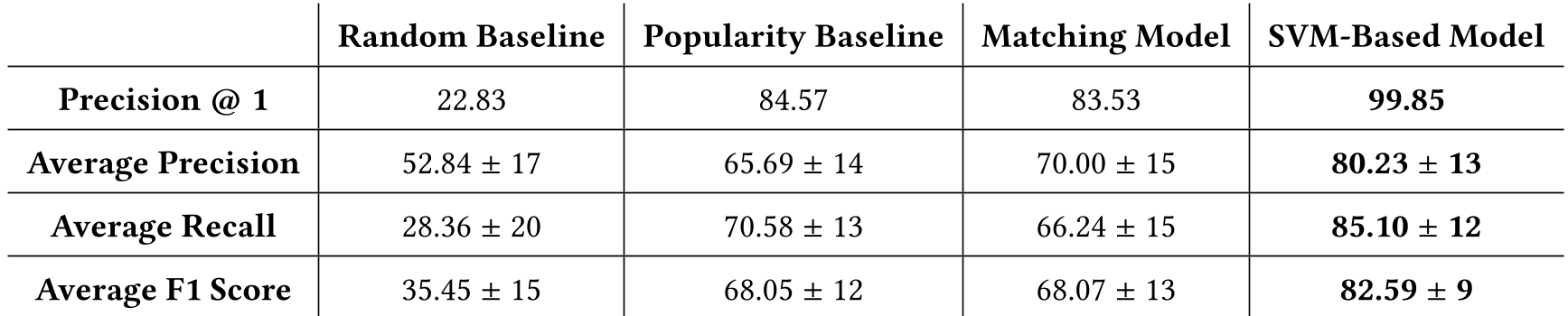 Table showing that the SVM-based model significantly outperforms the popularity and random baselines.
Results: A Winning Signal
The results were clear: Affordances are a high-fidelity signal.
- The SVM model reached 99.85% Precision@1 (identifying at least one correct SNS for nearly every participant).
- Even the simple Matching Model held its own against the "Popularity Baseline" (the "just-post-where-most-people-are" strategy).
The research found that Permanence (ephemerality) was the single most predictive category, though the best results came from combining all affordance types.
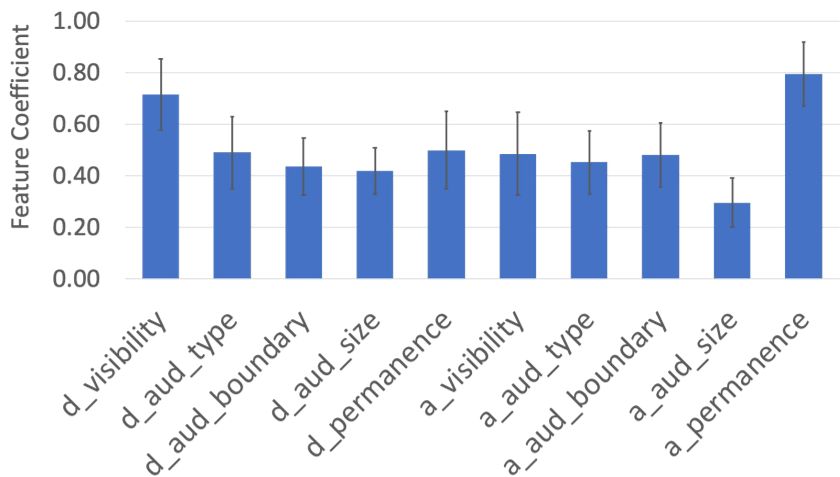 Average weights learned by the SVM: Notice how both desired (d_) and anticipated (a_) affordances contribute to the final decision.
Why This Matters: The Future of AI Routing
This isn't just about predicting a post; it's about building "Intelligent Critics." Imagine a system that:
- Reduces Cognitive Load: It suggests the right platform so you don't have to overthink the audience.
- Preserves Privacy: Because the model works on affordances (e.g., "I want this visible only to friends"), the AI doesn't actually need to read the confidential content of your post to recommend a destination.
- Corrects Biases: It can warn you if you're about to post sensitive content to a public-by-default platform, acting as a social safety net.
Critical Perspective
While powerful, the model currently requires users to self-report their perceptions. The next frontier will be automated affordance extraction—can an AI infer your "anticipated affordances" just by watching how you interact with an app? Furthermore, as platforms like TikTok or BeReal introduce new social mechanics, the model will need to evolve to capture even more granular affordances.
Conclusion
By grounding AI in the human-centric theory of affordances, this work provides a blueprint for smarter, more socially-aware assistants that understand not just what we are saying, but where and why we want to say it.