
AFRAID: Boosting Fraud Detection via Active Inference in Dynamic Social Networks
AFRAID: Fraud detection via active inference in time-evolving social networks
AFRAID (Active Fraud Investigation and Detection) is a framework designed for detecting social security fraud in bipartite, time-evolving social networks by combining collective inference with active learning. It utilizes a modified Random Walk with Restarts (RWR) that incorporates temporal decay to identify fraudulent nodes, achieving a SOTA precision increase of up to 15% on real-world Belgian social security data.
TL;DR
Detecting "spider constructions"—networks of companies created solely to evade taxes via bankruptcy and resource transfer—is a cat-and-mouse game. AFRAID (Active Fraud Investigation and Detection) utilizes a clever "Active Inference" loop. By asking human inspectors to verify just a few suspicious nodes, the system re-calculates the fraud risk for the entire network, boosting precision by up to 15% and effectively "blocking" the spread of fraudulent influence across time-evolving social graphs.
Problem & Motivation: The "Spider Construction" Challenge
In social security fraud, companies don't act in isolation. They form illegal structures where resources (machinery, employees, addresses) are shuffled between entities to avoid tax contributions.
The technical challenges are two-fold:
- Temporal Dynamics: Relationships that happened yesterday are more relevant than those from three years ago.
- The Oracle Constraint: Human inspectors have a microscopic budget. They can only check maybe 100 companies out of 200,000.
Existing methods often treat the network as static or fail to use the results of manual inspections to improve the inference of remaining unlabeled nodes.
Methodology: How AFRAID Works
AFRAID shifts the paradigm from simple classification to Active Inference.
1. The Time-Evolving Bipartite Graph
The network is bipartite, connecting Companies to Resources. To handle time, the authors apply exponential decay to edges: This ensures that recent resource sharing carries more weight in the fraud propagation model than old connections.
2. Time-Weighted Collective Inference (wRWR')
The core engine is a modified Random Walk with Restarts. It propagates "fraudulent energy" from known bad actors to their neighbors.
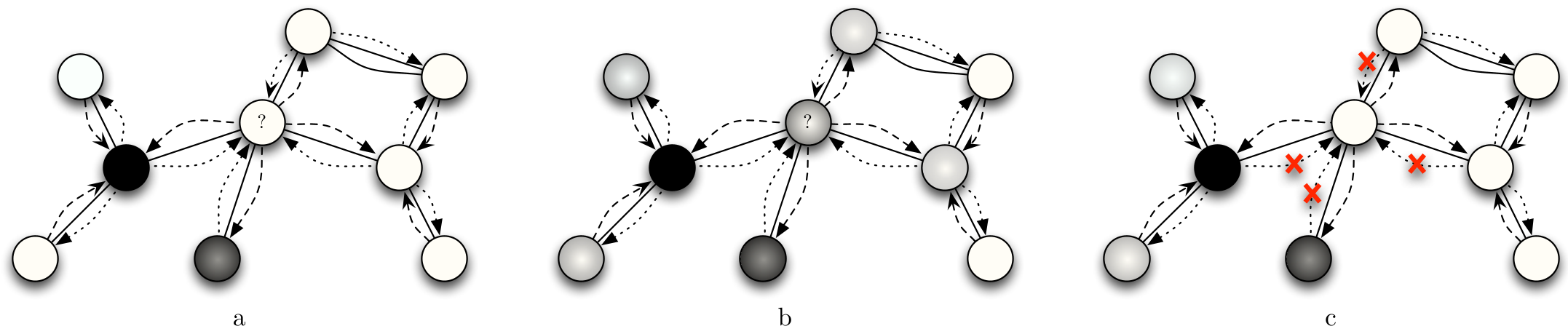 Fig 1: The wRWR' process. (a) Initial fraud nodes, (b) Propagation, (c) Edge cutting after inspection.
3. The Probing Strategy (Active Learning)
The "Active" part of AFRAID involves choosing which nodes to show the inspector. The authors found that a Committee-based strategy (MSU+)—where multiple classifiers (Random Forest, SVM, etc.) vote on the most uncertain nodes—performed best.
4. Dynamic Edge Cutting
A unique insight: If an inspector confirms a company is legitimate, AFRAID doesn't just label it "0". It temporarily cuts the incoming edges to that node. This prevents fraud "influence" from flowing through a confirmed honest company to other parts of the network, acting as a structural firewall.
Experiments & Results
Tested on massive real-world data from the Belgian Social Security Institution (10M records, 390k companies), AFRAID demonstrated significant gains.
Precision Boost
For Random Forest models, using Active Inference (MSU+) improved precision by 15% compared to non-active baselines.
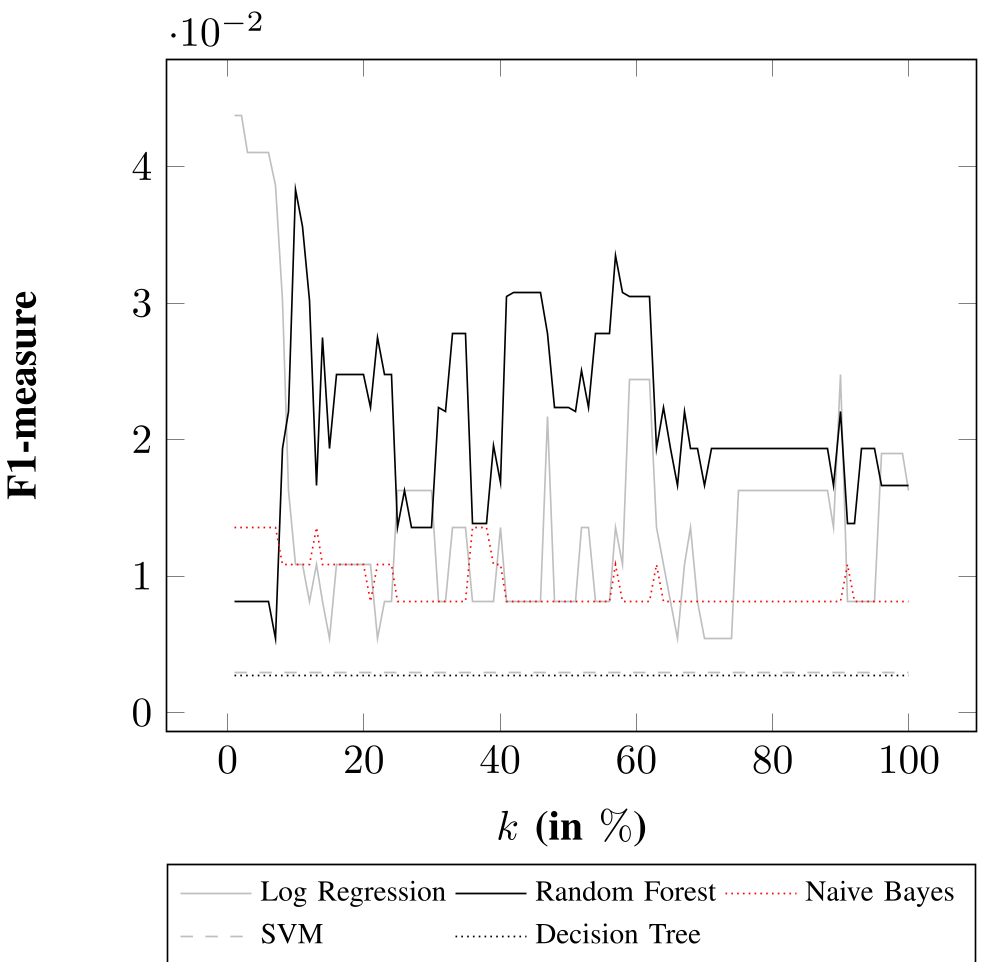 Fig 2: Model performance over different probing budgets. Note the significant climb for Random Forest (RF).
Probing as a Detection Tool
Interestingly, the probing strategies themselves are highly effective at finding fraudsters. The MSU+ strategy achieved a precision of over 50%, meaning more than half of the "uncertain" nodes the model asked about were actually fraudulent.
Critical Analysis & Takeaways
Why is this effective? The brilliance of AFRAID lies in its realization that fraud detection is a semi-supervised propagation problem. By strategically choosing nodes that "delude" the Collective Inference (CI) technique and correcting them via human inspectors, the model cleanses the signaling within the graph.
Limitations:
- Latency: Re-running wRWR' and re-training classifiers after every probe can be computationally expensive for massive graphs.
- Temporal Sensitivity: The decay parameters ( and ) require careful tuning to balance historical context with current behavior.
Conclusion: AFRAID proves that in high-stakes domains like fraud detection, human-in-the-loop is not just a safety feature—it is a performance multiplier. By focusing on nodes that bridge different structural clusters (Entropy and Uncertainty), we can maximize the ROI of limited human expertise.