
Generation Gap on Social Media: Why Older Adults are Actually More Satisfied with Facebook
Age differences in using Facebook: younger adults vs. older adults
This study investigates the intergenerational differences in Facebook usage patterns and satisfaction levels between younger (18-26) and older (60-86) adults. Through an online survey of 679 users, it identifies that age significantly influences specific platform activities and that older adults report higher levels of satisfaction despite spending less time on the platform.
TL;DR
Is Facebook a "young person's game"? Not necessarily. This research reveals a fascinating paradox: while younger adults use more features and spend more time on Facebook, older adults report significantly higher satisfaction. By analyzing 19 specific activities, the study highlights that seniors prefer active social bonding (commenting/posting) over the passive scrolling typically seen in younger cohorts.
Background & Motivation
For years, Human-Computer Interaction (HCI) research treated Facebook as a playground for college students and young professionals. However, as the user base ages, the "one-size-fits-all" interface is being challenged. The author, Eun Hwa Jung, argues that we cannot understand the true User Experience (UX) of SNSs without dissecting how different age groups perceive "value" and "satisfaction" within the same technical ecosystem.
Methodology: Beyond Simple Clicks
The study utilized a sample of 679 US-based users, split into:
- Younger Adults: 18-26 years old ()
- Older Adults: 60-86 years old ()
Unlike studies that only look at "total time spent," this research broke down usage into 19 distinct affordances, ranging from "Updating Status" to "Checking out the News Feed." Satisfaction was measured as a desire to spend more or less time on the platform, providing a proxy for perceived utility.
The "Activity Paradox": Quality vs. Quantity
The results from the independent-samples T-test provide a clear map of intergenerational behavior:
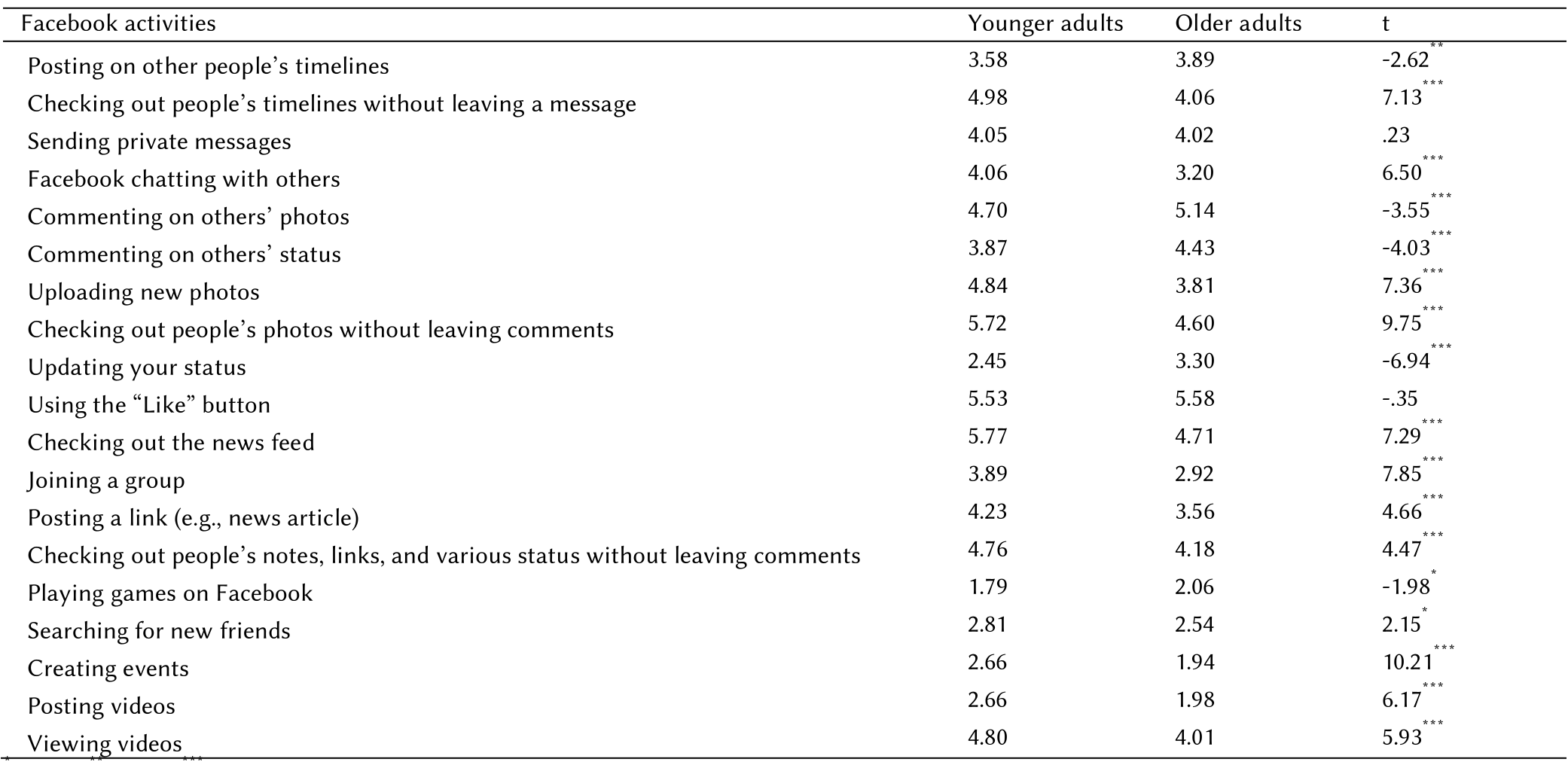
Key Insights:
- The Active Senior: Older adults were statistically more likely to engage in "high-effort" social activities: posting on timelines, commenting on photos, and playing games.
- The Passive Youth: Younger adults dominated "low-effort" consumption: checking the news feed, viewing videos, and "lurking" (checking timelines without leaving messages).
- Shared Ground: There were no significant age differences in "Sending Private Messages" or using the "Like" button, suggesting these are universal SNS "building blocks."
Why are Seniors Happier?
The most striking finding came from the ANCOVA analysis (controlling for time spent):
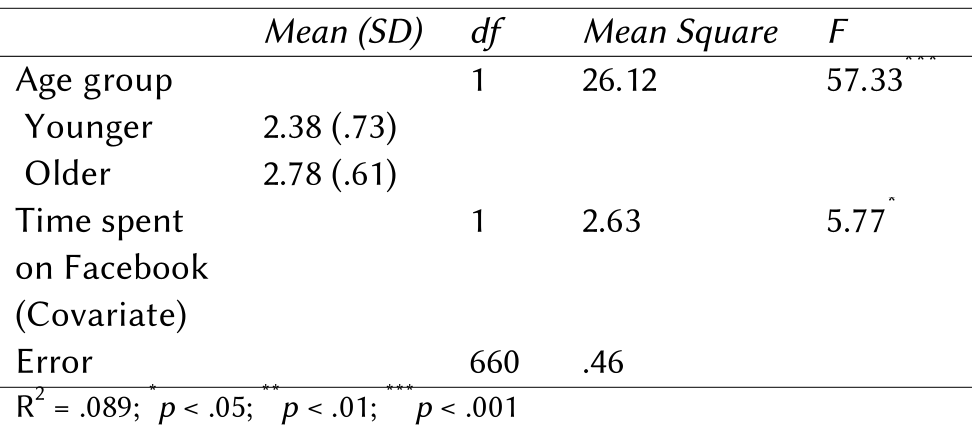
Despite spending less total time on the site, older adults reported a satisfaction level of 2.78, compared to 2.38 for younger users. The author suggests two main reasons for this:
- The Novelty Effect: For older adults, the ability to connect globally is still a relatively "new" and exciting affordance, whereas for younger users, it is a mundane utility or even a source of "social fatigue."
- Purposeful Interaction: By focusing on commenting and direct posting rather than passive scrolling, older adults may be extracting more social capital per minute spent on the platform.
Critical Analysis & Conclusion
This work provides empirical evidence that age is a primary determinant of digital behavior.
Takeaway for Developers & Researchers:
- Affordance Design: If older adults prefer commenting and direct timeline interaction, SNS interfaces should perhaps surface these "active" features more prominently for this demographic to increase retention.
- Psychological Mechanisms: The study's limitation is that it doesn't fully explain why these preferences exist. Is it a lack of technological self-efficacy leading to simpler active tasks, or a mature social preference for depth over breadth?
In conclusion, the "graying" of social media is not a sign of the platform's decline, but rather a shift toward a more satisfied, interaction-heavy user base that values community over content consumption.
Reference: E. H. Jung, 2018, Age Differences in Using Facebook: Younger Adults vs. Older Adults. OzCHI '18.