
Age and Gender Classification: Why Deep Learning Wins in the Wild
Age and Gender Classification Using Convolutional Neural Networks
This paper introduces a streamlined Deep Convolutional Neural Network (CNN) architecture specifically optimized for age and gender classification in unconstrained, "in-the-wild" images. By applying deep learning to the challenging Adience benchmark, the authors achieved state-of-the-art (SOTA) results, significantly outperforming traditional hand-crafted feature methods.
TL;DR
This landmark paper by Levi and Hassner bridges the gap between high-performance face recognition and the lagging field of age/gender estimation. By discarding traditional hand-crafted descriptors in favor of a specialized, "lean" Convolutional Neural Network (CNN), the authors set a new State-of-the-Art (SOTA) on the Adience benchmark, proving that deep learning can handle "real-life" image chaos—even with limited labeled data.
Background: The "In-the-Wild" Challenge
While face recognition has reached superhuman performance, estimation of age and gender has historically struggled. Why? Because social media images aren't lab-perfect. They suffer from:
- Extreme Blur & Low Resolution: Images uploaded from mobile devices.
- Occlusions: Hair, glasses, or hands blocking the face.
- Pose Variation: Faces turned away from the camera.
Most prior work used "tailored" descriptors like Local Binary Patterns (LBP). These methods are brittle; they break the moment the lighting changes or the subject tilts their head.
Methodology: Leaner is Better
The core insight of this paper is the balance between model depth and data scarcity. Since labeled datasets for age are much smaller than those for identity, a massive network (like those used for 10,000-class face recognition) would simply overfit—memorizing the noise instead of the features.
The Architecture
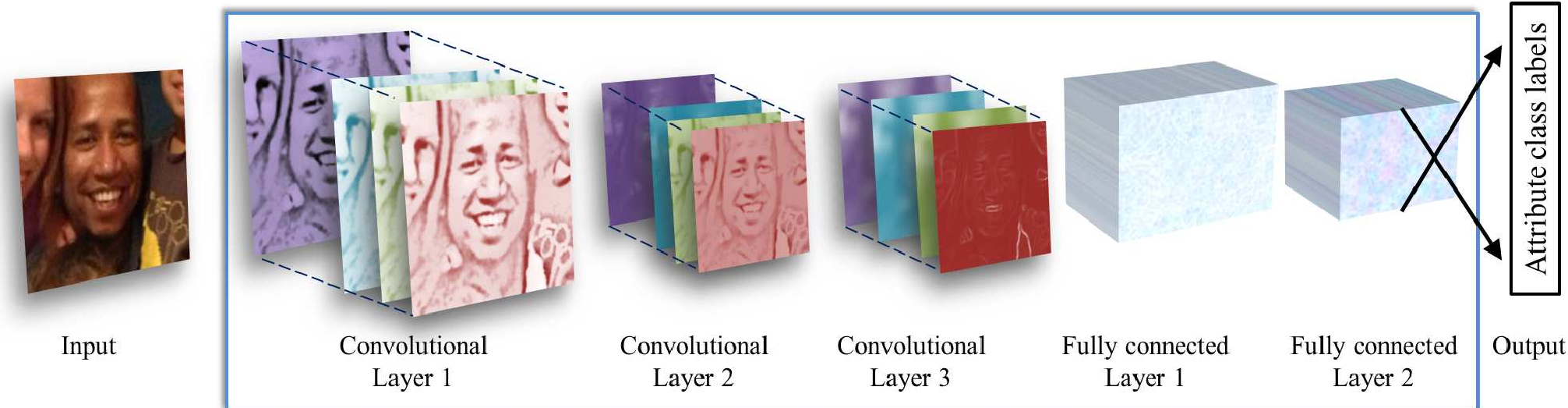
The proposed CNN is intentionally shallow, featuring:
- Three Convolutional Layers: Each followed by ReLU and Max Pooling.
- Two Fully Connected Layers: With 512 neurons each.
- Local Response Normalization (LRN): To enhance contrastive features.
Over-sampling: The "Robustness" Secret Sauce
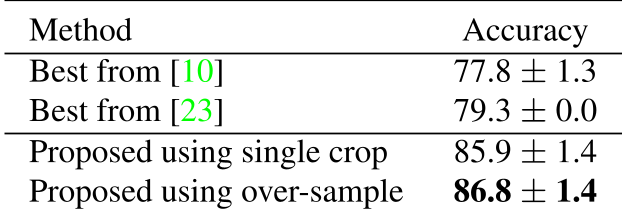
One of the paper's most practical contributions is the Over-sampling technique used during inference. Instead of looking at the face once, the network extracts five crops (four corners + center) and their horizontal reflections. By averaging these 10 versions, the system becomes naturally resilient to the minor misalignments common in unstructured photos.
Experiments and Benchmarking
The researchers utilized the Adience Benchmark, a collection of ~26,000 images from Flickr. Unlike previous datasets (like FERET), Adience images are unfiltered and "messy."
SOTA Results
The CNN approach dominated previous methods (LBP + SVM) across the board:
- Gender Accuracy: Boosted from 79.3% to 86.8%.
- Age Accuracy (1-off): Reached 84.7%, showing that even when the model misses the exact "age bucket," it's almost always in the neighboring range.
Analyzing the Failures
The paper honestly acknowledges its limitations. Misclassifications often occur in:
- Infants: Where gender cues are biologically subtle.
- Heavy Makeup: Which acts as a "natural" occlusion for age and gender features.

Deep Insight & Conclusion
The significance of this work lies in its simplicity. It proves that you don't need a 100-layer ResNet or millions of images to leverage the power of deep learning for biometrics. By carefully designing a "shallow but deep" network and using data augmentation, we can overcome the limitations of small datasets.
Takeaway for Practitioners: When working with domain-specific tasks where data is scarce, prioritize architectural efficiency and intelligent data augmentation (like over-sampling) over raw model depth.