
Intelligent Agents: Reconstructing the Fabric of Artificial Social Networks
13905_Agent-Based Creation and Simulation of Artificial Social Networks and the Analysis of Their Properties.
This paper presents a scalable agent-based simulation model for generating artificial social networks. By utilizing autonomous "intelligent agents" with individual personalities and interest areas, the researchers successfully reproduced real-world network properties, specifically achieving scale-free degree distributions (SOTA-level power law fit) and significant clustering.
TL;DR
Researchers have developed a highly scalable agent-based model that moves beyond "passive particle" simulations. By giving agents individual personalities and distinct interest areas, the model successfully replicates the scale-free and clustered nature of real-world human interactions. The result? A simulation environment where social networks don't just exist—they evolve naturally.
Problem & Motivation: Beyond "Dumb" Particles
In the world of network science, the topology of a network determines everything from how a virus spreads to how a marketing campaign goes viral. Historically, researchers relied on two extremes:
- Random Erdős-Rényi Networks: Mathematically simple but socially unrealistic (they lack heavy tails).
- Passive Agent Models: These treat humans like gas particles in a container—bumping into each other randomly without preference or memory.
The authors argue that real human sociality is driven by homophily (the tendency to associate with similar others) and agency. To bridge this gap, they propose a model where agents have "minds" of their own, making decisions based on internal preferences.
Methodology: The Anatomy of Social Selection
The core of this paper lies in its definition of an agent as an autonomous entity rather than a passive node.
1. The Agent Model
Each agent is defined by its location, its current relationships, and most importantly, its personality (E). Where is the friendliness factor and represents a profile of interests.
2. The Meeting Mechanism
Social link formation is divided into:
- Involuntary Meetings: Random encounters with strangers or neighbors (spatial constraints).
- Voluntary Meetings: Agents actively seek out "friends" or "friends-of-friends." The priority for these meetings is determined by interest similarity (), ensuring that connections are not random but driven by shared values.
3. Strength and Decay
Relationships are dynamic. They strengthen when agents meet (asymptotically, so older friendships are more stable) and decay over time if neglected. This creates a "survival of the fittest" environment for social bonds.
Experiments & Results: Realism at Scale
The authors validated their model against a population of up to 25,000 agents. The key question: Does this look like a real human network?
- Power Law Fit: The resulting degree distribution exhibited a heavy tail. With a scaling parameter and a p-value of 0.56, the network passed the rigorous statistical tests for being a "true" scale-free network.
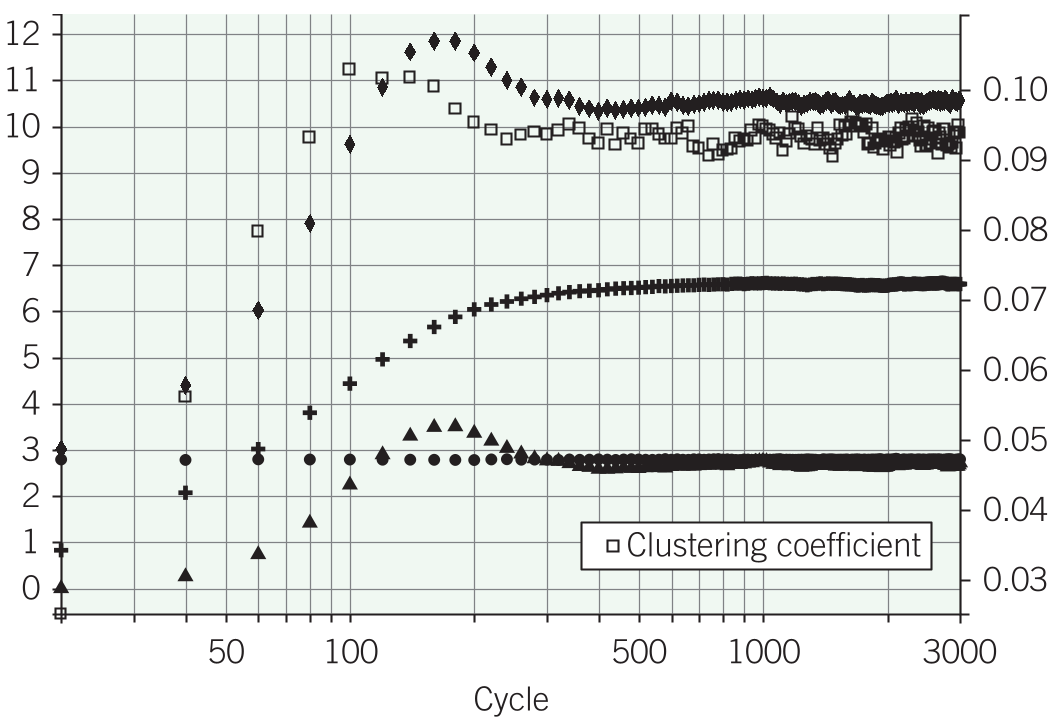
- Clustering: Unlike random graphs, the model maintained a high clustering coefficient (around 0.1 to 0.3), mirroring the "cliquishness" of real human groups.
- Steady State: As shown in the simulation logs, the network properties stabilize after an initial "warm-up" period, proving the model's robustness.
Deep Insight: Why Voluntary Meetings Matter
One of the most profound findings in the paper is the impact of Voluntary vs. Forced interactions. The authors found that increasing the number of involuntary (random) meetings significantly decreased the clustering coefficient and moved the network away from its realistic scale-free structure.
This suggests that the freedom to choose based on shared interests is not just a psychological detail—it is the structural engine that creates the "Small World" and "Scale-Free" properties we see in global social networks.
Critical Analysis & Future Work
While the model is highly effective, it currently relies on one-to-one meetings. The authors acknowledge that real-life sociality often involves group interactions (parties, clubs, workplaces), which might further boost the clustering coefficient to even more realistic levels.
Future Outlook: Integrating this model with trust mechanisms or belief-propagation algorithms could allow us to simulate modern phenomena like "fake news" spread or radicalization in polarized interest groups with unprecedented accuracy.
Takeaway for the Industry: For developers building social recommendation engines or epidemic simulations, this paper proves that "Interest Areas" and "Friend-of-Friend" discovery are the most critical parameters for maintaining a healthy, realistic network topology.