
Agent-Based Evolving Societies: Can AI Recreate the Rise of Civilization?
Agent-Based Evolving Societies
The paper introduces a methodology for Multi-Agent Based Simulation (MABS) where artificial societies expand bottom-up by dynamically creating organizations. Applying theories from social sciences (e.g., Jared Diamond), it successfully models the evolution from a tribal society to a chiefdom and finally to a bureaucratic state through endogenous trigger mechanisms.
Executive Summary
TL;DR: This paper presents a novel methodology for building artificial societies that grow and reorganize themselves from the bottom up. By linking individual dissatisfaction to the creation of formal institutions (like police or schools), the researchers successfully simulated the historical transition of human groups from egalitarian tribes to centralized states, proving that social structures are essentially "problem-solving tools" for population growth.
Positioning: This work bridges the gap between Social Science Theory (Jared Diamond's evolutionary stages) and Multi-Agent Systems (MAS). It moves beyond simple "Sugarscape" style simulations by introducing a formal mechanism for institutional emergence.
The Scaling Problem: Why Tribes Fail
Historically, human societies didn't just "decide" to have kings or bureaucracies because they sounded like fun. They did so because they reached a breaking point.
The authors identify a critical bottleneck: Social Control.
- In small tribes, kinship (family ties) prevents violence.
- As population grows, "family distance" increases. Conflict can no longer be resolved at the dinner table.
- This leads to a systemic failure that the authors represent as individual "dissatisfaction."
The core insight is that unless a society can expand its "organizational repertoire," it will succumb to internal violence and collapse back into small, disconnected groups.
Methodology: The Architecture of Emergence
The researchers define an organization as a triple: (Purpose, Cost, Effect). The transition logic follows a sophisticated feedback loop:
- Individual Observation (): Agents notice a problem (e.g., "I got hit in a fight").
- Social Merging (): Dissatisfaction is pooled (via voting or averaging).
- Creation (): If crosses a threshold and resources are available, an organization is birthed.
- Behavioral Enforcement (): The organization pays agents to perform new roles (e.g., "Policeman").
- Feedback: The "Effect" reduces the "Observation," stabilizing the society.
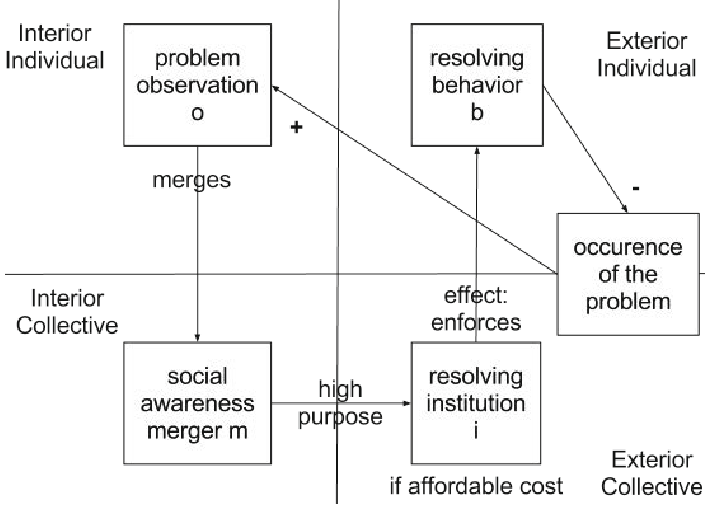 The MASQ formalism used to represent the transition from individual perception to global organizational creation.
Visualizing the Evolution
The experiment tracked two major transitions:
1. From Tribe to Chiefdom
When the population capacity was increased, "social dissatisfaction" spiked. Once 50% of the population felt unsafe, the Police organization was created.
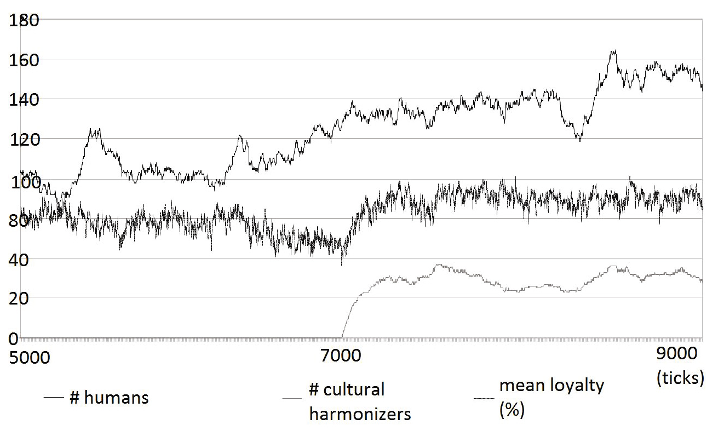 Figure 4: As dissatisfaction (o1) peaks, the police organization is created, eventually settling into a stable resource-to-need ratio.
2. From Chiefdom to State
As the population grew beyond 50,000, "Loyalty" became the new bottleneck. To combat cultural divergence, the society birthed Cultural Harmonizers (analogous to teachers or priests) to unify the population's values.
Key Results & Critical Analysis
The most striking finding was the "No Skipping" rule. The authors tested a "what-if" scenario: Could a tribe jump straight to a high-tech state without the "Police" phase?
The result? Total Collapse. Without the intermediate step of centralized force (Chiefdom), the violence caused by density destroyed the population before the cultural state could even form. This provides strong computational evidence for the "Linear Evolution" theories in anthropology.
| Stage | Population | Decision Making | Conflict Resolution |
|---|---|---|---|
| Tribe | Hundreds | Egalitarian | Informal/Kinship |
| Chiefdom | Thousands | Centralized | Police/Chief |
| State | > 50,000 | Centralized | Law/Judges/Culture |
Table Summary: Key societal traits captured in the simulation.
Conclusion: Toward a Logic of Economy
Vanhee et al. have demonstrated that institutions are not just "top-down" impositions but emergent adaptations to environmental and demographic pressure.
Limitations: The current model uses a simplified "Blackbox" for organizational effects. In reality, organizations are composed of agents who may have their own corrupt motivations.
Future Work: The authors suggest evolving this into a "Logic of Economy," where complex supply chains (Wheat → Flour → Bread) emerge through the same organizational birth-process. This could revolutionize how we design NPCs in open-world games and how we model resource management in complex systems.