
Beyond Rationality: Leveraging Agent-Based Modeling for Organizational Dynamics
Applying Agent-Based Modeling to Integrate Bounded Rationality in Organizational Management Research
This paper explores the application of Agent-Based Modeling (ABM) to organizational management research, specifically focusing on its ability to integrate "Bounded Rationality." It positions ABM as a superior tool compared to System Dynamics (SD) and Discrete Event Simulation (DES) for modeling the coevolution of organizations and their environments.
TL;DR
Modern organizations are complex adaptive systems that don't always behave "rationally." This paper argues that Agent-Based Modeling (ABM) is the premier computational tool to bridge the gap between individual cognitive limits—Bounded Rationality—and macro-level organizational evolution, outperforming traditional simulation methods in capturing emergence and self-organization.
The "Rationality" Trap in Management Research
For decades, organizational theory was haunted by the phantom of the "Rational Actor." Neoclassical models assumed that managers possessed unlimited information and infinite processing power. However, as any manager knows, real organizations are messy. They are composed of individuals with limited time, biased perspectives, and restricted access to data—a concept known as Bounded Rationality.
The pain point is clear: If we assume everyone is perfectly rational, we can't explain why organizations share tasks, why administrative bloat occurs, or why some firms fail to adapt to obvious environmental shifts. Traditional empirical methods struggle with these "what if" scenarios because today's business environments are too interconnected and fast-moving to freeze in a lab.
Methodology: The Simulation Spectrum
The authors compare three major "Simulation Schools" to see which can handle the 11 characteristics of complex systems (like non-linearity, feedback loops, and emergence).
1. Discrete Event Simulation (DES)
- Logic: System state changes only when specific events occur.
- Flaw: Elements are reactive, not active. They don't "communicate" or "learn"; they just respond to triggers.
2. System Dynamics (SD)
- Logic: Uses "stocks" and "flows" (differential equations) to look at macro-level trends.
- Flaw: It treats the organization as a single holistic block. It cannot see the individual agent or the impact of personal irrationality.
3. Agent-Based Modeling (ABM) - The Winner
- Logic: Models the system from the bottom-up using autonomous "Agents."
- Insight: Because ABM focuses on the micro-level, we can program individual agents to have specifically limited data or "emotions" (like fear or loyalty).
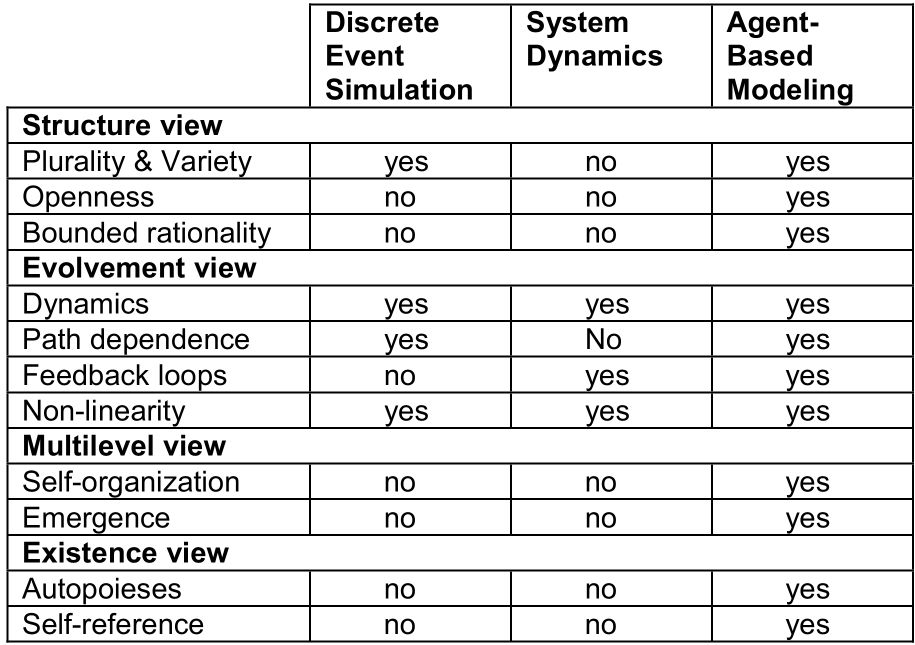 Table: ABM is the only method that satisfies requirements across the structure, evolvement, multilevel, and existence views.
Implementing Bounded Rationality
The core contribution of this paper is defining how to actually code "irrationality" into a model. The authors identify two main paths:
- Constrained-Optimal Approach: You set a physical limit. For example, an agent can only remember the last 3 transactions or talk to their 2 closest neighbors. They optimize, but only with the tiny slice of the world they can see.
- Non-Optimal Decision Rule Approach: Agents follow heuristics or "rules of thumb" that don't change, even if the environment does. This is perfect for simulating "organizational inertia" where a company keeps doing what it’s always done despite declining profits.
Critical Results & The Complexity Challenge
The study highlights that ABM allows for Emergence—where simple rules at the individual level (micro) lead to complex structures at the organizational level (macro).
However, the authors offer a sober warning: the "Arbitrary Results" problem. Because there are so many ways to model Bounded Rationality, you can essentially make a simulation prove anything if you tweak the agent rules enough.
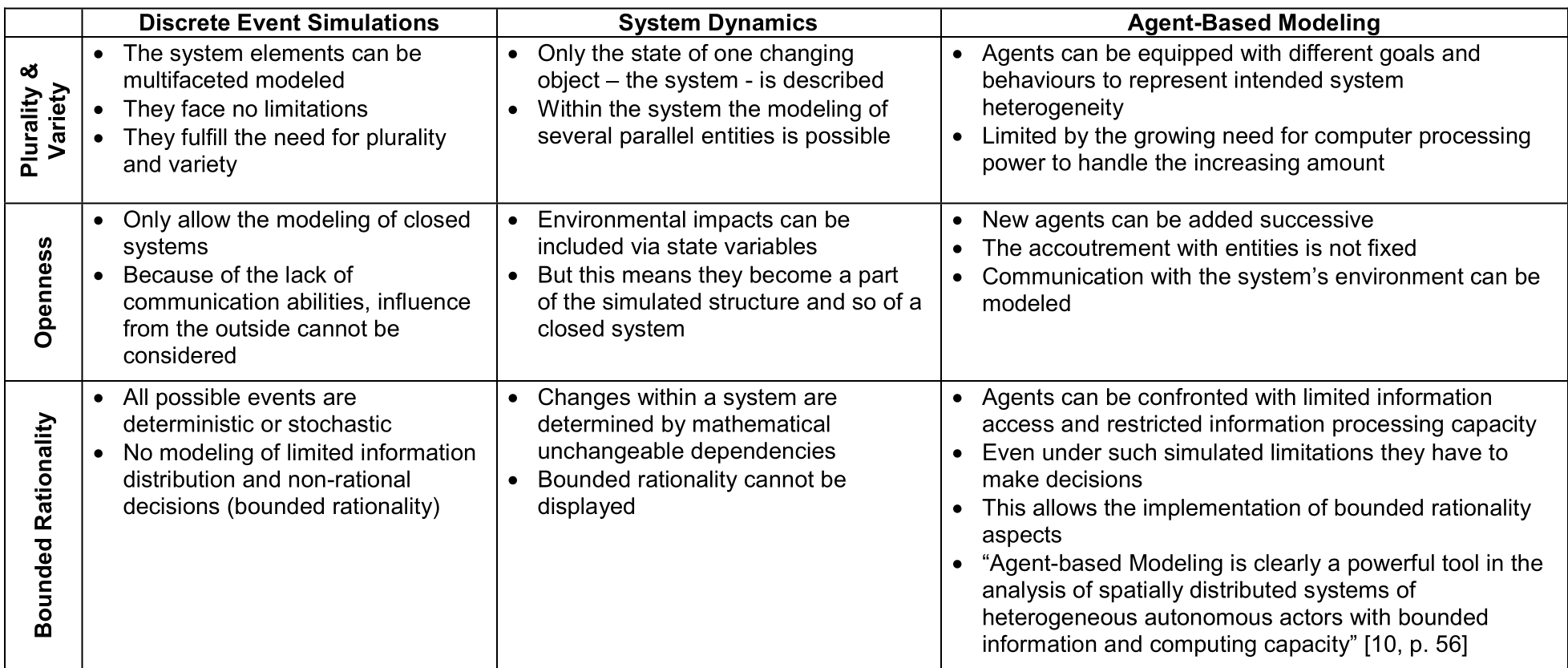 Table: Key distinctions in how different simulation types handle agent variety and information access.
Final Insight: The Death of Universal Theories?
The paper concludes that we should stop trying to find "Universal Laws" of management using simulations. Instead, ABM should be used as a Context-Specific Laboratory.
Takeaway for Practitioners: If you want to understand how your specific organization will react to a market crash or a remote-work transition, you must model the specific cognitive bounds of your employees and the specific information silos of your departments. ABM is not a crystal ball—it’s a microscope for viewing the "inner life" of organizational complexity.
Limitations & Future Work
The "Social Agent"—an agent that can recognize and react to the strategies of other agents—remains a theoretical ideal not yet fully realized in common practice. Future research must focus on Model Validation: proving that the artificial agents in our code actually mimic the irrational, beautiful, and frustrating reality of human employees.