
Bridging Topology and Autonomy: Predictive Multi-Agent Modeling of Social Networks
Agent-based Modelling of Social Organisations
This paper introduces a hybrid framework combining Social Network Analysis (SNA) and Multi-Agent Systems (MAS) to model and predict the evolution of social organizations. By integrating global structural metrics with local autonomous agent behaviors, the authors successfully simulated user role transitions and community growth within the "couchsurfing.net" social portal.
TL;DR
Predicting how a community grows is more than just looking at a graph; it requires understanding individual motivations. This paper presents a framework that combines Social Network Analysis (SNA) to define the "where" and Multi-Agent Systems (MAS) to define the "why." By applying this to Couchsurfing data, the authors demonstrate a system capable of predicting future user roles and interaction patterns with remarkable precision.
Context: The Static vs. Dynamic Gap
Most social network research falls into two camps. SNA experts treat society as a graph, measuring things like Betweenness (who is a bridge) or PageRank (who is important). Meanwhile, MAS researchers build "SimCity"-like environments where agents follow rules. The gap is that SNA is often descriptive (what happened) rather than predictive of proactive change, and MAS can be too theoretical. This paper builds a bridge, using SNA to "tune" the agents so they act like real people in specific social portals.
Methodology: The Hybrid Evolution Model
The authors define a society as a dynamic tuple . The core innovation lies in the Agent Decision Functions.
1. The Global SNA Seed
The system first analyzes existing data to assign users roles like Host, Traveller, or Observer. It also calculates topological attributes (Closeness, Betweenness) which serve as the initial "DNA" for the agents.
2. The Local MAS Engine
Once the simulation starts, agents operate based on four primary functions:
- : Updates the agent's internal attributes.
- (Willingness for Interaction): Determines if an agent wants to find a new friend or a place to stay.
- (Willingness for Acceptance): Determines if the receiving agent will accept the proposed interaction (e.g., accepting a guest).
- : Recalculates the strength of social relations based on successful interactions.
The General Schema of the Simulator:
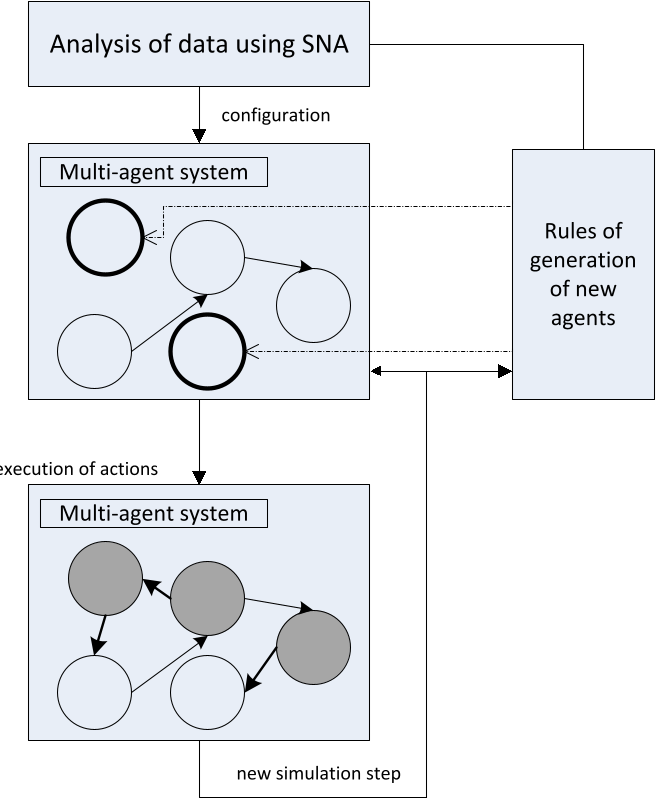
Experiments & Real-World Validation
The authors tested their model on couchsurfing.net data, specifically targeting Central-Eastern European users. They looked at how wealthy vs. poorer backgrounds influenced roles (wealthier users traveled more while poorer users played more stationary roles).
The MAS was initialized with early-period data and then asked to "predict" what the roles would look like in the future.
Performance Comparison
The results showed a high correlation between the simulation (MAS) and the actual recorded data (SNA).
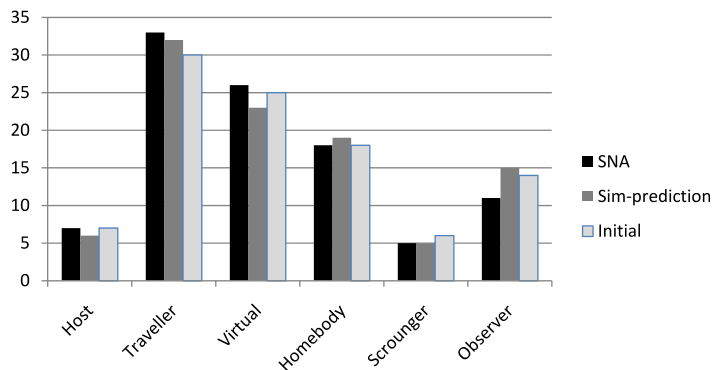
As seen in the chart above, the Sim-prediction closely tracks the SNA reality for roles like "Host" and "Homebody." The slight deviation in "Traveller" and "Observer" counts was attributed to the seasonal drift (summer holidays) which the initial agents hadn't "learned" to account for—a classic example of how external environmental variables impact social simulations.
Deep Insight: Why This Matters
This work highlights that social structures are emergent properties of local interactions encoded with global awareness. By giving agents knowledge of their "role" in the wider network, their local decisions (who to message, who to host) collectively reconstruct a realistic social graph over time.
Limitations & Future Work
- External Factors: As the summer holiday discrepancy showed, models need to incorporate temporal/seasonal cycles.
- Scalability: While effective for a portal like Couchsurfing, scaling this to billions of nodes in a network like X (Twitter) would require significant optimization of the interaction acceptance functions.
Conclusion
By moving beyond static graph theory and into the realm of proactive agent modeling, this paper provides a blueprint for "Digital Twins" of virtual communities. It allows platform designers to not just see where their network is, but where it is going.
Disclaimer: This post is a technical breakdown of "Agent-based modelling of social organisations" by J. Koźlak and A. Zygmunt.